
China's 3,500-gigawatt plan is not a surge — it's a pivot to making wind and solar act like firm power
China's planners set a 3,500 gigawatts (GW) renewable target for 2030 that implies a sharp slowdown from 2025's boom, betting that firm capacity, grid-forming plants, storage and new transmission can turn intermittent gigawatts into reliable peak power — and determine whether coal actually falls.


What happenedChina's top planners (NDRC and NEA) issued the 15th Five-Year Plan for Renewable Energy on 6 July 2026 (published 23 July), targeting ~3,500 GW renewable capacity and ~6,000 TWh generation by 2030 with new firm-capacity and grid-friendly requirements.
Why it mattersUnderstand why the world's biggest wind/solar builder is deliberately slowing headline additions to fix reliability, and what will decide whether that actually cuts coal, peaks emissions, and keeps cheap solar flowing globally.
Still openWhether the 8% firm capacity / 20% evening peak / 300 GW storage + UHVDC buildout will be enough and fast enough to absorb curtailed power and avoid new coal peaking, given provincial auction pricing and coal contract floors.
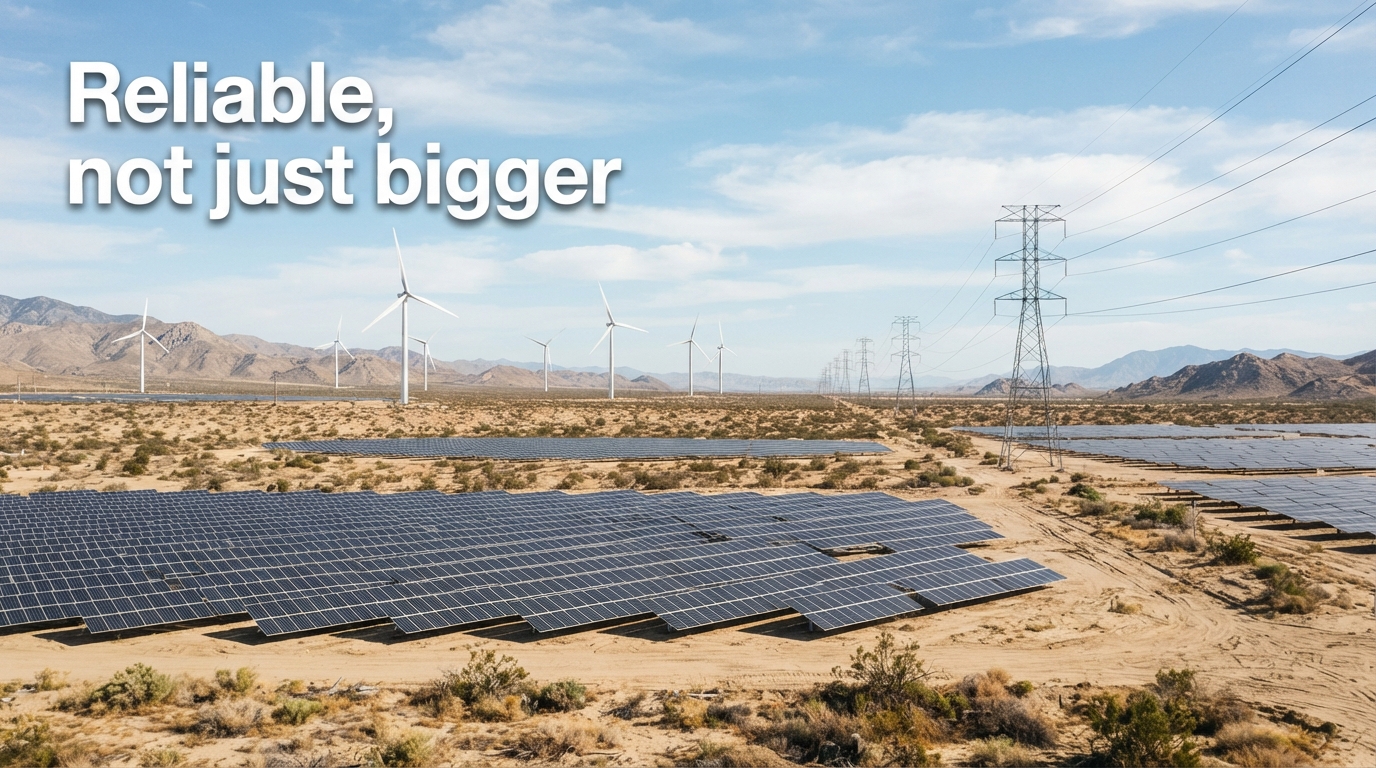
China's top economic planner and its energy regulator — the National Development and Reform Commission (NDRC) and the National Energy Administration (NEA) — issued a new five-year blueprint for renewable energy on 6 July, published on 23 July, that aims for about 3,500 gigawatts of renewable capacity and about 6,000 terawatt-hours of generation by 2030, with new requirements that wind and solar prove they can show up reliably at peak times and help keep the grid stable. The plan matters because the world's biggest builder of wind and solar is deliberately throttling headline growth to fix reliability — and whether that actually cuts coal use, helps China peak carbon before 2030, and keeps cheap solar flowing abroad will hinge on transmission, storage and new provincial power markets that are still being built.
China's renewable capacity 2016-2025 and the 2030 target what the slower implied pace looks like against the recent boom. China's installed renewable power capacity rose from about 540 GW in 2016 to 2,340 GW by end-2025, with wind and solar alone reaching 1,840 GW after a record ~430 GW of wind+solar was added in 2025. The 15th Five-Year Plan targets about 3,500 GW of renewables by 2030 (including more than 2,800 GW of wind and solar)—a path that implies roughly 160 GW of wind+solar and about 220 GW of total renewables each year, well below the 2025 boom. Wind+solar 2016–2024 and total renewables 2016–2021 from Ember Electricity Data (IRENA-aligned); total renewables 2022–2025 and 2030 targets from NEA / NDRC (via IEA-PVPS, english.www.gov.cn, and the 15th Five-Year Plan published 23 July 2026). — AI-assisted analytic, built only from real cited or sourced data. Source: National Energy Administration (NEA), National Energy Administration, State Council / Xinhua via english.www.gov.cn. As of 2026-07-30.
The key uncertainty is not whether China can build the turbines and panels, but whether an 8% firm-capacity standard, a push for more than 20% of evening peak demand from wind and solar, and 300 gigawatts of new storage plus more ultra-high-voltage lines will be enough, fast enough, to absorb power that is already being wasted and to avoid locking in more coal for peaking.
A huge number that means slowing down
On paper, 3,500 GW looks like another leap. In context, it is a step down in speed.
At the end of 2025, China had 2,340 GW of renewables, including 1,840 GW of wind and solar — 640 GW wind, 1,200 GW solar — plus about 450 GW of hydropower, according to NEA data. Renewable generation was about 3,990 to 4,000 TWh, roughly 38% of electricity, with wind and solar alone about 22%.
The new plan lifts the 2030 wind-and-solar goal to more than 2,800 GW inside that 3,500 GW total, and more than 4,000 TWh of wind and solar generation inside 6,000 TWh total. Renewable energy consumption is meant to reach about 1.8 billion tonnes of standard coal equivalent — a common Chinese energy-accounting unit that converts all energy to the amount of coal that would hold the same energy —, up from about 1.18 billion in 2025.
That requires adding roughly 220 GW of total renewables a year, and about 160 GW a year of wind and solar, between 2026 and 2030. In 2025 alone, China added about 430 GW of wind and solar — 317 GW of solar by itself — more than 60% of all renewable additions globally. The previous 2030 target for wind and solar, 1,200 GW set in 2020, was met six years early, in 2024.
The implied pace is also below China's own climate pledge pathway. Its updated nationally determined contribution aims for 3.6 terawatts of wind and solar by 2035, which implies about 200 GW a year. And a study by Tsinghua University's Institute of Climate Change and Sustainable Development found China would need more than 4,000 GW of non-fossil capacity by 2030 to stay on a climate-commitment-consistent path unless total energy use is held below 6.5 billion tonnes of coal equivalent — above the plan's 3,500 GW renewable target.
Analysts therefore call the target conservative. Officials frame it differently: as "reasonable scale and rhythm" and a shift captured in two slogans — "expand quantity and improve quality, reliable substitution" and "establish before breaking" — moving from chasing installed gigawatts to making renewables capable of replacing coal as a main power source. State Grid, the country's dominant grid operator, reinforces that view, pointing to its own pledge to connect about 200 GW a year of wind and solar in its service area and to accelerate transmission, suggesting 3,500 GW could be a floor that gets exceeded.
From megawatts to reliable megawatts
The load-bearing change is not the capacity number but what counts as good capacity.
The plan makes "firm capacity" a binding system metric. Firm capacity is the power wind and solar can be counted on to provide at 95% confidence during supply-guarantee periods, including storage built alongside the plant, weighted by how much of the capacity is actually used locally.
By 2030, the national average for wind and solar together is to be 8% — about 11% for wind, 6% for solar. During summer and winter evening peaks, wind and solar together should provide more than 20% of demand, up about 10 percentage points from today, and add 300 GW of new reliable peak capability over the five years. New centralized wind and solar plants are in principle to hit at least 10% firm capacity, with more than 20% encouraged where conditions allow.
Alongside it comes a "grid-friendly" or "system-friendly" requirement. That does not just mean generating energy; it means supporting grid stability — providing voltage and frequency support, inertia — the grid's built-in resistance to sudden changes in frequency, traditionally provided by the spinning mass of coal and gas turbines —, and using grid-forming inverters that can help set grid conditions rather than just follow them — plus better forecasting, coordinated dispatch, and integration with storage, solar thermal or biomass. The tools the plan lists include sharing substations between wind and solar, co-locating with solar thermal, expanding pumped storage from 66 GW to about 160 GW and new-type storage — largely batteries — from 136 GW to 300 GW, plus virtual power plants, demand response and flexible loads such as data centres and industry.
Analysts describe the pivot as positive for displacing coal peaking plants, but note what is missing: there is no quantitative gigawatt target for grid-forming capability or inertia, and no detailed measures yet for how dispatch and market rules will reward plants that provide it. An 8% average does not by itself guarantee no new coal peakers will be needed.
Where the power will be built — and where it needs to go
The geography explains why reliability, not just volume, is now the test.
More than 370 GW is to come from seven large wind and solar bases in the north and northwest — the Sanbei, or Three North, deserts and Gobi, including Xinjiang, the upper Yellow River, the Hexi Corridor, the Yellow River bend, northern Hebei and the Songliao region. Offshore wind is to add about 100 GW of new starts to reach more than 100 GW cumulative by 2030. Distributed solar and wind — on rooftops, in villages and industrial parks — is to add more than 300 GW, about 60 GW a year.
To soak up surplus, the plan also pushes non-power uses: 150 million tonnes of coal equivalent of renewable energy used directly in industry, transport and buildings by 2030, 2.5 times the 60 million in 2025, including 2 million tonnes of renewable hydrogen, up from 0.25 million. Other storage-related targets include solar thermal to 15 GW from 1.82 GW and marine energy to 0.4 GW.
All of that is built far from demand. The deserts are in the northwest; the load is in the east and south. Moving power is the binding constraint.
The grid is the bottleneck
Curtailment — electricity generated but wasted because the grid cannot take or move it — is already high. National solar curtailment was 6.6% in the first half of 2025, up from 3.9% a year earlier, and wind 5.7% up from 3%. In 2025, solar curtailment ran 10-17% in Qinghai, Xinjiang and Gansu. In the first half of 2026, curtailment reached about 360 terawatt-hours, exceeding the 258 TWh of demand growth in the same period, with 15-30% rates in Inner Mongolia, Xinjiang and Qinghai. One estimate found that if utilization losses had been avoided in 2025, wind and solar generation would have been about 13% higher, displacing a further 5% of coal generation worth about $17 billion.
The ultra-high-voltage direct-current (UHVDC) lines that carry power from the desert bases to the east have not kept up. About 315 GW of megabase capacity will need roughly 27 UHVDC lines by 2030, but only six were completed or started between 2021 and 2025, and the plan adds about 10. State Grid says it will build 15, backed by 4 trillion yuan of fixed-asset investment from 2026 to 2030, up 40% from the previous five years, lifting cross-regional transmission capacity by 30% from end-2025 levels. Its first line under the new plan, Shaanxi-Anhui — 1,055 km, ±800 kilovolts, 8 GW with more than 50% renewable and 36 TWh a year — is presented as a model that integrates 11 GW of renewables.
Today, wind and solar account for only about 20% of electricity moved on UHVDC lines, stuck at that level since 2021, while coal accounts for 42%. Eleven planned lines pair 129 GW of wind and solar with 40 GW of coal, with dispatch split roughly evenly between the two, raising the risk that new transmission entrenches coal rather than displaces it. State Grid's investment is a pledge, not yet delivered capacity.
The price is now an auction
The other bottleneck is how wind and solar get paid.
Under Document 136 — the February 2025 central directive to deepen market-based reform of feed-in tariffs for new energy — China is shifting wind and solar from fixed tariffs benchmarked to coal to auctioned, contract-for-difference-like contracts set by provincial markets. Each province offers a fixed price to a set amount of new capacity each year, linked to its clean-energy quota, with the price set at auction on a lowest-price-first basis; projects that miss out must sell on the open market.
By 15 October 2025, only 18 of 31 provinces had issued finalised plans, with 10 still in draft and three — Jiangsu, Tianjin and Tibet — with no plan at all, according to Carbon Brief analysis of provincial releases. The 18 finalised provinces account for 61% of China's energy-related emissions. The delay reflects local policymakers building a new pricing system from scratch, with meaningful differences between drafts and final versions, and a rush of installations ahead of the 1 June 2025 cut-off — an estimated 100 solar cells installed every second in May.
The early results alarmed developers. In Shandong, the first province to run a full auction in September, solar cleared at 0.225 yuan per kilowatt-hour (£23.8/MWh, $31.6/MWh), seen by many as below a financeable level, while wind cleared at 0.319 yuan (£33.8/MWh, $44.8/MWh), 91% of the cap. The provincial development and reform commission argued the solar result was not nationally representative: the solar quota was small — 1.248 TWh versus 5.967 TWh for wind — and more than 3,000 participants panic-bid in the inaugural auction, with a 125% subscription threshold designed to ensure not all bidders succeed. Yunnan shortly afterwards held its first auction at 0.33 yuan/kWh for both wind and solar. Officials and industry expect more flexible quota allocation in later rounds, and wind's higher clearing price showed the market can differentiate by system value.
Regulators are also trying to steady the supply chain without imposing a formal price floor. On 27 July 2026, the State Administration for Market Regulation convened 27 firms in Yancheng to strengthen cost accounting under a new voluntary group standard that unifies cost boundaries from polysilicon to modules, relying on reminders and interviews rather than mandated floors. In August, eight leading polysilicon makers — including Tongwei, GCL, Daqo and Xinte, covering more than 90% of effective capacity — pledged not to sell below cost under the new standard and to eliminate outdated high-energy capacity.
Whether auctions will provide bankable revenues for new plants and for storage — whose income depends on provincial market rules and capacity payments that are still being designed — remains a live debate. Critics see a chilling effect; defenders see iterative market-building where the first auction is the noisiest. The International Energy Agency in October 2025 shaved 5% off its outlook for wind and solar growth in China to 2030 — a 129 GW reduction — attributing it to pricing reforms impacting project economics, while still projecting nearly 2,660 GW of new renewable capacity between 2025 and 2030.
Will it cut coal and keep cheap solar flowing?
For the climate, the plan supports China's pledge to peak carbon before 2030, cut carbon intensity by 17% over 2026-2030, and reach 25% non-fossil energy by 2030. In 2025, renewables met all demand growth — about 5,193 TWh of new renewable generation against 5,161 TWh of demand growth — and coal generation fell for the first time in a decade, according to the Centre for Research on Energy and Clean Air.
But coal has not been pushed out of the system. According to analysis by the Centre for Research on Energy and Clean Air and Global Energy Monitor, coal still provides about 70% of load-regulation capacity and about 80% of peak capacity in a coal-dominant fleet where gas is limited, and capacity payments of at least 165 yuan per kilowatt-year from 2026 and medium- and long-term contract floors of 60-70% are defended as reliability remuneration. That same analysis argues that when curtailment hit about 360 TWh in the first half of 2026, those mechanisms can turn backup into baseload, crowding out renewables. The plan says coal and oil consumption will peak but sets no year or absolute cap for coal capacity or generation. Whether the curtailed terawatt-hours are absorbed via transmission, storage and local demand — including green hydrogen, data centres and zero-carbon parks — will determine if coal actually declines. The Tsinghua gap is a reminder: at 3,500 GW, the plan sits below the level modelled as consistent with climate commitments unless total energy is capped.
For world markets, the implications are double-edged.
China holds about 44% of global renewable capacity — 2,258 GW of 5,149 GW at end-2025 — and accounted for more than 60% of global additions in 2025. It dominates the solar supply chain with about 93% of polysilicon, 97% of wafers, 92% of cells and 86% of modules in 2024. That scale drove module prices to historic lows. In late June 2026, OPIS, an energy-price reporting service owned by Dow Jones, assessed its Chinese Module Marker for TOPCon — tunnel-oxide passivated contact, the current mainstream high-efficiency solar-cell design — modules at $0.113/W free-on-board China, with spot indications $0.110-0.117/W, and forward prices for Q4 2026 at $0.113/W and Q1-Q3 2027 at $0.114/W edging lower on softer second-half demand. Imported TOPCon modules of 600W and above were assessed at €0.108/W delivered duty-paid in Europe, with ex-works Europe at €0.111/W — after prices halved in 2023 and fell another 25% in 2024, with polysilicon down more than 70% in 2023. OPIS noted many overseas buyers had already secured procurement ahead of China's cancellation of export tax rebates for solar products on 1 April, European inventories had normalized after two years of oversupply, and procurement had shifted from delaying purchases to project-based buying, with storage and flexibility now driving value.
According to analysis by the Center for Strategic and International Studies, oversupply triggered a brutal consolidation — top-five firms cut more than 30% of their workforce in 2024, more than 40 smaller firms exited — but also a more vertically integrated, patent-heavy core. That analysis puts China at 65% of global solar patents in 2024, with TOPCon cell efficiency at 25.4% and a perovskite-silicon tandem record at 34.85%.
Trade fragmentation is reshaping where that cheap equipment can go. CSIS notes the European Union's Net-Zero Industry Act caps single-source procurement at 50% and its Foreign Subsidies Regulation filters tenders, while the United States' 50% Section 301 tariffs plus anti-circumvention duties on Southeast Asia and detentions under the Uyghur Forced Labor Prevention Act have effectively decoupled the US market. According to that analysis, Chinese firms are responding by exporting wafers and cells and building plants in Indonesia, Vietnam, Malaysia and Saudi Arabia to meet diversification rules. Non-Chinese makers face 50-100% cost premiums and bankruptcy risk — seen in cases like Meyer Burger and Norwegian Crystals — while that analysis finds China's global leadership has not been eroded outside the US.
A near-term price jolt illustrated the sensitivity: Reuters reported Beijing cancelled a 9% export VAT rebate for solar and batteries on 1 April 2026, prompting a 20-30% spike as buyers front-loaded orders; details beyond the headline removal are attributed to that reporting. Prices softened again as European inventories normalized.
The plan's bet is that quality can do what quantity alone could not: make wind and solar reliable enough at evening peaks, stable enough for the grid, and valuable enough in provincial markets to actually displace coal rather than just add to it. The targets for firm capacity and grid-friendly plants, backed by 160 GW of pumped storage and 300 GW of new-type storage, set the direction. The UHVDC buildout, the auction designs, and whether 360 TWh of curtailed power finds a home will decide if the direction becomes generation that replaces coal — and whether the world's cheapest solar continues to flow beyond China.
Source recordSources / claims / limits
How this piece is framed: From how much to how reliable: China's 15th renewable plan slows headline growth to make wind and solar act like firm power
Charts & tables — AI-assisted; provenance on each line
- Headline growth slows to make wind and solar act like firm power — sourced for this figure · as of 2026-07-30
Visuals not shipped — planned but not fulfilled
- Built in the deserts, needed in the east: China's geography problem (req_map_megabases_uhvdc_curtailment): failed — worker wrote outside analytics_workspace/: backend/algent_backend/agent_system/agents/radar/verify.py, backend/algent_backend/cli/newsroom/radar.py
Sources
- (primary) State Grid plans massive investments for 15th Five-Year Plan — China Daily / State Grid — https://www.chinadaily.com.cn/a/202601/16/WS6969b2aea310d6866eb34243.html · read in full · captured 2026-08-12
- (primary) Renewable capacity statistics 2026 — IRENA — https://www.irena.org/-/media/Files/IRENA/Agency/Publication/2026/Mar/IRENA_DAT_RE_capacity_statistics_2026.pdf · read in full · captured 2026-08-12
- (primary) Shandong Pioneers Full Market Integration of Renewable Power Through Pricing Auction — State Grid News / Shandong DRC — https://www.newenergyera.com/news/shandong-pioneers-full-market-integration-of-renewable-power-through-pricing-auction.html · read in full · captured 2026-08-12
- (primary) China launches major UHV power link to deliver renewable electricity — CGTN / State Grid — https://news.cgtn.com/news/2026-06-30/China-launches-major-UHV-power-link-to-deliver-renewable-electricity-1OoL69sTI9W/p.html · read in full · captured 2026-08-12
- (primary) China unveils five-year plan for renewable energy development — State Council / Xinhua via english.www.gov.cn — https://english.www.gov.cn/news/202607/23/content_WS6a617ed3c6d00ca5f9a0c5e8.html · read in full · captured 2026-08-12
- (primary) National Energy Administration (NEA) — https://www.nea.gov.cn/20260723/cab1eb6727674bcf9a0efea45ed525e0/20260723cab1eb6727674bcf9a0efea45ed525e0_360d36cb349c4c4279945e87bdd7369744.pdf · read in full · captured 2026-08-12
- (primary) NDRC / NEA — https://www.ndrc.gov.cn/xxgk/zcfb/ghwb/202206/P020220602315308557623.pdf · read in full · captured 2026-08-12
- (secondary) China Wind & Solar brief July 2026 — Global Energy Monitor — https://globalenergymonitor.org/sites/default/files/2026-07/GEM%20China%20Wind%20%26%20Solar%20brief%20July%202026.pdf.pdf · read in full · captured 2026-08-12
- (secondary) Built for backup, contracted to run: China's coal support system risks crowding out clean power — CREA / GEM — https://energyandcleanair.org/publication/built-for-backup-contracted-to-run-chinas-coal-support-system-risks-crowding-out-clean-power/ · read in full · captured 2026-08-12
- (secondary) What drove Chinas historic drop in power-sector emissions? — Centre for Research on Energy and Clean Air (CREA) — https://energyandcleanair.org/what-drove-chinas-historic-drop-in-power-sector-emissions/ · read in full · captured 2026-08-12
- (secondary) China draws a line under the solar price war — pv magazine — https://www.pv-magazine.com/2026/08/04/china-draws-a-line-under-the-solar-price-war/ · read in full · captured 2026-08-12
- (secondary) China's Solar Industry Is in UpheavalThe Effects Will Be Global — CSIS — https://www.csis.org/analysis/chinas-solar-industry-upheaval-effects-will-be-global · read in full · captured 2026-08-12
- (secondary) China solar module forward prices ease amid softer Europe demand — pv magazine / OPIS — https://www.pv-magazine.com/2026/07/03/china-solar-module-forward-prices-ease-amid-softer-europe-demand/ · read in full · captured 2026-08-12
- (secondary) Eight major polysilicon producers pledge to avoid below-cost sales amid anti-involution push — Global Times / Shanghai Securities Journal — https://www.globaltimes.cn/page/202608/1367739.shtml · read in full · captured 2026-08-12
- (secondary) Q&A: What does Chinas 15th five-year plan for renewables mean for climate change? — Carbon Brief — https://www.carbonbrief.org/qa-what-does-chinas-15th-five-year-plan-for-renewables-mean-for-climate-change · read in full · captured 2026-08-12
- (secondary) Analysis: Only half of Chinese provinces finalise key Document 136 renewable rules — Carbon Brief — https://www.carbonbrief.org/analysis-only-half-of-chinese-provinces-finalise-key-document-136-renewable-rules · read in full · captured 2026-08-12
- (tertiary) 15th Five-Year Plan for Renewable Energy Development (translation) — China Energy Portal — https://chinaenergyportal.org/en/15th-plan-for-renewable-energy-development/ · read in full · captured 2026-08-12
- (primary) NDRC/NEA Q&A on 15th Renewable Plan — 扩量提质、可靠替代 — Xinhua / news.cn — https://www.news.cn/politics/20260723/4676455946f545c2b784d76625808391/c.html · full text not obtained — used its summary
- (primary) National Energy Administration — https://www.nea.gov.cn/20260130/503483f133e44016a66ddd6fad8ab695/c.html · full text not obtained — used its summary
- (primary) 2025 — National Energy Administration — https://www.nea.gov.cn/20260212/742b8c6a078347b0b39de676c05c5d58/c.html · full text not obtained — used its summary
- (secondary) China to scrap export tax rebates for photovoltaic and battery products — Reuters — https://www.reuters.com/sustainability/climate-energy/china-scrap-export-tax-rebates-photovoltaic-battery-products-2026-01-09/ · full text not obtained — used its summary
Claims, and how far we tracked each down
- [confirmed] The 15th Five-Year Plan for Renewable Energy Development (2026-2030) was jointly issued by NDRC and NEA on 6 July 2026 (document Fa Gai Neng Yuan [2026]1067) and published 23 July 2026. · read in full (as of 2026-08-12)
- [confirmed] By 2030, total renewable power generation installed capacity is targeted at about 3,500 GW (35 0 kW). · read in full (as of 2026-08-12)
- [confirmed] By 2030, combined wind and solar capacity is targeted to exceed 2,800 GW, accounting for over 50% of total power capacity. · read in full (as of 2026-08-12)
- [confirmed] By 2030, total renewable generation is targeted at about 6,000 TWh per year, with wind and solar >4,000 TWh (about 30% of total generation). · read in full (as of 2026-08-12)
- [confirmed] By 2030, total renewable energy consumption is targeted at about 1.8 billion tonnes of standard coal equivalent, up from about 1.18 billion tonnes in 2025. · read in full (as of 2026-08-12)
- [confirmed] At end-2025, China's renewable capacity was 2,340 GW, including wind+solar 1,840 GW (wind 640 GW, solar 1,200 GW), hydropower 450 GW (pumped storage 66 GW), solar thermal 1.82 GW. · read in full (as of 2026-08-12)
- [confirmed] In 2025, renewable generation was about 3,990-4,000 TWh (wind+solar about 2,300 TWh), about 38% of total electricity; wind+solar alone was 22% of total output. · read in full (as of 2026-08-12)
- [confirmed] Firm capacity (6e13b) is defined as guaranteed power at 95% confidence during supply-guarantee periods, including source-side storage, weighted by locally utilized grid-connected capacity. · read in full (as of 2026-08-12)
- [confirmed] Reliable substitute targets for 2030: national average wind+solar firm capacity 8% (wind ~11%, solar ~6%), wind+solar share during summer/winter evening peaks >20% (up ~10 percentage points), and +300 GW new reliable peak generation capability over 2026-2030. · read in full (as of 2026-08-12)
- [confirmed] New centralized wind/solar plants are required to achieve firm capacity of at least 10% in principle by 2030, with >20% encouraged where conditions allow. · read in full (as of 2026-08-12)
- [confirmed] Grid-friendly (system-friendly) plants are defined as providing voltage, frequency and inertia support, grid-forming capability, multi-energy integration (wind+solar+storage, solar thermal, biomass), improved forecasting and coordinated dispatch. · read in full (as of 2026-08-12)
- [confirmed] In 2025, China added ~430-500 GW of wind+solar (solar ~317-370 GW, wind ~120 GW), accounting for over 60% of global renewable additions; China holds about 2,258 GW of 5,149 GW global renewable capacity (~44%). · read in full (as of 2026-08-12)
- [confirmed] Curtailment is rising: national solar curtailment 6.6% in H1 2025 (from 3.9% year earlier), wind 5.7% (from 3%); 10-17% solar in Qinghai/Xinjiang/Gansu in 2025, 15-30% wind+solar in Inner Mongolia/Xinjiang/Qinghai in H1 2026; about 360 TWh curtailed in H1 2026, exceeding 258 TWh demand growth. · read in full (as of 2026-08-12)
- [confirmed] Across China's UHVDC network, wind+solar account for only about 20% of transmitted electricity vs coal 42% since 2021; about 315 GW of megabase capacity will need ~27 UHVDC lines by 2030, but only 6 were completed/started 2021-2025 and the 15th plan adds about 10 lines (State Grid plans 15). · read in full (as of 2026-08-12)
- [confirmed] The 15th plan supports China's pledge to peak carbon before 2030 and carbon intensity -17% over 2026-2030, non-fossil 25% of energy by 2030, and the NDC target of 3.6 TW wind+solar by 2035 (implying ~200 GW/year vs 430 GW added in 2025). · read in full (as of 2026-08-12)
- [confirmed] A Tsinghua University study found China would need >4,000 GW non-fossil capacity by 2030 or total energy <6.5 Gtce to meet climate commitments, above the plan's 3,500 GW renewable target. · read in full (as of 2026-08-12)
- [likely] NDRC/NEA justify the ~160 GW/year wind+solar pace as 'reasonable scale and rhythm' balancing energy security and green transition, framing the pivot as 'expand quantity + improve quality, reliable substitution' (扩量提质、可靠替代) and 'establish before breaking' (先立后破、破立并举) — shifting from pursuit of installed capacity to system support capability (reliable peak power, grid-friendly plants) rather than a conservative retreat. · read in full (as of 2026-08-12)
- [confirmed] State Grid presents UHVDC and grid investment as accelerating: 4 trillion yuan fixed-asset investment 2026-2030 (+40% vs 14th Plan), targeting ~200 GW/year wind+solar within its zones, +30% cross-regional transmission capacity vs end-2025, and commissioning of first 15th-Plan UHVDC (Shaanxi-Anhui ±800kV, 1,055 km, 8 GW, >50% renewable, 36 TWh/year, 11 GW renewable integrated) with 43 UHV projects already exceeding 380 GW cross-regional capacity. · read in full (as of 2026-08-12)
- [likely] Coal/power-sector view frames coal as backbone and stabilizing force for peak-load security, providing ~70% of load-regulation capacity and ~80% of peak capacity in China's coal-dominant thermal fleet where gas is limited; capacity payments (RMB 165/kW-year minimum from 2026) and 60-70% medium/long-term contract floors are defended as reliability remuneration, while CREA/GEM analysis argues they now crowd out renewables when curtailment hits 360 TWh in H1 2026. · read in full (as of 2026-08-12)
- [confirmed] Shandong Provincial DRC defends Document 136 auction feasibility: mechanism pricing works on 'volume and price' — volume set by consumption targets, clearing price by highest winning bid on lowest-price-first basis; 0.225 yuan/kWh solar result reflected panic bidding due to small solar quota (1.248 TWh vs 5.967 TWh wind) in China's first auction with >3,000 participants, not a nationally representative financeable level; officials and industry expect more flexible wind/solar quota allocation in subsequent rounds. · read in full (as of 2026-08-12)
- [confirmed] CPIA/industry and regulators present overcapacity as 'involution-style' competition being corrected via market-compliant tools: SAMR July 31 2026 Yancheng price-compliance meeting instructed 27 firms to strengthen cost accounting and self-inspection under new voluntary group standard 'General Rules for Cost Accounting Model of PV Industry' (July 27), unifying polysilicon-to-module cost boundaries; no numerical price floor imposed, enforcement via reminders/interviews, with formal action only for serious disruptors. · read in full (as of 2026-08-12)
- [confirmed] Eight leading polysilicon producers (>90% effective capacity: Tongwei, GCL, Daqo, Xinte, Asia Silicon, East Hope, Qinghai Lihao, Goens) pledged Aug 2026 to not sell below cost calculated under the new standard, accept SAMR supervision and mutual reporting, and proactively eliminate high-energy outdated capacity — indicating industry self-discipline toward high-quality development. · read in full (as of 2026-08-12)
- [likely] CSIS analysis offers contrary interpretation of supply-chain dominance: current price war and consolidation (top-5 firms cut >30% workforce in 2024, >40 smaller firms exited, module prices halved in 2023 +25% in 2024, polysilicon RMB 230k→65k/ton) is forging a more resilient Chinese core, embedding deeper into global value chains via overseas plants (Indonesia, Vietnam, Malaysia, Saudi Arabia) and shifting to wafers/cells exports to meet EU diversification rules, while securing technological lead (65% of global PV patents 2024, TOPCon 25.4% efficiency, perovskite/silicon tandem 34.85% record). Trade barriers (EU NZIA 50% cap, FSR, US 50% Section 301 + anti-circumvention/UFLPA) have decoupled US but not eroded global leadership. · read in full (as of 2026-08-12)
- [confirmed] The previous 2030 target for wind+solar of 1,200 GW (set in 2020) was met six years early, by 2024. · read in full (as of 2026-08-12)
- [confirmed] The 14th Five-Year Plan (2021-2025) targeted 3,300 TWh renewable generation, 33% total electricity (18% non-hydro), and renewable consumption of 1.0 Gtce by 2025. · read in full (as of 2026-08-12)
- [confirmed] During 2026-2030, the seven major northern wind+solar bases (Sanbei, including Xinjiang, Yellow River upper reaches, Hexi Corridor, Yellow River bend, Jibei, Songliao) will add >370 GW, and new offshore wind starts will total ~100 GW to reach >100 GW cumulative offshore by 2030. · read in full (as of 2026-08-12)
- [confirmed] Distributed new energy is targeted to add >300 GW over 2026-2030 (about 60 GW per year). · read in full (as of 2026-08-12)
- [confirmed] By 2030, pumped storage is targeted at ~160 GW (from 66 GW in 2025), new-type energy storage at 300 GW (from 136 GW end-2025), solar thermal at 15 GW (from 1.82 GW), marine energy at 0.4 GW. · read in full (as of 2026-08-12)
- [confirmed] Non-power use of renewables is targeted at 150 Mtce by 2030, 2.5 times the 2025 level of 60 Mtce; renewable hydrogen production is targeted at 2 million tonnes (from 0.25 Mt in 2025). · read in full (as of 2026-08-12)
- [confirmed] China's solar module FOB price was about $0.112-0.119/W in mid-2026 (TOPCon), with EU DDP about.108-0.111/W; forward prices softened after the 9% export VAT rebate was cancelled on 1 April 2026. · read in full (as of 2026-08-12)
- [confirmed] China dominates the solar supply chain with about 93% of polysilicon, 97% of wafers, 92% of cells and 86% of modules in 2024; module prices halved in 2023 and fell another 25% in 2024, with polysilicon down >70% in 2023. · read in full (as of 2026-08-12)
- [confirmed] Trade barriers fragment markets: EU Net-Zero Industry Act caps single-source procurement at 50% and Foreign Subsidies Regulation filters tenders; US Section 301 imposes 50% tariffs plus anti-circumvention and UFLPA enforcement effectively decouples US market. · read in full (as of 2026-08-12)
- [confirmed] Eleven planned UHVDC lines serving megabases pair 129 GW wind+solar with 40 GW coal, with dispatch split roughly evenly between coal and renewables, risking coal lock-in. · read in full (as of 2026-08-12)
- [confirmed] Provincial market reform (Document 136) is incomplete: only 18 of 31 provinces had finalized market-based wind/solar pricing rules by 15 Oct 2025, with 10 drafts and 3 with no plan, creating investment uncertainty. · read in full (as of 2026-08-12)
- [likely] If utilization losses had been avoided in 2025, wind+solar generation would have been about 13% higher, displacing a further 5% of coal generation, valued at about $17 billion. · read in full (as of 2026-08-12)
Where we hit a limit / what to double-check
- We did not obtain the full text of NDRC/NEA Q&A on 15th Renewable Plan — 扩量提质、可靠替代 (https://www.news.cn/politics/20260723/4676455946f545c2b784d76625808391/c.html); claims resting on it are from its summary — you may be able to reach it directly.
- We did not obtain the full text of https://www.nea.gov.cn/20260130/503483f133e44016a66ddd6fad8ab695/c.html (https://www.nea.gov.cn/20260130/503483f133e44016a66ddd6fad8ab695/c.html); claims resting on it are from its summary — you may be able to reach it directly.
- We did not obtain the full text of 2025 (https://www.nea.gov.cn/20260212/742b8c6a078347b0b39de676c05c5d58/c.html); claims resting on it are from its summary — you may be able to reach it directly.
- We did not obtain the full text of China to scrap export tax rebates for photovoltaic and battery products (https://www.reuters.com/sustainability/climate-energy/china-scrap-export-tax-rebates-photovoltaic-battery-products-2026-01-09/); claims resting on it are from its summary — you may be able to reach it directly.
- Figures we could not match to our stored evidence — worth confirming against the source (which may state them exactly), and note live sources move: 61%, 91%, 125%, 100%.