
China’s reported immersion DUV tool production start lacks proof it can replace ASML at scale
Reuters reports Shanghai Aishengna Electronic Technology Group has begun domestic immersion deep ultraviolet lithography tools, but coverage points to tiny early outputs and further testing needs—so it’s not yet shown that the machines are qualified, reliable, and scalable enough to substitute for ASML.


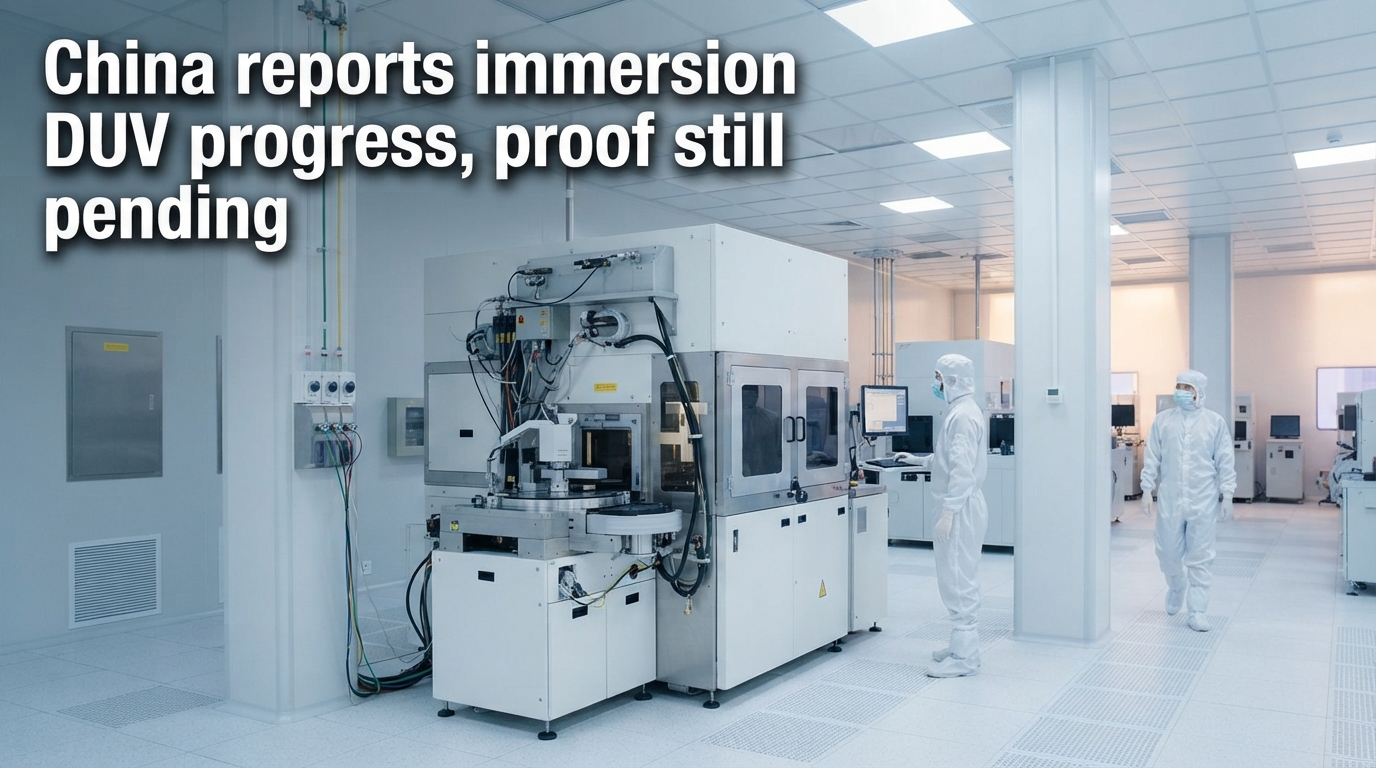
China is reported to have started domestic production of immersion deep ultraviolet lithography tools, a high-end chipmaking category used to print fine circuit patterns on wafers and still central to ASML’s business.
Reuters identified Shanghai Aishengna Electronic Technology Group as the state-backed company leading the effort in Shanghai. The same reporting says the first machines are expected to go to Semiconductor Manufacturing International Corp, Hua Hong Semiconductor, and ChangXin Memory Technologies, and that the initial output is tiny — about five systems in 2026 and roughly 20 in 2027.
One Reuters account described the step as mass production; another said the machines still need further testing before high-volume manufacturing. What matters now is whether the tools clear the gates that turn a reported production start into a real commercial shift: fab qualification, accepted deliveries, repeatable yield, reliability, and serviceability.
That is where the evidence still stops. Reuters said the reported Aishengna machine lags ASML’s competing models on performance and reliability, and a Reuters Breakingviews column argued that the immediate threat to ASML may be overstated because the technical lead remains large and the Chinese tools may only cover the lower end of the market. In other words, this looks like an industrial step, but not yet a proven substitute.
The distinction matters because a working domestic immersion DUV line would give Chinese fabs another source for a critical lithography tool class that has been constrained by Western export controls. But that only becomes a meaningful shift if the tools actually work at scale. A reported production start is not the same thing as a qualified tool running in volume inside fabs.
The policy backdrop is real, but the causal story is not settled. The U.S. imposed major semiconductor export controls in October 2022, tightened them again in October 2023, and made further refinements in 2024. ASML says export controls and the wider push for technological sovereignty may reshape trade dynamics, competition and technology supply chains over time. What the evidence here does not show is whether those controls mainly slowed China, mainly encouraged substitution, or did both.
So the right question is not whether China has produced a headline-grabbing machine. It is whether the machine can pass the tests that would make it a genuine alternative to ASML: qualification, reliable output, and scale.
China-reported immersion DUV system output vs ASML immersion DUV system sales
How many immersion DUV systems China is reported to produce (2026–2027) compared with ASML’s annual immersion DUV sales systems count/scale, when data exists The chart compares China’s reported domestic immersion-DUV targets of about 5 systems in 2026 and about 20 in 2027 with ASML’s latest published baseline: 279 total DUV systems recognized in sales in 2025, of which ASML says 47% were immersion systems. ASML does not publish the exact immersion-system count or 2026–2027 immersion counts in the cited materials, so the baseline is labeled precisely and no forecast is shown. Sources: ASML 2025 Annual Report and ASML Q4 2025 business summary; China figures are the reported profile targets supplied with this request. — AI-assisted analytic, built only from real cited or sourced data. Source: Reuters, ASML. As of 2026-07-29.
Source recordSources / claims / limits
How this piece is framed: The focal thing is a reported Chinese milestone in domestic immersion DUV tooling — possibly a low-volume production start, possibly described more aggressively in some coverage as mass production — but the reader should judge it by the missing proof points: fab qualification, shipped/accepted systems, yield, reliability, and whether the tools cover only the lower end of the market or could actually substitute for ASML. The story is not ‘export controls failed’ and not ‘ASML is doomed’; it is a reality-check on what must be demonstrated before a reported manufacturing step becomes a commercially meaningful shift, with export controls as backdrop rather than proven cause.
Charts & tables — each built only from the cited claims below, by an AI tool
- China-reported immersion DUV system output vs ASML immersion DUV system sales — from claims clm_caaccda53b, clm_d0ec639588, clm_6dec3b8798, clm_08233e8a40, clm_6c71c6c0a0 · as of 2026-07-29 · ⚠ figures not all matched to the cited claims: 47%
Sources
- (primary) ASML 2025 Annual Report — https://www.asml.com/investors/annual-report/2025 · read in full · captured 2026-07-29
- (primary) Implementation of Additional Export Controls: Certain Advanced Computing Items; Supercomputer and Semiconductor End Use; Updates and Corrections; and Export Controls on Semiconductor Manufacturing Items; Corrections and Clarifications — Federal Register / U.S. Department of Commerce BIS — https://www.federalregister.gov/documents/2024/04/04/2024-07004/implementation-of-additional-export-controls-certain-advanced-computing-items-supercomputer-and · read in full · captured 2026-07-29
- (primary) Export Controls on Semiconductor Manufacturing Items — Federal Register / U.S. Department of Commerce BIS — https://www.federalregister.gov/documents/2023/10/25/2023-23049/export-controls-on-semiconductor-manufacturing-items · read in full · captured 2026-07-29
- (primary) Foreign-Produced Direct Product Rule Additions, and Refinements to Controls for Advanced Computing and Semiconductor Manufacturing Items — Federal Register / U.S. Department of Commerce BIS — https://www.federalregister.gov/documents/2024/12/05/2024-28270/foreign-produced-direct-product-rule-additions-and-refinements-to-controls-for-advanced-computing · read in full · captured 2026-07-29
- (primary) Implementation of Additional Export Controls: Certain Advanced Computing and Semiconductor Manufacturing Items; Supercomputer and Semiconductor End Use; Entity List Modification — Federal Register / U.S. Department of Commerce BIS — https://www.federalregister.gov/documents/2022/10/13/2022-21658/implementation-of-additional-export-controls-certain-advanced-computing-and-semiconductor · read in full · captured 2026-07-29
- (secondary) China’s reported chip breakthrough comes with some big caveats — CNBC — https://www.cnbc.com/2026/07/28/china-chipmaking-duv-tool-asml-explained.html · read in full · captured 2026-07-29
- (secondary) Chip toolmaker ASML expected to shine light on capacity and China challenges — Reuters — https://www.reuters.com/world/china/chip-toolmaker-asml-expected-shine-light-capacity-china-challenges-2026-07-14 · read in full · captured 2026-07-29
- (secondary) Breakingviews - ASML’s China chip threat looks overdone - Reuters — Reuters Breakingviews — https://www.reuters.com/commentary/breakingviews/asmls-china-chip-threat-looks-overdone-2026-07-28/ · read in full · captured 2026-07-29
- (secondary) EXCLUSIVE: China starts production of home-grown immersion DUV chipmaking tools - source - Reuters — https://www.reuters.com/world/china/china-starts-production-home-grown-immersion-duv-chipmaking-tools-source-2026-07-28/ · read in full · captured 2026-07-29
- (primary) asml-2025-annual-report-based-on-ifrs.pdf — https://ourbrand.asml.com/m/6ea363f69344ebd4/original/asml-2025-annual-report-based-on-ifrs.pdf · full text not obtained — used its summary
- (secondary) China begins making homegrown DUV chipmaking tools, The Information reports - Reuters — https://www.reuters.com/world/china/china-begins-making-homegrown-duv-chipmaking-tools-information-reports-2026-07-27/ · full text not obtained — used its summary
Claims, and how far we tracked each down
- [likely] China has begun manufacturing domestically developed immersion deep ultraviolet lithography machines. · read in full (as of 2026-07-29)
- [likely] Reuters identified Shanghai Aishengna Electronic Technology Group as the state-backed company leading the production effort. · read in full (as of 2026-07-29)
- [likely] The first machines are expected to be delivered in 2026 to Semiconductor Manufacturing International Corp, Hua Hong Semiconductor, and ChangXin Memory Technologies. · read in full (as of 2026-07-29)
- [likely] Reported production targets are about five immersion DUV systems in 2026 and roughly 20 in 2027. · read in full (as of 2026-07-29)
- [likely] The reported Chinese immersion DUV system still lags ASML’s competing models on performance and reliability and needs further testing before mass production. · read in full (as of 2026-07-29)
- [likely] A credible counter-view is that the China DUV story does not imply an imminent hit to ASML’s core business because ASML’s technical lead remains large, China revenue is still mainly tied to DUV sales and servicing already under export-control pressure, and the reported domestic tools are still unproven on yield, reliability, and scale. · read in full (as of 2026-07-29)
- [contested] The strongest evidence that would confirm the bearish substitution thesis would be fab-side qualification, repeatable high-yield production, and evidence that Chinese fabs shift meaningful procurement away from ASML on a sustained basis; absent that, the more conservative reading is that domestic DUV production is a partial hedge rather than a near-term replacement. · read in full (as of 2026-07-29)
- [confirmed] The United States imposed major semiconductor export controls in October 2022 through BIS rules. · read in full (as of 2026-07-29)
- [confirmed] BIS issued additional semiconductor manufacturing-item export controls in October 2023 and later refinements in April 2024 and December 2024. · read in full (as of 2026-07-29)
- [unconfirmed] The reported domestic Chinese DUV breakthrough does not by itself prove that export controls accelerated substitution; the direction of causality remains unresolved from the available evidence. · read in full (as of 2026-07-29)
Where we hit a limit / what to double-check
- We did not obtain the full text of China begins making homegrown DUV chipmaking tools, The Information reports - Reuters (https://www.reuters.com/world/china/china-begins-making-homegrown-duv-chipmaking-tools-information-reports-2026-07-27/); claims resting on it are from its summary — you may be able to reach it directly.
- We did not obtain the full text of asml-2025-annual-report-based-on-ifrs.pdf (https://ourbrand.asml.com/m/6ea363f69344ebd4/original/asml-2025-annual-report-based-on-ifrs.pdf); claims resting on it are from its summary — you may be able to reach it directly.