
Low water on the Danube is forcing Europe's nuclear plants toward shutdown
Record heat and record-low river levels have pushed reactors in Hungary and Romania toward full shutdown, cut hydropower to decade lows and driven evening prices above 300 exposing how much of Europe's electricity still depends on rivers.


What happenedRecord heat and record-low Danube levels in summer 2026 forced Hungary's and Romania's river-cooled nuclear plants toward full shutdown, cut European hydropower to decade lows and drove evening wholesale prices above 300 per megawatt-hour.
Why it mattersHeat lifts demand for cooling while cutting hydro, wind and river-cooled thermal at once, exposing how much of Europe's power still depends on rivers and leaving import-dependent countries facing higher bills.
Still openHow long the Danube stays below the -134cm threshold that forces full shutdown it needs weeks of rain and whether imports and short-duration storage can cover a weeks-long loss without mandatory factory curtailment.
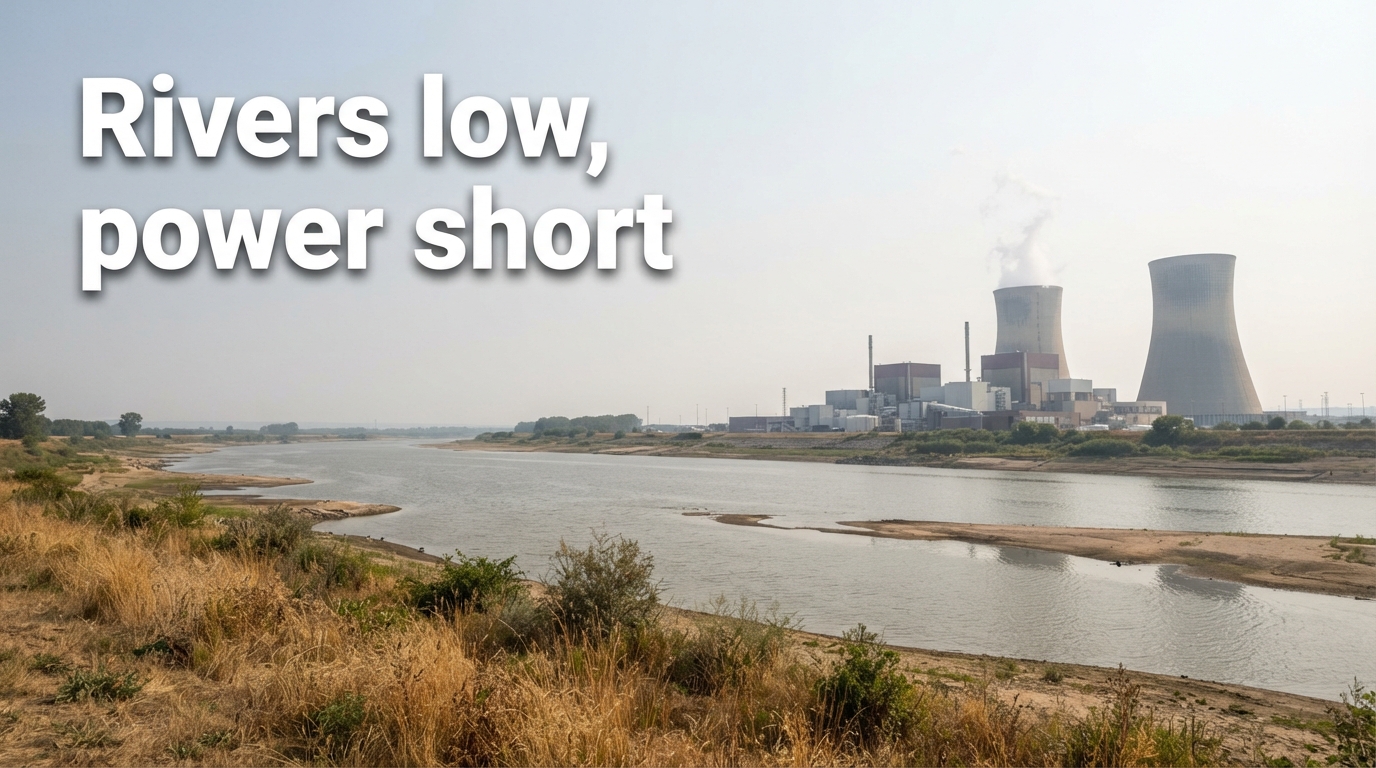
Record heat and record-low water on the Danube in summer 2026 have forced Hungary's and Romania's nuclear plants toward full shutdown, cut European hydropower to its lowest in more than a decade, and driven evening wholesale electricity prices above €300 per megawatt-hour — more than double the normal €100-150. How long the squeeze lasts hinges on rain: the river needs weeks to recover, and if the Danube stays below the threshold that forces Hungary's plant to stop entirely, imports and short-term storage may not cover a weeks-long loss of river-cooled and hydro power without factory curtailments and sustained high bills.
EU electricity mix 2025: a third depends on rivers
Where Europe's electricity comes from in 2025 — and how much depends on water EU electricity generation in 2025, by source share. Nuclear (23%) and hydro (~10%) together make about a third of the mix drought-exposed through river flow and cooling; wind plus solar reached 30.1% (841 TWh), edging past fossil fuels (29.0%, 809 TWh) for the first time, while coal hit a historic low of 9.2% (257 TWh). Shares are reported 2025 generation from Ember; hydro is approximate (~10%) and 'other' is residual to 100%. — AI-assisted analytic, built only from real cited or sourced data. Source: Ember. As of 2026-08-07.
Europe's electricity grid — how rivers cool power plants and why drought cuts power — is the through-line. The Danube, Europe's second-longest river flowing through central and southeast Europe, is not only a shipping route and hydropower source but cooling infrastructure. Hungary's Paks plant — four reactors, about 2,000 megawatts, normally about half of Hungary's electricity — and Romania's Cernavoda plant — two reactors, about 1,400 megawatts, about a fifth of Romania's electricity — both use once-through cooling. That system draws river water, runs it past the plant to absorb heat, and returns it warmer to the river. It only works if there is enough water to draw and if the returned water stays cool enough to protect fish and river life.
Both conditions failed at once. At Paks the Danube gauge hit -106cm on 27 July, beating the previous record low of -98cm in 2018, and was forecast toward -144cm. At -134cm the plant must shut completely. By 1 August Paks had fallen to 965 MW and by 3-4 August to about 240 MW — roughly 12% of normal, one of eight turbines running — a curtailment the operators said would be the first full shutdown in its 44 years since 1982, taking weeks to restart even if water returns. In Romania, Cernavoda had one reactor offline in late July and was preparing to take the second offline in early August — the first time both would be offline for low water — with Danube flow at its intake down to about 1,650 cubic metres per second versus an average of 4,750. The Romanian Navy blasted rock in the Bala channel to build a temporary dam to divert more water to the remaining reactor.
The same physics hit elsewhere, but not everywhere. In France, where nuclear provides about two-thirds of electricity, EDF — the French state-owned nuclear operator — shut three reactors (Golfech 2, Bugey 3 and Chooz 2, together 3.65 GW) and reduced output at seven others in July on the Meuse, Moselle, Garonne and other rivers because discharge temperatures would have breached environmental limits, causing about a 9% dip in nuclear production. Only about 14% of the world's 440 reactors — around 60, eight of them in France — use once-through river cooling and are most vulnerable to this kind of heat and drought. Plants with cooling towers or coastal seawater cooling are far less exposed.
Why heat cuts supply while lifting demand
The squeeze is a pincer, not a single outage. Heat simultaneously raises demand and cuts several kinds of supply.
Demand for cooling jumped about 20% — France's daily demand rose almost 20% during the June heatwave. At the same time, hydropower fell to its lowest in more than a decade in July; in 2025 EU hydro had already fallen 12% year-on-year. Gas turbines lose about 10-13% of capacity when air hits 40C compared with 20C, and many need river water for cooling too. Wind drops 30-50% under heat domes that bring still air; in the UK wind fell to about 15% of the mix in June versus a 30% average. Solar was the exception: it set a record 52 TWh across the EU in June, beating 47 TWh in May, and provided up to 80% of Hungary's daytime power, but it fades after sunset. That leaves a 5pm-10pm evening peak — the wholesale evening peak price, what power companies pay when air-conditioning stays high but solar is gone — to be met by scarce dispatchable plants — those that can be switched on on demand — and imports. Analysis cited for the UK government notes transmission capacity can fall about 16% for each 10C rise in temperature, which would further constrain imports if it materialised, but that derating has not been confirmed as observed in the 2026 event.
The result was a sharp, correlated price spike. On 6 August day-ahead evening peaks reached €298.20 at hour 21 in Hungary, €301.60 in Romania, €285-288 in Slovenia and Croatia, and €326 at hour 20 in Serbia, against a base around €182 in Hungary. The Hungary-Germany spread was €82.91. Those are snapshots for four countries, not a volume-weighted average for the whole market, and they are wholesale peaks, not the household bill — how much passes through to consumers depends on contracts and subsidies and is not yet quantified. No blackouts had occurred as of 7 August, but governments had prepared decrees for mandatory factory shutdowns.
The scale of the weather behind it was unprecedented in the instrumental record for the region. June 2026 was the hottest June on record for western Europe at 20.74C, 3.06C above the 1991-2020 average, and the second-warmest June globally at 16.54C, according to the Copernicus Climate Change Service run by the European Centre for Medium-Range Weather Forecasts. Sea-surface temperatures for June were the highest on record for the month, with a strong El Niño developing in the Pacific. River flow was below average across large parts of France and central and eastern Europe, with widespread drier-than-average conditions. Hydropower's global share fell to an all-time low of 14% in 2025 even as absolute output hit a record 4,437 TWh, because demand grew faster.
How much of Europe's power depends on rivers
That weather lands on a system still heavily river-dependent. In 2025, 71% of EU electricity came from low-carbon sources. Nuclear was the largest single source at 23% — eight of the ten countries with the highest nuclear shares globally are in the EU. Wind and solar together reached 30.1% (841 TWh), overtaking fossil fuels at 29% for the first time, with renewables at 47.7% and coal at a historic low of 9.2% (257 TWh, down from 705 TWh a decade ago). Gas was about 17%. Hydro fell 12% and wind 2% in 2025, pushing gas generation up 8% (+34 TWh) and the EU power-sector gas import bill up 16% to €32 billion. Because gas often sets the marginal price — the price of the last, most expensive plant needed to meet demand — any hydro or nuclear shortfall lifts gas burn and prices directly.
Analysts put drought-exposed generation — hydro plus river-cooled nuclear and thermal — at roughly 30-35% of EU electricity, but nationally it can be over 50%. Hungary at about 50% from Paks and France at about 69% nuclear are structurally concentrated. That concentration, not just the weather, determines who is hit hardest.
Evening peak prices more than doubled
Evening electricity prices on 6 August vs a normal summer evening Day-ahead evening peak prices on 6 August 2026 more than doubled a normal summer evening across five Southeast European bidding zones, with Serbia highest at €326/MWh and Hungary–Germany spread at €82.91. Normal bars use the midpoint (€125) of the usual €100–150/MWh evening range. Figures are day-ahead hourly prices for hours 20–21, not volume-weighted averages. — AI-assisted analytic, built only from real cited or sourced data. Source: Serbia SEE Energy, New Scientist. As of 2026-08-07.
Hungary and Romania are most acute: Hungary has little storage, very little wind or hydro and few modern gas plants despite significant solar, so losing Paks removes half its domestic supply at once. Romania pairs about 20% nuclear with about 20% hydro via the Iron Gate plants on the Danube border with Serbia, both curtailed by low flow. Serbia, with about 65% coal and 25% hydro, saw Iron Gate output at a fraction of average and its Kostolac coal plants cut for Danube cooling constraints, while Danube shipping was limited to light loads.
Other countries show how design buffers the same drought. Slovakia's Bohunice and Mochovce nuclear plants use closed-loop cooling towers and were less affected; its Gabcikovo hydro on the Danube had only one of eight turbines running but generation was only about 12% down year-on-year. Bulgaria's Kozloduy nuclear plant, which can provide up to 40% of Bulgaria's power, stayed near full output due to a better low-water cooling design, and the country has 3.3-3.4 GW / 8.6 GWh of battery storage — about 16% of its system capacity and more than 46% of combined solar and wind capacity — plus diversified solar and wind and low hydro dependence. Austria, which gets about 60% of electricity from hydropower, was less affected because much of it is storage and pumped hydro that can hold water, unlike run-of-river plants that need continuous flow. France's earlier upgrades also matter: heatwave losses fell from 5.5 TWh in 2003 to 0.5 TWh in 2022 as cooling systems and operating practices improved.
Who pays and what is asked to give
Costs flow first to wholesale markets, then to import-dependent countries that must buy at those peaks for weeks, then to industry and households. Hungary's import capacity of 3,600-3,800 MW could in theory cover a full 2,000 MW Paks loss, but with evening demand up 20% and another 400 MW lost at the Százhalombatta gas plant, the margin is thin. Prime Minister Péter Magyar — who leads Hungary's government for the Tisza party as of August 2026 — said the grid operator would ask large consumers, including battery and car manufacturers, to voluntarily cut use between 5pm and 10pm, and asked households not to charge electric cars or run air conditioners then. Voluntary cuts reduced demand by about 700 MW on 3 August, according to his government. In Romania, Dacia and Ford Romania paused production until 19 August, cutting about 200 MW, and Prime Minister Ilie Bolojan urged evening conservation. Audi Győr, MOL and others in Hungary also scaled back. Bulgaria's batteries point to a different price path: by shifting about 10% of daily solar and wind to the evening by 2030, storage can dampen those peaks, but it does not cover a weeks-long correlated loss.
The drought cascades beyond power, though the power story remains the core. Danube shipping was limited to light loads, ferries suspended and a cruise ship grounded near Vidin; coal and petrochemical transport was constrained, raising logistics costs; refineries lost cooling efficiency; maize and sunflower harvests in southeast Europe were below average; and wildfires burned in Iberia and southern France. Those drags amplify energy stress through fuel logistics and weaker economic activity.
What fixes help, how fast, and at what cost
Four mitigations exist, none quick or free, and each trades against something else.
First, cooling retrofits. Adding cooling towers or pre-cooling discharge — as EDF did with ventilators at Civaux on the Vienne that chill discharge by 3-7C before reinjection — reduces river dependence. But retrofitting once-through to closed-cycle carries an energy penalty of 0.8% to 8.8% because the plant must power the towers and condensers, plus higher capital cost — dry towers cost 5-10 times wet towers — land constraints, extended downtime and extra air emissions from burning more fuel to compensate. The U.S. Environmental Protection Agency rejected a universal closed-cycle mandate for existing plants in 2014 for those reasons, favouring site-specific determinations. EDF's climate adaptation plan is €8.7 billion over 15 years to about 2040, and only the Civaux pre-cooling has been deployed; hybrid dry-cooling towers that would make output largely immune to river temperatures are slower and more expensive and must fit into outage schedules, not a weeks-long drought.
Second, the ecological limit itself. Discharge limits — for example, keeping the Garonne below 28C downstream of Golfech — exist to protect aquatic life. Warm water holds less dissolved oxygen while fish metabolism rises, risking suffocation, toxic algae blooms and blocked salmon migration. When flows are low, the same permitted pollutant load enters a smaller volume of water, raising concentrations, and warmer temperatures help pathogens grow. Waiving limits to keep reactors online, as has happened in past French heatwaves, trades power for river and human-health costs, a choice environmental regulators oppose.
Third, storage and interconnection. Bulgaria shows batteries can be deployed in 1-2 years — about €2 billion in two years, partly via the EU Recovery and Resilience Facility — but its 3.4 GW is sized for about four hours, useful for the evening gap, not for weeks when hydro and river-cooled thermal are both down. Interconnection helped France remain a net exporter of more than 10 GW despite curtailing about 6.4 GW by mid-July, but Hungary's 3.6-3.8 GW of import capacity is insufficient against a 20% peak rise plus domestic losses, and booking transmission is costly.
Fourth, firm capacity and market design. Analysts at Bruegel, a Brussels-based economic think-tank, the EU Agency for the Cooperation of Energy Regulators and the Tony Blair Institute warn that batteries and interconnection smooth volatility but cannot yet replace abundant, always-available baseload for prolonged drought or wind lulls. Storage and demand response have accounted for only about 3% of firm capacity payments historically; most payments go to generators. Cross-border participation is limited by high transmission booking costs and distrust that neighbours will maintain exports in scarcity, risking over-procurement at home or free-riding on neighbours. That points to coordinated capacity mechanisms rather than a single national fix.
Politics frames the same facts differently. Magyar's government presents the emergency response — imports plus voluntary 5-10pm curtailment — as avoiding collapse without mandatory shutdowns, and blames Paks's 50% dependence on infrastructure choices inherited from Viktor Orbán, including the €12.5 billion contract with Rosatom, Russia's state-owned nuclear company, to build Paks II awarded without tender, blocked wind development and underinvestment in storage and gas. It pledges to review that contract, diversify nuclear fuel to U.S. and French suppliers, lift wind restrictions and double the renewable share by 2040, while keeping utility price caps and only pledging to end Russian energy dependence by 2035 — eight years after the EU's REPowerEU deadline of 2027 — and aligning with the European People's Party, which has weakened parts of the Green Deal. That is not a progressive pivot, but a structural diagnosis that concentration plus low flexibility equals fragility.
The climate context makes the pattern familiar, not freakish. Scientists at World Weather Attribution attribute the unprecedented temperatures to human-caused climate change. France has seen heat-related nuclear reductions in 2003, 2006, 2015, 2018, 2019, 2022 and 2025; the Danube has hit critical lows in 2003, 2018, 2022, 2025 and now 2026. Adaptation has cut losses before, but not eliminated them. Near-term relief still depends on temperatures falling and weeks of rain to recharge rivers, not on infrastructure that takes years to build. Two figures on the page — the EU's 2025 mix showing about a third of power still river-dependent, and the evening price jump to more than double normal — carry the scale that words alone cannot.
Source recordSources / claims / limits
How this piece is framed: Europe's power system under a correlated climate stress test — heat simultaneously lifts demand and knocks out multiple generation types, with the Danube's once-through cooling as the acute, emblematic failure point
Charts & tables — AI-assisted; provenance on each line
- EU electricity mix 2025: a third depends on rivers — from claims clm_4062d0bc0c, clm_d871de1a89, clm_fe588e6966, clm_edc4aad2e9, clm_aad068cf7d · as of 2026-08-07
- Evening peak prices more than doubled — from claims clm_d56f762401, clm_bb3efe680a · as of 2026-08-07
Sources
- (primary) Copernicus: Record heatwave brings hottest June for western Europe during second-warmest June globally — Copernicus / ECMWF — https://climate.copernicus.eu/copernicus-record-heatwave-brings-hottest-june-western-europe-during-second-warmest-june-globally · read in full · captured 2026-08-07
- (primary) Cooling Water Intake Structures: Summary of the EPA Rule - EveryCRSReport.com — https://www.everycrsreport.com/reports/R41786.html · read in full · captured 2026-08-07
- (primary) European Electricity Review 2026 — Ember — https://ember-energy.org/latest-insights/european-electricity-review-2026 · read in full · captured 2026-08-07
- (primary) Record low water levels force nuclear output cuts in Hungary and Romania - Reuters — https://www.reuters.com/business/energy/hungarys-paks-nuclear-plant-could-shut-down-thursday-or-friday-pm-says-2026-07-30 · read in full · captured 2026-08-07
- (primary) Danube's record low levels force shutdown of Hungary's only nuclear plant — BBC / MVM Paks — https://www.bbc.co.uk/news/articles/cn0nqv05g0do · read in full · captured 2026-08-07
- (primary) 3.4 Water pollution and human health - European Environment Agency — EEA — https://www.eea.europa.eu/en/europe-environment-2025/thematic-briefings/environment-and-human-health/water-pollution-and-human-health · read in full · captured 2026-08-07
- (primary) Europe's electricity capacity mechanisms need to be better coordinated - Bruegel — https://www.bruegel.org/policy-brief/europes-electricity-capacity-mechanisms-need-be-better-coordinated · read in full · captured 2026-08-07
- (primary) Southeast Europe power market split widens as central markets face evening supply pressure — HUPX/OPCOM/SEEPEX day-ahead 6 Aug 2026 — Serbia SEE Energy — https://serbia-energy.eu/southeast-europe-power-market-split-widens-as-central-markets-face-evening-supply-pressure · read in full · captured 2026-08-07
- (primary) European Electricity Review 2026 — Chapter 1: 2025 at a glance — Ember — https://ember-energy.org/latest-insights/european-electricity-review-2026/2025-at-a-glance · read in full · captured 2026-08-07
- (primary) Hungary's nuclear plant shutdown gets reprieve / Romania blasts rocks to reroute Danube — Reuters — https://www.reuters.com/business/energy/hungarys-nuclear-plant-shutdown-due-low-danube-gets-reprieve-until-later-week-2026-08-03 · read in full · captured 2026-08-07
- (primary) Global Electricity Review 2026 — Chapter 3.7 Hydro — Ember — https://ember-energy.org/latest-insights/global-electricity-review-2026/electricity-demand-and-supply-trends · read in full · captured 2026-08-07
- (primary) The Power to Compete: Europe's Energy Reset - Tony Blair Institute — Tony Blair Institute for Global Change — https://institute.global/insights/climate-and-energy/the-power-to-compete-europes-energy-reset · read in full · captured 2026-08-07
- (primary) European Union | Ember — https://ember-energy.org/countries-and-regions/european-union · read in full · captured 2026-08-07
- (primary) Low Danube river levels force Romania to shut down both nuclear power reactors — Reuters / Nuclearelectrica — https://www.reuters.com/business/energy/low-danube-river-levels-force-romania-shut-down-both-its-nuclear-power-reactors-2026-07-29 · read in full · captured 2026-08-07
- (primary) France idles reactors on cooling rules — EDF/RTE detail via Brussels Signal — https://brusselssignal.eu/2026/07/france-idles-reactors-on-cooling-rules-as-spanish-and-us-plants-run-right-through-the-heat · read in full · captured 2026-08-07
- (secondary) Warming Europe complicates France's bet on nuclear power - Politico — Politico Europe — https://www.politico.eu/article/warming-europe-complicate-france-nuclear-power · read in full · captured 2026-08-07
- (secondary) Hungary plans to shut down only nuclear power plant amid drought — Al Jazeera — https://www.aljazeera.com/news/2026/8/2/hungary-plans-to-shut-down-only-nuclear-power-plant-amid-drought · read in full · captured 2026-08-07
- (secondary) How drought threatens Europe's electricity supplies — DW — https://www.dw.com/en/drought-europe-electricity-supplies-danube/a-78269916 · read in full · captured 2026-08-07
- (secondary) France shuts down nuclear reactors as heatwave intensifies — Euronews — https://www.euronews.com/business/2026/07/13/france-shuts-down-nuclear-reactors-as-heatwave-intensifies · read in full · captured 2026-08-07
- (secondary) Q&A: What Magyar's defeat of Orban in Hungary means for climate and energy - Carbon Brief — https://www.carbonbrief.org/qa-what-magyars-defeat-of-orban-in-hungary-means-for-climate-and-energy · read in full · captured 2026-08-07
- (secondary) Why is France shutting down its nuclear reactors during the heatwave? - India Today — https://www.indiatoday.in/science/story/france-nuclear-reactors-shut-heatwave-warms-rivers-cooling-limits-2947762-2026-07-14 · read in full · captured 2026-08-07
- (secondary) Bulgaria surges to world's No. 1 in battery systems share — Balkan Green Energy News — https://balkangreenenergynews.com/bulgaria-surges-to-worlds-no-1-in-battery-systems-share · read in full · captured 2026-08-07
- (secondary) Drought and heat push Europe's power grid to breaking point — New Scientist — https://www.newscientist.com/article/2583740-drought-and-heat-push-europes-power-grid-to-breaking-point · read in full · captured 2026-08-07
- (secondary) Factcheck: How nuclear, gas, wind and solar power are affected during heatwaves — Carbon Brief — https://www.carbonbrief.org/factcheck-how-nuclear-gas-wind-and-solar-power-are-affected-during-heatwaves · read in full · captured 2026-08-07
- (secondary) The Danube is drying up: Drought paralyzes Europe's lifeline — DW — https://www.dw.com/en/the-danube-is-drying-up-drought-paralyzes-europes-lifeline/g-78179821 · read in full · captured 2026-08-07
- (secondary) Blog by Grace Waters: Why France's nuclear plants are shutting down during peak summer demand — Energy in Demand — https://energyindemand.com/2026/07/25/blog-by-grace-waters-why-frances-nuclear-plants-are-shutting-down-during-peak-summer-demand · read in full · captured 2026-08-07
- (secondary) 40% of SE European nuclear capacity offline amid drought — Montel News — https://montelnews.com/it/news/c65ea15f-ba28-4f0e-a2c7-1504a3c411a4/40-of-se-european-nuclear-capacity-offline-amid-drought · full text not obtained — used its summary
- (secondary) Hungary braces for a full shutdown of the Paks nuclear plant as the Danube River hits record lows — ABC News — https://abcnews.com/International/wireStory/hungary-braces-full-shutdown-paks-nuclear-plant-danube-135263354 · full text not obtained — used its summary
Claims, and how far we tracked each down
- [confirmed] June 2026 was the hottest June on record for western Europe, averaging 20.74C, 3.06C above 1991-2020 average, and the second-warmest June globally · read in full (as of 2026-08-07)
- [confirmed] In June 2026 river flow was below average across large parts of France and central/eastern Europe, with widespread drier-than-average conditions · read in full (as of 2026-08-07)
- [confirmed] Hungary's Paks nuclear plant (4 reactors, ~2000 MW normal, ~40-50% of Hungary's electricity) fell to 965 MW on Aug 1 and 240 MW overnight, operating at ~12% capacity, with all but one of eight turbines shut · read in full (as of 2026-08-07)
- [confirmed] Danube gauge at Paks reached -106 cm on July 27 (new record), full shutdown triggered at -134 cm, forecast to -144 cm, far below previous -98 cm record in 2018 · read in full (as of 2026-08-07)
- [confirmed] A full shutdown of Paks would be the first in its 44-year history since 1982 and would take weeks to restart even if water levels recover · read in full (as of 2026-08-07)
- [confirmed] Romania's Cernavoda nuclear plant (2x700 MW, ~20% of Romania's electricity) had one reactor taken offline; authorities blasted rock and dumped rock to divert Danube water to its intake · read in full (as of 2026-08-07)
- [confirmed] France's EDF shut 3 nuclear reactors and reduced output at 7 others in July-Aug 2026 due to low river flows/high water temperatures on Meuse, Moselle and other rivers, causing ~9% dip in nuclear production · read in full (as of 2026-08-07)
- [likely] About 2.44 GW or 40% of southeast Europe's nuclear capacity was offline on Aug 3 2026 due to Danube drought · read in full (as of 2026-08-07)
- [confirmed] Europe's hydropower generation fell to its lowest in more than a decade in July 2026; EU hydropower fell 12% in 2025 vs 2024 · read in full (as of 2026-08-07)
- [likely] 32% of Italy's thermal (gas) fleet — up to ~20 GW — was at risk from lack of cooling water from rivers/canals · read in full (as of 2026-08-07)
- [confirmed] Power demand can jump ~20% during heatwaves due to air conditioning; France daily demand rose almost 20% during June 2026 heatwave · read in full (as of 2026-08-07)
- [confirmed] Wholesale evening peak prices exceeded €300/MWh in Poland, Slovakia, Romania and Hungary in early August 2026, vs normal €100-150/MWh · read in full (as of 2026-08-07)
- [confirmed] Solar generated a record 52 TWh across the EU in June 2026 (47 TWh in May), and provided up to 80% of Hungary's daytime power, but is unavailable for evening peak without storage · read in full (as of 2026-08-07)
- [confirmed] EU electricity mix in 2025: nuclear 23% (largest single source), wind+solar 30% (first time above fossil 29%), renewables 48%, coal 9.2% historic low, gas ~17% · read in full (as of 2026-08-07)
- [confirmed] EU electricity mix 2025: 71% low-carbon, nuclear 23% largest single source (8 of top 10 nuclear-share countries are EU), wind+solar 30.1% (841 TWh) above fossil 29.0% (809 TWh) for first time, renewables 47.7% (1331 TWh), coal 9.2% (257 TWh) historic low down from 24.6% (705 TWh) a decade ago, gas ~17% (16.7%) · read in full (as of 2026-08-07)
- [confirmed] EU hydro fell 12% and wind -2% in 2025 vs 2024; gas generation rose 8% (+34 TWh) largely to replace hydro, pushing EU power-sector gas import bill to €32bn, +16% YoY · read in full (as of 2026-08-07)
- [confirmed] Global hydropower 4,437 TWh in 2025 (+3 TWh +0.1% vs 2024, record absolute) but share fell to all-time low 14% as demand outpaced hydro; EU hydro fell 43 TWh · read in full (as of 2026-08-07)
- [confirmed] France EDF shut 3 reactors (Golfech 2 1300 MW, Bugey 3 900 MW, Chooz 2 1450 MW =3.65 GW ~6% of 61 GW) and reduced 7 others July 2026 for river-temperature discharge limits (Garonne <28°C), environmental not safety; curtailment ~6.4 GW by 13 July yet France remained net exporter >10 GW · read in full (as of 2026-08-07)
- [confirmed] Day-ahead evening peaks 6 Aug 2026: HUPX Hungary €298.20 at hour 21 (base €182.42), Romania €301.60, Slovenia €285.30, Croatia €288.80, Serbia €326 at hour 20; Hungary-Germany spread €82.91 · read in full (as of 2026-08-07)
- [confirmed] Paks NPP (4 reactors ~2000 MW normal ~50% Hungary) fell to 965 MW Aug 1 and 240 MW (~12% one turbine) Aug 3-4 2026; Danube gauge at Paks -106 cm 27 July (record) vs -98 cm 2018, full shutdown at -134 cm, forecast -144 cm · read in full (as of 2026-08-07)
- [confirmed] Cernavoda NPP (2x706 MW ~20% Romania) had one reactor shut early week July 2026, second scheduled early Aug 2026 — first time both offline for low water; Danube at entry 1650 m3/s vs 4750 avg, forecast 1500 vs 1400 record 1985; Romanian Navy blasted Bala channel to divert water to intake · read in full (as of 2026-08-07)
- [confirmed] Environmental discharge limits (e.g., Golfech 286C downstream on Garonne) exist to protect aquatic life: warm water holds less dissolved oxygen while fish metabolism rises, risking suffocation, toxic algae blooms and blocking salmon migration. Waiving limits to keep reactors online would trade power for ecological damage, a trade-off opposed by environmental regulators. · read in full (as of 2026-08-07)
- [confirmed] Retrofitting once-through cooling to closed-cycle (cooling towers) carries a 0.8% to 8.8% energy penalty (DOE 2002 estimates cited by CRS), plus higher capital cost (dry towers 5-10x wet towers), land constraints, extended downtime and higher air emissions from compensatory fuel burn. EPA rejected universal closed-cycle mandate for existing plants in 2014 for these reasons, favoring site-specific determinations. · read in full (as of 2026-08-07)
- [confirmed] EDF's climate adaptation plan is 8.7 billion over 15 years (to ~2040) covering nuclear, hydro and island systems. The only deployed pre-cooling retrofit cited is Civaux on the Vienne (ventilators chill discharge 3-76C before reinjection). Hybrid dry-cooling towers that would make output immune to river temperatures are described as slower and more expensive to build, fitting into outage schedules, not a near-term fix for weeks-long drought. · read in full (as of 2026-08-07)
- [confirmed] Hungarian political framing is contested: PM Pter Magyar (Tisza) blames Paks vulnerability on infrastructure shortcomings inherited from Orbn, while pledging to review the 12.5bn Rosatom Paks II contract (awarded without tender), diversify nuclear fuel to US/French suppliers, abolish Orbn-era wind-turbine restrictions and double renewable share by 2040. Critics note Tisza will maintain utility price caps and only pledges to eliminate Russian energy dependence by 2035, eight years after EU REPowerEU deadline of 2027, and is aligned with EPP which has weakened Green Deal elements not a progressive pivot. · read in full (as of 2026-08-07)
- [confirmed] Hungarian authorities state import capacity of 3,600-3,800 MW could cover a full Paks shutdown (2,000 MW), but Reuters reports a critical situation remains due to +20% evening peak demand, loss of 400 MW at Szzhalombatta gas plant, and need for voluntary curtailment 5pm-10pm of battery/car manufacturers and households. This undercuts claims that interconnection alone resolves multi-week loss of ~50% of domestic generation. · read in full (as of 2026-08-07)
- [likely] Market-design analysts (Bruegel, ACER, Tony Blair Institute) argue batteries and interconnection cannot replace firm capacity for prolonged drought/Dunkelflaute: storage and demand response account for only ~3% of firm capacity payments historically; most capacity payments go to generators. Bruegel notes cross-border participation is limited by high transmission booking costs and distrust that neighbours will maintain exports in scarcity, risking over-procurement domestically or free-riding. Institute Global concludes 'storage and interconnectors help smooth volatility, but they cannot yet replace the need for abundant, always-available baseload.' · read in full (as of 2026-08-07)
- [confirmed] Gas power plant efficiency falls with heat: ~13% capacity loss and 7% efficiency loss at 40C vs 20C; simple gas turbines lose ~10% per 10C · read in full (as of 2026-08-07)
- [confirmed] Nuclear plants using once-through river cooling make up ~14% of global fleet (~60 of 440 reactors, 8 in France) and are most vulnerable to heat/drought · read in full (as of 2026-08-07)
- [confirmed] Heatwave curtailments cut annual nuclear generation by average 0.6% 2003-2022; only France 2003 lost >1% (1.3%); France losses fell from 5.5 TWh in 2003 to 0.5 TWh in 2022 due to upgrades · read in full (as of 2026-08-07)
- [confirmed] Bulgaria has 3.32-3.43 GW / 8.6 GWh battery storage, ~16% of its power system capacity, highest share globally, covering >46% of combined PV+wind capacity · read in full (as of 2026-08-07)
- [confirmed] Bulgaria's Kozloduy nuclear plant (up to 40% of Bulgaria's power) remained at almost full capacity due to better low-water cooling design, unlike Paks/Cernavoda · read in full (as of 2026-08-07)
- [confirmed] Slovakia's Bohunice and Mochovce nuclear plants use cooling towers (closed loop) and were less affected; its Gabcikovo hydro on Danube had only 1 of 8 turbines operating but generation only ~12% down year-on-year · read in full (as of 2026-08-07)
- [confirmed] Austria generates ~60% electricity from hydropower but was less affected due to storage/pumped-storage vs run-of-river, plus ~30% other renewables · read in full (as of 2026-08-07)
- [confirmed] Serbia's mix ~65% coal, ~25% hydro; Iron Gate hydro plants generating fraction of average; Kostolac coal plants cut output due to Danube cooling constraints; Danube shipping limited to light loads · read in full (as of 2026-08-07)
- [confirmed] Hungary's energy crisis forced Audi Gyor, MOL and other large firms to scale back production; Romania's Dacia and Ford Romania also scaled back; Hungary urged voluntary conservation 5pm-10pm peak · read in full (as of 2026-08-07)
- [confirmed] No blackouts had occurred as of Aug 7 2026, but governments warned of critical days ahead and potential mandatory factory shutdown decrees · read in full (as of 2026-08-07)
- [confirmed] Low wind speeds during heat domes reduced wind output 30-50% in Europe during heatwaves; UK wind fell to ~15% of mix in June 2026 vs ~30% average · read in full (as of 2026-08-07)
- [confirmed] Solar panel efficiency falls 0.2-0.5% per C above 25C, but high irradiance outweighs loss; EU solar still set records during heatwave · read in full (as of 2026-08-07)
- [confirmed] Hungary lacks storage, has too few modern gas plants and very little wind/hydro, making it more vulnerable than neighbours despite significant solar capacity · read in full (as of 2026-08-07)
- [confirmed] Solar generated record 369 TWh in 2025 (+20.1% YoY, 4th year >20% growth), 13% of EU electricity, capacity +65.1 GW (+19%) · read in full (as of 2026-08-07)
- [confirmed] EEA warns climate change will increase pollutant concentrations when permitted discharge loads enter smaller water volumes during low flows, and warmer temperatures facilitate pathogen growth amplifying ecological and human-health costs if thermal discharge limits are waived during drought. · read in full (as of 2026-08-07)
Where we hit a limit / what to double-check
- We did not obtain the full text of 40% of SE European nuclear capacity offline amid drought (https://montelnews.com/it/news/c65ea15f-ba28-4f0e-a2c7-1504a3c411a4/40-of-se-european-nuclear-capacity-offline-amid-drought); claims resting on it are from its summary — you may be able to reach it directly.
- We did not obtain the full text of Hungary braces for a full shutdown of the Paks nuclear plant as the Danube River hits record lows (https://abcnews.com/International/wireStory/hungary-braces-full-shutdown-paks-nuclear-plant-danube-135263354); claims resting on it are from its summary — you may be able to reach it directly.
- Figures we could not match to our stored evidence — worth confirming against the source (which may state them exactly), and note live sources move: 35%, 69%.