
Poland halves coal's share of electricity as solar drives July low
Yearly power is still just over half coal, the grid built for big central plants is curtailing wind and solar and refusing connections, and the plan to replace baseload coal hinges on a contested nuclear build already three years behind schedule.


What happenedCoal dropped to about 53.5% of Poland's electricity in a sunny July 2026, down from about 92% when Poland joined the EU, but yearly data still shows just over half coal and the July share is so far via press citing the grid operator, not yet in its published monthly totals.
Why it mattersIt shows if Europe's most coal-dependent power system can quit coal without blackouts or abandoning Silesia, where mining jobs are nationally small but locally concentrated — a test for other coal-heavy economies and for EU energy costs.
Still openWhether summer solar peaks become a lasting annual shift, and whether a €42bn nuclear programme and €15bn grid upgrade can provide baseload and flexibility before the 5GW Bełchatów lignite plant closes in the mid-2030s.
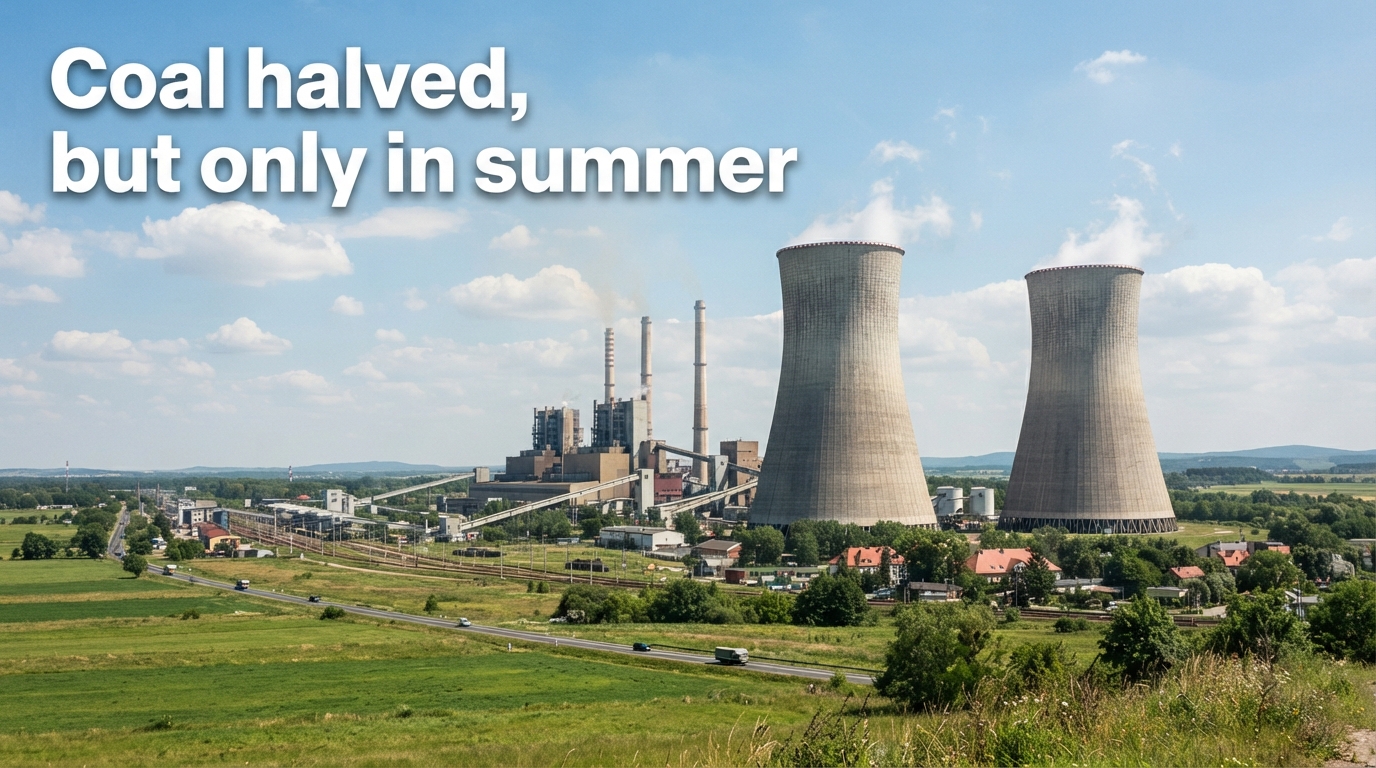
Poland the European Union's most coal-dependent power system made about 53.5% of its electricity from coal in July 2026, down from about 92-94% when it joined the EU in 2004. That is a halving in a generation, but it was a sunny summer month, not a full year. The annual average is still just over half coal, and whether a July dip becomes a permanent crossing depends less on adding more solar than on whether a strained grid and a contested Bbn nuclear plan can replace the country's biggest coal plant before it closes.
The gap between month and year is the story. In July, hard coal was 35.3% and lignite, the cheaper brown coal, was 18.2%, for 53.5% coal in total, while renewables were roughly 38% to 42% depending on how they are counted, with about 21% solar and 15% wind. The year as a whole is cooler: coal was 59% in 2023, 56.2% in 2024 and 52.7% in 2025, while renewables were 29.4% in 2024 and 31.4% in 2025. June 2025 was the first month ever when renewables (45.6%) edged above coal (42.3%), yet the year still ended majority-coal. At 666 grams of CO2 per kilowatt-hour, Poland remains the EU's most carbon-intensive grid, against an EU average of 251 grams.
The July shares also have a checkability limit. Poland's state-owned transmission operator PSE, which runs the high-voltage grid and publishes generation data, reports annual capacity 77,331 megawatts at the end of 2025, up from 72,188 a year earlier, with wind and other renewables at 37,106 megawatts and large thermal plants at 37,794 megawatts but its own monthly totals in terawatt-hours for July 2026 were not yet published on 13 August 2026. The July percentages are therefore via Polish business press citing PSE. The direction is real a fall of about 30 points in a decade but the absolute scale of that July is not yet verified in PSE's monthly data.
Demand did not push coal out. Poland used about 154 terawatt-hours in 2024 and is expected to need 210 to 230 by 2040 as heating, transport and industry electrify. Three things overlapped to make coal expensive and solar cheap at the same time.
First, the EU Emissions Trading System, the EU-wide market where power plants buy a permit for each tonne of CO2 they emit. By 2025 carbon made up 63% of the short-run cost of hard coal about p of a 0 per megawatt-hour cost on the domestic coal price tracked by analysts at Modo Energy, up from 43% in 2020. Coal still sets the price in most hours, but it does so while losing money. That 63% is one methodology's snapshot; cheaper panels and EU-funded grid work moved in parallel, so no single cause can be isolated.
Second, a rooftop boom. Households and businesses that both produce and sell power so-called prosumers reached 1.5 million micro-installations totalling 12.7 gigawatts by the end of 2024, within 24.8 gigawatts of total solar by end-2025, plus about 10.5 gigawatts of wind. Renewables are now more than half of installed capacity at 37.8 gigawatts, even though they are only about 30% of generation because wind and solar run fewer hours than coal.
Third, EU money for wires. Between 2004 and 2024 Poland obtained more than 55bn Polish zloty from the EU for energy transformation, according to Trade.gov.pl summarising a Polish Economic Institute report. The report says those funds helped modernise or build 1,977 km of extra-high-voltage lines 12.3% of that network and 1,391 km of heating network, alongside building upgrades and onshore wind. In 2004, 94% of electricity came from hard coal and lignite and 3% from renewables; by 2023 coal was 59% and renewables 27%.
More solar has not meant linearly less coal because the grid was built for a handful of big coal plants in the centre, not millions of rooftops and coastal wind farms. Ordered turn-downs of wind and solar when the grid cannot take them curtailment were 731 gigawatt-hours in 2024, about 2% of variable renewable potential, and nearly doubled to about 1.4 terawatt-hours by July 2025. Hours when generators pay to stay online negative day-ahead prices ran 300 to 400 hours in 2025, roughly twice 2024, with a low of -528 zloty per megawatt-hour in June 2025. PSE refused 74 gigawatts of connection requests in 2024, more than the entire 72-gigawatt system.
Storage cannot yet smooth this. Poland has about 1.7 gigawatts of pumped hydro and only megawatts of batteries against 33.5 gigawatts of renewable capacity, so summer surplus and winter lulls persist a 10-day wind-and-solar lull in November 2024 pushed prices to c0 per megawatt-hour. PSE plans to spend about bn between 2025 and 2034 to accommodate 18 gigawatts of offshore wind plus 19 gigawatts onshore and 45 gigawatts of solar, within a wider e0-670bn transition need to 2040. That is a target, not delivered capacity, and system costs already more than double the cost of solar alone once curtailment and balancing are included. Flexible gas, which can start in 5-10 minutes versus 80-150 minutes for coal, is part of the bridge, but Warsaw does not want it as long-term baseload.
The long-term baseload answer is meant to be nuclear, to replace Be42chatw in central Poland Europe's largest lignite plant at 5.1 to 5.3 gigawatts, supplying 20-25% of national demand when running flat out, due to close in the mid-2030s. The wider coal fleet is set to shrink from 26.5 gigawatts today to 8.7 gigawatts by 2049, with 18 gigawatts already holding a retirement date.
Poland's Energy Policy until 2040 envisages 6 to 9 gigawatts of nuclear. The first plant, at Lubiatowo-Kopalino on the Baltic coast, is three AP1000 reactors Westinghouse's large pressurised-water design totalling 3.75 gigawatts, built by the Westinghouse-Bechtel consortium and owned by the 100% state-owned company Polskie Elektrownie Jdrowe (PEJ). On 31 March 2026 PEJ filed a construction licence application with Poland's National Atomic Energy Agency (PAA) the first such application in post-1989 Poland of more than 40,000 pages prepared by over 200 experts. The regulator has 24 months to decide, not counting time for PEJ to supplement the file. PEJ plans to seek a building permit in 2027, pour first nuclear concrete in late 2028, and bring units online in 2036, 2037 and 2038 three years later than the original 2033 target, in line with a global average delay of about three years.
The price tag is B-45bn, or 192bn zloty. Financing is 30% equity 60.2bn zloty from the state budget between 2025 and 2030 plus 70% debt via export credit agencies in the US, Canada and France, with state guarantees on all the debt. Revenue support is a two-way Contract for Difference, a 40-year government contract that guarantees a fixed strike price and makes consumers or the budget pay the difference to the market price. The European Commission approved the aid on 9 December 2025 under EU state-aid rules, case SA.109707, after an in-depth investigation opened in December 2024. Available summaries say the Commission cut the contract from 60 to 40 years, required the strike price to be set by a model limited to the funding gap, imposed profit-sharing and periodic cost reviews, and conditioned approval on PEJ remaining legally and functionally independent and on at least 70% of annual output being sold on the open power exchange.
What that strike price will be is not disclosed in the available summaries. Poland's December 2024 notification, as reported in Polish press, put it at 470-550 zloty per megawatt-hour in real terms, about 0-130, assuming the plant runs 92.7% of the time and costs 192bn zloty to build above the 2026 forward price of about 459 zloty and comparable to offshore wind caps of 485-512 zloty. The same filings show it is sensitive to overruns, delays and currency moves: a 30% cut in build cost would lower it to 400-480 zloty, a 40% overrun would raise it to 600-680 zloty, with similar rises for a three-year delay or a 20% zloty depreciation. Those are reported ranges, not a settled price. A second plant to reach 6-9 gigawatts is planned with a technology partner to be chosen in 2027 and a site confirmed in 2028, preferably reusing coal infrastructure at Be42chatw and Konin in central Poland, with Kozienice and Po42aniec as alternatives, for construction around 2032 and operation in 2040-42. That schedule is likely, not confirmed.
Nationally, coal is now small less than 2% of employment. Locally, it is still everything. Direct jobs fell from about 390,000 in 1990 to about 78,500 in Silesia and 88,000 nationally in 2020-22, plus about 21,000 indirect jobs in Silesia; the exact figure moves with whether lignite and contractors are counted. In some Silesian districts, up to 20% of the working-age population depends on mining, and 70% of 1,054 contractors depend on a single mine. Eighty percent of contract value stays within 20 km in Silesia.
The Social Contract Umowa Spo42eczna signed on 28 May 2021 in Katowice after nine months and more than 20 meetings between the government, Silesian authorities, mining communes and unions, tries to stretch that pain to 2049. It sets a mine-by-mine closure schedule through the end of 2049 and guarantees employment until pension for those employed on 25 September 2020, with a social package written into law on 1 October 2021: mining leave up to four years at 80% of salary for those who can retire before 1 January 2028, processing-plant leave up to three years at 80% before 1 January 2027, a one-off severance of 120,000 zloty net, an allocation system moving workers from closing to operating units, and free retraining. The 31,000 zloty severance figure still circulating is outdated. Take-up is low in qualitative terms miners resist wage cuts of more than 250 zloty and shun solar and wind jobs and demography complicates the picture: Silesia's population fell 4.4% between 2000 and 2017, so some districts face labour shortages rather than mass unemployment. The EU's Just Transition Fund has earmarked 2.4bn for Silesia, but past transitions are sobering: a 1998 package cut 102,600 jobs yet left Silesian unemployment at 17.4% in 2003.
Both bets nuclear and 2049 are contested, and the serious arguments run both ways. The government and Commission case is that 6-9 gigawatts of nuclear is necessary baseload, that the aid is proportionate and market-compatible, and that the project is on track. The energy think tank Ember notes Poland cut coal from 91% to 51% in 20 years while growing GDP, making it a relatable model for other coal-heavy economies, and Warsaw has already fully exited Russian coal and gas 0% in 2024 versus 52% gas dependence in 2015 via the winoujcie LNG terminal and Baltic Pipe, albeit at a 112bn zloty fossil import bill in 2024.
The counter-cases are documented. On nuclear, a June 2024 finance study for Greenpeace by researchers at Copenhagen Business School and TU Berlin finds nuclear systematically suffers overruns, delays and reliability problems, leaving private investor appetite low, with profitability requiring heavy de-risking where taxpayers and ratepayers bear risk while liability, decommissioning and waste costs are typically excluded from initial calculations. Campaigners call it a black hole for taxpayers when wind and solar are already cheaper and falling. The Commission itself doubted proportionality, which is why it cut the contract to 40 years and imposed the 70% exchange-sale rule. Consumer advocates note the reported strike price sits above market forwards and offshore wind caps and is highly sensitive to overruns, delays and currency moves, with the cost ultimately levied via bills or the budget.
On 2049, unions, analysts and courts pull in opposite directions. Solidarity, the main mining union, says the deal liquidates a strategic industry; about 5,000 miners and energy workers protested in Warsaw on 9 January 2025 against closures of Rybnik in 2027, Dolna Odra in 2025 and 41aziska in 2028, with banners reading "Polish coal, Polish electricity," after 7,000-10,000 protested in 2021 over job guarantees. Energy analysts are blunt the other way: Forum Energii analyst Aleksandra Gawlikowska-Fyk said "2049 is far too late. Everybody knows there won't be place for coal in 2049," Ember analyst Dave Jones called continued subsidies 9bn zloty in 2025, about 600 zloty per household or 10% of personal income tax revenue, with mining costs above 900 zloty per tonne versus about 148 zloty in the US the most blatant fossil fuel subsidy and a blank cheque, and the Polish policy research firm Polityka Insight called the contract a tactical ceasefire, expecting hard-coal mines to close within 15 years. Poland is the only EU state without a coal phase-out date and, as of October 2025, the only state that had not submitted its final National Energy and Climate Plan due in June 2024, prompting Commission infringement action; its draft envisages coal at 0-4.8% by 2040. In court, the environmental law group ClientEarth sued PGE GiEK in September 2019 to close 11 of 12 Be42chatw units by 2030 and the last by 2035; on 22 September 2020 the District Court in 41d ordered negotiation within three months, with the judge stating the climate crisis is real and must be acted on the first such finding in a Polish court.
Poland has therefore done something real and something seasonal at once. It has halved coal's share in a generation without cutting demand, driven by carbon pricing, cheaper panels and turbines, and EU-funded wires. It has not yet made a majority non-coal year, its grid cannot yet absorb the renewables it has, and its plan to replace Be42chatw hinges on a nuclear build whose price consumers will pay and whose schedule has already slipped three years, while Silesia is promised jobs until 2049 that analysts, unions and judges all say will not hold as written. Whether July's 53% becomes an annual 49% will be decided less by another record solar month than by whether the grid and the reactors arrive before the coal plants leave.
Source recordSources / claims / limits
How this piece is framed: The seasonal peak vs the structural shift: Poland's generational coal decline is real, but July's 53% is a solar-driven low — the binding story is what drove it, what now blocks it (grid + concentrated jobs), and what Poland is betting to replace baseload coal (a contested €42bn nuclear build).
Visuals not shipped — planned but not fulfilled
- Poland's coal share has fallen 40 points in 20 years — July's low is still seasonal (vis_01_coal_decline_seasonal): skipped — analytics canary failed: canary produced no chart (run failed: grok timed out after 120.0s) (version grok 1.0.3 (1a29d5bc12))
- From central coal to coastal nuclear: Poland's baseload shift (vis_02_coal_to_nuclear_geography): skipped — analytics canary failed: canary produced no chart (run failed: grok timed out after 120.0s) (version grok 1.0.3 (1a29d5bc12))
Sources
- (primary) Umowa spoleczna dla gornictwa podpisana — gov.pl / Ministry of State Assets — https://www.gov.pl/web/aktywa-panstwowe/umowa-spoleczna-dla-gornictwa-podpisana · read in full · captured 2026-08-14
- (primary) Raport 2025 KSE Zestawienie danych ilociowych dotyczcych funkcjonowania KSE (PSE Annual Report 2025) — https://www.pse.pl/dane-systemowe/funkcjonowanie-kse/raporty-roczne-z-funkcjonowania-kse-za-rok/raporty-za-rok-2025 · read in full · captured 2026-08-14
- (primary) Breaking: EU's biggest coal plant must negotiate closure with environmental lawyers, court decides — ClientEarth — https://www.clientearth.org/latest/press-office/press-releases/breaking-eu-s-biggest-coal-plant-must-negotiate-closure-with-environmental-lawyers-court-decides/ · read in full · captured 2026-08-14
- (primary) Electricity Market Characteristics — Energy Regulatory Office (URE) — https://ure.gov.pl/en/markets/electricity/elctricitymrket/292,Electricity-Market-Characteristics.html · read in full · captured 2026-08-14
- (primary) Support for Polish Coal Regions in Transition — World Bank — https://www.worldbank.org/en/country/poland/publication/support-for-polish-coal-regions-in-transition · read in full · captured 2026-08-14
- (primary) Polskie Elektrownie Jadrowe applied for a construction license to build a nuclear power plant in Pomerania — https://pej.pl/en/press-center/news/polskie-elektrownie-jadrowe-applied-for-a-construction-license-to-build-a-nuclear-power-plant-in-pomerania/ · read in full · captured 2026-08-14
- (primary) Energy Policy of Poland until 2040 (EPP2040) — Ministry of Climate and Environment (Gov.pl) — https://www.gov.pl/web/climate/energy-policy-of-poland-until-2040-epp2040 · read in full · captured 2026-08-14
- (primary) Ustawa z dnia 1 pazdziernika 2021 r. o zmianie ustawy o funkcjonowaniu gornictwa wegla kamiennego — Dziennik Ustaw — https://api.sejm.gov.pl/eli/acts/DU/2021/2071/text.html · read in full · captured 2026-08-14
- (secondary) Poland - Ember Energy — https://ember-energy.org/countries-and-regions/poland/ · read in full · captured 2026-08-14
- (secondary) 2025_wrapped by Forum Energii - a rapid review of the most interesting power-sector data from 2025 — https://www.forum-energii.eu/en/2025_wrapped · read in full · captured 2026-08-14
- (secondary) Poland agrees coal mining phase out with unions by 2049 — Climate Home News — https://www.climatechangenews.com/2020/09/25/poland-agrees-coal-mining-phase-unions-2049/ · read in full · captured 2026-08-14
- (secondary) Why Poland is clinging onto coal, despite the economic and environmental costs — Notes from Poland — https://notesfrompoland.com/2025/08/14/why-poland-is-clinging-onto-coal-despite-the-economic-and-environmental-costs/ · read in full · captured 2026-08-14
- (secondary) Coal, solar, and volatility: inside Poland's power market — Modo Energy — https://modoenergy.com/research/en/coal-solar-pse-tauron-enea-orlen-tge-utilities-spreads-retirement-solar-merit-gas-bess-batteries-poland-liberalised-carbon-ets-srmc · read in full · captured 2026-08-14
- (secondary) Transformation of the energy sector in Poland after accession to the EU — Trade.gov.pl / Polish Economic Institute — https://www.trade.gov.pl/en/news/transformation-of-the-energy-sector-in-poland-after-accession-to-the-eu/ · read in full · captured 2026-08-14
- (secondary) EU approves Polish state aid for nuclear plant — World Nuclear News — https://world-nuclear-news.org/articles/eu-approves-polish-state-aid-for-nuclear-plant · read in full · captured 2026-08-14
- (secondary) Koniec Polski węglowej. Tak kończy się era "czarnego złota" — Forsal.pl — https://forsal.pl/biznes/energetyka/artykuly/11289225,koniec-polski-weglowej-tak-konczy-sie-era-czarnego-zlota.html · read in full · captured 2026-08-14
- (secondary) Thousands join miners protest in Warsaw against coal power plant closures — Notes from Poland — https://notesfrompoland.com/2025/01/10/thousands-join-miners-protest-in-warsaw-against-coal-power-plant-closures/ · read in full · captured 2026-08-14
- (secondary) Energy Transition in Poland. Edition 2025 — Forum Energii — https://www.forum-energii.eu/en/transformacja-energetyczna-polski-edycja-2025 · read in full · captured 2026-08-14
- (secondary) Share of renewables in Poland's energy mix stagnant in 2025, with coal still dominant — Notes from Poland — https://notesfrompoland.com/2026/01/02/share-of-renewables-in-polands-energy-mix-stagnant-in-2025-with-coal-still-dominant/ · read in full · captured 2026-08-14
- (secondary) Węgiel kamienny wciąż liderem. Wiatr i fotowoltaika zwiększyły udział w produkcji prądu — Bankier.pl / PAP Biznes — https://www.bankier.pl/wiadomosc/Wegiel-kamienny-wciaz-liderem-Wiatr-i-fotowoltaika-zwiekszyly-udzial-w-produkcji-pradu-9181029.html · read in full · captured 2026-08-14
- (secondary) Tyle zaplacimy za prad z polskiej elektrowni jadrowej. Padly juz konkretne kwoty — Portal Samorzadowy — https://www.portalsamorzadowy.pl/inwestycje/tyle-zaplacimy-za-prad-z-polskiej-elektrowni-jadrowej-padly-juz-konkretne-kwoty,599067.html · read in full · captured 2026-08-14
- (secondary) Nuclear power's financial problems exposed in new report — Greenpeace — https://www.greenpeace.org/eu-unit/issues/climate-energy/47124/nuclear-powers-financial-problems-exposed-in-new-report/ · read in full · captured 2026-08-14
- (secondary) Poland energy outlook, 2026 & beyond — Arthur D. Little — https://www.adlittle.com/en/insights/report/poland-energy-outlook-2026-beyond · read in full · captured 2026-08-14
- (secondary) Bruksela zdradzila, ile bedzie kosztowac prad z polskiego atomu. Moze byc taniej — Rzeczpospolita Energia — https://energia.rp.pl/atom/art41835811-bruksela-zdradzila-ile-bedzie-kosztowac-prad-z-polskiego-atomu-moze-byc-taniej · read in full · captured 2026-08-14
- (secondary) What are the Polish miners' protests all about? — Deutsche Welle — https://www.dw.com/en/polish-energy-policy-protests-reflect-power-struggle/a-57878428 · read in full · captured 2026-08-14
- (primary) Commission approves Polish State aid for construction and operation of first nuclear power plant (IP/25/2963, SA.109707) — European Commission — https://ec.europa.eu/commission/presscorner/detail/en/ip_25_2963 · full text not obtained — used its summary
- (secondary) Polish nuclear finance law signed — Nuclear Engineering International — https://www.neimagazine.com/news/polish-nuclear-finance-law-signed/ · full text not obtained — used its summary
- (secondary) Monthly Magazine: July — Forum Energii Monthly Magazine — https://forum-energii-newsroom.prowly.com/467385-monthly-magazine-july · full text not obtained — used its summary
- (secondary) Just energy transition: navigating Poland's transition away from coal mining — IOP Publishing / Progress in Energy — https://iopscience.iop.org/article/10.1088/2516-1083/adba38 · full text not obtained — used its summary
- (secondary) New schedule delays Poland's first NPP — Nuclear Engineering International — https://www.neimagazine.com/news/new-schedule-delays-polands-first-npp/ · full text not obtained — used its summary
Claims, and how far we tracked each down
- [confirmed] EU funds provided >PLN55bn for energy transformation 2004-2024 and enabled modernization of 1,977 km of extra-high voltage lines and 1,391 km of heating network. · read in full (as of 2026-08-14)
- [confirmed] Poland's electricity system remains the EU's most coal-dependent and most carbon-intensive at 666 gCO2e/kWh vs EU average 251 gCO2e/kWh in 2024. · read in full (as of 2026-08-14)
- [confirmed] Energy Policy of Poland until 2040 (EPP2040) targets 6-9 GW nuclear, ~23-25 GW RES by 2030, offshore wind 5.9 GW by 2030 and ~11 GW by 2040, with total investment needs ~EUR200bn for fuel and energy sector. · read in full (as of 2026-08-14)
- [confirmed] Revenue support is a two-way Contract for Difference (CfD); European Commission approved state aid on 9 Dec 2025 after in-depth investigation opened Dec 2024, with CfD duration cut from 60 to 40 years and strike price set via discounted cash flow to limit aid to funding gap. · read in full (as of 2026-08-14)
- [confirmed] Poland's coal mining employment fell from ~390,000 in 1990 to ~80,000-88,000 direct jobs in 2020-2022; Silesia holds EU's largest coal workforce with ~78,500 direct + ~21,000 indirect jobs. · read in full (as of 2026-08-14)
- [confirmed] Revised official timeline for first nuclear plant: construction start (first concrete) 2028, commercial operation of unit 1 in 2036, units 2 and 3 in 2037 and 2038. · read in full (as of 2026-08-14)
- [confirmed] On 31 March 2026 PEJ submitted construction license application to President of National Atomic Energy Agency (PAA) for Lubiatowo-Kopalino (Choczewo commune) first such application in post-1989 Poland comprising >40,000 pages prepared by >200 experts, including Preliminary Safety Analysis Report (PSAR), quality assurance program, physical security design, and emergency management documentation under Atomic Law Act. PAA issues decision within 24 months of submission (excluding applicant supplementation time). Construction start (first nuclear concrete) expected Q4 2028; PEJ to file building permit with Pomeranian Voivode in 2027; preparatory works since 2025. Plant: 3 AP1000, 3,750 MWe (1,250 MWe each), contractor Westinghouse/Bechtel. Each reactor ~7 years build + ~1 year testing/commissioning; commercial operation unit 1 2036, unit 2 2037, unit 3 2038 three-year delay vs original 2033 target. · read in full (as of 2026-08-14)
- [confirmed] Bełchatów is Poland's largest power plant at ~5.3 GW installed capacity, supplying 20-25% of national demand at full output, and is planned to close in mid-2030s in overlap with first nuclear unit. · read in full (as of 2026-08-14)
- [confirmed] Poland's coal fleet is 26.5 GW and scheduled to shrink to 8.7 GW by 2049; 18 GW already has a retirement date, with Be2chat2w 5.1 GW lignite complex due to close by 2036. · read in full (as of 2026-08-14)
- [confirmed] Annual coal share remains higher than the July low: 51% in 2025 (Ember), 52.2% in 2025 (Fraunhofer via Notes from Poland), 56.2% in 2024 (Forum Energii), 59% in 2023 (PEI). · read in full (as of 2026-08-14)
- [confirmed] Modo Energy SRMC methodology: hard-coal SRMC EUR110/MWh in 2025 = EUR37/MWh fuel (PSCMI-1 domestic coal index) + EUR70/MWh EU ETS allowances + EUR4/MWh variable O&M; ETS share 63% in 2025 vs 43% in 2020. Coal sets marginal price in most hours; on typical summer weekday solar peaks ~12 GW, coal must bid below zero or shut down, driving >300 hours negative prices in 2025 and intraday swings. Causality caveat: ETS price rise, solar cost decline, and EU-funded grid/prosumer expansion (PLN55bn/1,977 km EHV per Trade.gov.pl secondary, still snippet_only) are correlated with coal decline (92%->53% July 2026, 56.2%->52.7% annual 2024->2025) but no counterfactual/demand-side control; demand flat 154 TWh (2024) ->210-230 TWh (2040) per Forum Energii, so drop not demand-driven, but merit-order vs ETS marginal effect not isolated. EU ETS allowance price series (ICE EUA futures) not deep-read remains open. · read in full (as of 2026-08-14)
- [confirmed] Greenpeace-commissioned study (Weibezahn/Steigerwald, Copenhagen School/TU Berlin, June 2024) finds nuclear projects systematically suffer budget overruns, construction delays and operational reliability problems, keeping private investor appetite low to non-existent; profitability requires heavy government de-risking with taxpayers/ratepayers bearing risk, while liability insurance, decommissioning and waste costs are typically excluded from initial calculations and later fall to taxpayers. · read in full (as of 2026-08-14)
- [confirmed] Social Contract 2049 faces sustained union and miner resistance beyond 'uptake low': Solidarity (Solidarno5b07) head Dominik Kolorz said deal signed liquidation of one of most important industries; ~5,000 miners/energy workers protested in Warsaw 9 Jan 2025 against PGE closures (Rybnik 2027, Dolna Odra 2025, 41aziska 2028) with banners 'Polish coal, Polish electricity', demanding reversal and upholding 2021 guarantees; DW 2021 reported 7,000-10,000 protesting lack of dialogue and job protection, with Solidarity spokesman Marek Lewandowski citing lack of answers on job protection. · read in full (as of 2026-08-14)
- [confirmed] In July 2026, coal (hard coal + lignite) accounted for ~53-54% of Polish electricity generation (hard coal 35.33%, lignite 18.20% = 53.53%). · read in full (as of 2026-08-14)
- [confirmed] Social Contract (Umowa Spoleczna) signed 28 May 2021 in Katowice by government, Silesian Voivodeship, mining communes and representative unions after 9 months/20+ meetings: establishes financing mechanism for hard-coal companies, wage indexation, clean-coal installations, Silesian Transformation Fund, employment guarantees until pension for those employed 25 Sep 2020, and social package (mining leave up to 4y at 80%, processing-plant leave up to 3y at 80%, one-off severance PLN120k net, allocation system, free retraining). Sets schedule for ending hard-coal exploitation in individual mines through end-2049. · read in full (as of 2026-08-14)
- [confirmed] PSE plans ~EUR15bn grid investment 2025-2034 to handle up to 18 GW offshore wind + 19 GW onshore wind + 45 GW PV; total energy transition investment 2025-2040 estimated at EUR650-670bn (~4-5% of GDP annually). · read in full (as of 2026-08-14)
- [confirmed] Coal employment discrepancy reflects definitions: ~78,500 direct in Silesia (Upper Silesian Basin) vs ~88,000 nationally (2020-2022, hard coal + lignite direct) vs ~99,500 including ~21,000 indirect in Silesia. Social package applies to hard-coal underground + mechanical processing workers employed 25 Sep 2020, with allocation between production units. · read in full (as of 2026-08-14)
- [confirmed] 2049 date is widely criticized as too late and outlier: Forum Energii analyst Aleksandra Gawlikowska-Fyk said '2049 is far too late. Everybody knows there won't be place for coal in 2049'; Ember analyst Dave Jones called continued subsidies 'most blatant fossil fuel subsidy... blank cheque'; Polityka Insight analyst Robert Tomaszewski said EC unlikely to approve state aid to keep mines open, calling deal 'tactical ceasefire' with hard-coal mines expected to close within 15 years due to decarbonisation. · read in full (as of 2026-08-14)
- [confirmed] Grid stability is stressed: Poland curtailed 1,425 GWh of renewables by end-July 2025 (61% more than same period 2024, 252 GWh in July alone), recorded 300+ hours of negative day-ahead prices in 2025, and refused 74 GW of connection requests in 2024 (exceeding total system capacity 72 GW). · read in full (as of 2026-08-14)
- [confirmed] In July 2026, renewables accounted for ~38-42% of generation, with solar PV ~21.4%, wind ~15.0%, hydro ~1.6% (Forsal: 21% solar, 15% wind, 2% hydro = 38%; PSE via PAP: 21.37% PV + 14.99% wind + 1.58% hydro = 37.94%; Forum Energii July monthly: 41.6% RES including 6.0 TWh). · read in full (as of 2026-08-14)
- [confirmed] Financing structure: 30% equity via state budget injection of PLN60.2bn (EUR14-15bn) 2025-2030 to PEJ (100% state-owned SPV), 70% debt via foreign export credit agencies (US Ex-Im, US DFC, Canada, France), plus state guarantees on 100% of debt. · read in full (as of 2026-08-14)
- [confirmed] Annual coal share 56.2% in 2024 (record low, -4.3pp y/y) and 52.7% in 2025; annual RES share 29.4% in 2024 and 31.4% in 2025. In 2024 RES 49.8 TWh (wind 24.5 TWh 14.5%, PV 15.2 TWh 9.0%, more than lignite); in 2025 hard coal 57.6 TWh, lignite 33.5 TWh, gas 24.4 TWh, onshore wind 23.8 TWh (13.8%), PV 20.3 TWh (11.8%). June 2025 monthly RES peak 45.6% vs coal 42.3% — first month RES > coal. · read in full (as of 2026-08-14)
- [confirmed] Second nuclear plant (6-9 GW total programme) is planned with partner selection in 2027 and site confirmation in 2028; preferred locations are Be2chat2w and Konin. · read in full (as of 2026-08-14)
- [confirmed] European Commission approved Polish nuclear State aid 9 December 2025 (IP/25/2963, case SA.109707) under Art 107(3)(c) TFEU after in-depth investigation opened December 2024 (notified September 2024). Approved package: up to 3,750 MW Lubiatowo-Kopalino, nominal investment ~EUR42bn (PLN 178bn) [Polish notification EUR45bn/PLN192bn], 30% equity injection ~EUR14bn (PLN60.2bn) + 100% state guarantees on ~EUR33bn debt (70%) via export credit agencies, plus two-way Contract for Difference for 40 years (cut from 60). Strike price via discounted cash flow methodology accounting for equity/guarantees to limit aid to funding gap, with profit-sharing/overcompensation control and periodic cost review. CfD remunerates availability not output. Conditions: >=70% annual output sold on open power exchange (day-ahead/intraday/futures) lifetime, remainder via objective/transparent/non-discriminatory auctions; PEJ legally/functionally independent; compliance with Regulation (EU) 2024/1747 CfD design principles. · from a source summary — we did not read the full source
- [confirmed] Grid stability is stressed: Poland curtailed 1,425 GWh of renewables by end-July 2025, recorded 300+ hours of negative day-ahead prices in 2025, and refused 74 GW of connection requests in 2024. · read in full (as of 2026-08-14)
- [confirmed] Poland's coal fleet is 26.5 GW and scheduled to shrink to 8.7 GW by 2049; 18 GW already has a retirement date, with Bełchatów 5.1 GW lignite complex due to close by 2036. · read in full (as of 2026-08-14)
- [confirmed] PSE primary July 2026 monthly report with TWh totals, gas 8.52% share, and offshore wind 0.02 TWh not located in PSE monthly reports portal (pse.pl/raporty-miesieczne and raporty.pse.pl) as of 13 Aug 2026; portal lists annual reports only. Therefore July 2026 percentages (53.53% coal = 35.33% hard coal + 18.20% lignite; 21.37% PV + 14.99% wind + 1.58% hydro = 37.94% RES; gas 8.52%) remain secondary-sourced via Forsal/Bankier/PAP (src_37f976ce03, src_45b8980781). PSE annual report 2025 provides primary context: total installed capacity 77,331 MW (31 Dec 2025) vs 72,188 MW (2024), with wind+other renewables 37,106 MW and professional thermal 37,794 MW. EC state-aid approval now primary-sourced via EC IP/25/2963, replacing secondary World Nuclear News for headline CfD/approval facts. · read in full (as of 2026-08-14)
- [confirmed] Polish media discussion landscape frames transition as stalled and costly: Notes from Poland (Aug 2025) reports coal mining cost >900 PLN/tonne vs ~148 PLN/tonne US, subsidies 9bn PLN in 2025 (~600 PLN per household, 10% of PIT revenue), with Forum Energii VP Tobiasz Adamczewski saying without renegotiating 2049 'we are living in a world of fiction'; Wysokie Napicie calculation cited; PGE's 2023 carbon-neutral-by-2040 plan was abandoned within a week after union backlash demanding CEO removal. · read in full (as of 2026-08-14)
- [confirmed] EC approved Polish nuclear aid 9 Dec 2025 under Art 107(3)(c) TFEU after Dec 2024 in-depth investigation: CfD duration cut 60->40 years; strike price set via discounted cash flow model accounting for equity injection (~EUR14bn/PLN60.2bn, 30%) and 100% state guarantees on debt (~EUR33bn, 70%) to limit aid to funding gap; revised CfD design for efficient operation/market response; >=70% annual output sold on open power exchange (day-ahead/intraday/futures) lifetime, remainder via objective/transparent/non-discriminatory auctions; PEJ legally/functionally independent; overcompensation control via profit-sharing. · read in full (as of 2026-08-14)
- [confirmed] Act of 1 October 2021 amending the Act on functioning of hard-coal mining (Dz.U. 2021 poz. 2071) implements Social Contract social package: mining leave (urlop g3rniczy) up to 4 years at 80% of monthly salary (calculated as holiday pay) 75% for entitlements granted before 1 Dec 2021 conditional on acquiring pension rights before 1 Jan 2028; processing-plant leave (urlop dla pracownik3w zakadu przer3bki mechanicznej wgla) up to 3 years at 80% (75% before 1 Dec 2021) conditional on pension before 1 Jan 2027; one-off severance (jednorazowa odprawa) PLN 120,000 net for eligible employees of liquidated units (PLN 120k is correct per Social Contract/implementing act; PLN 31k figure in earlier secondary summary is outdated/incorrect); allocation system transferring employees from liquidated to operating units; free retraining; guarantees apply to employees employed as of 25 September 2020. · read in full (as of 2026-08-14)
- [confirmed] Renewables growth is driven by solar prosumer boom: 1.5 million micro-installations (12.7 GW) by end-2024, total solar 24.8 GW by end-2025, wind ~10.5 GW; renewables now >50% of installed capacity (37.8 GW) but only ~25-31% of generation due to lower capacity factors. · read in full (as of 2026-08-14)
- [confirmed] Renewables growth is driven by solar prosumer boom: 1.5 million micro-installations (12.7 GW) by end-2024, total solar 24.8 GW by end-2025. · read in full (as of 2026-08-14)
- [confirmed] Poland's coal mining employment fell from ~390,000 in 1990 to ~80,000-88,000 direct jobs in 2020-2022; Silesia (Upper Silesian Basin) holds EU's largest coal workforce with ~78,500 direct + ~21,000 indirect jobs (2019). · read in full (as of 2026-08-14)
- [confirmed] Energy Policy of Poland until 2040 (EPP2040) targets 6-9 GW nuclear, ~23-25 GW RES by 2030, offshore wind 5.9 GW by 2030 and ~11 GW by 2040. · read in full (as of 2026-08-14)
- [confirmed] Social Contract (Umowa Spoeczna) for hard-coal mining signed 28 May 2021 in Katowice at Silesian Voivodeship Office after 9 months / 20+ plenary/working/remote meetings (several hundred hours) from first draft December 2020, following September 2020 agreement between Inter-Union Protest-Strike Committee and government delegation. Signatories: government (Ministry of State Assets, Vice-Premier Jacek Sasin, Deputy Minister Artur Sobo), representative trade unions, Silesian Voivodeship, mining communes, and mining companies' management; with participation of Ministries of Finance, Funds & Regional Policy, Family & Social Policy, Development/Labour/Technology and local governments. Content: mechanism for financing hard-coal companies, wage indexation, clean-coal installations, Silesian Transformation Fund, employment guarantees, and social package for employees of liquidated Production Units; schedule for ending hard-coal exploitation in individual mines through end-2049; commitment to create additional support for specialist mining cooperators and mining communes; next step prenotification/notification to EC via UOKiK. · read in full (as of 2026-08-14)
- [confirmed] Annual renewables share was ~29-31% in 2024-2025 (29.4% in 2024 Forum Energii, 29.4% in 2025 Fraunhofer, 31% low-carbon in 2025 Ember, 25.3% RES in 2024 URE), well below the July 2026 peak, showing strong seasonality. · read in full (as of 2026-08-14)
- [confirmed] Poland remains EU's most coal-dependent (52.2% coal in 2025 per Fraunhofer, 57% per other 2024 data) and the only EU member state without a coal phase-out date and, as of Oct 2025, the only state that had not submitted final National Energy and Climate Plan (NECP) due June 2024, prompting European Commission infringement/legal action; draft NECP envisages 65.6-68.9% renewables by 2040 and coal 0-4.8%, but not yet approved. · read in full (as of 2026-08-14)
- [confirmed] Total investment cost for first nuclear plant is estimated at EUR42-45bn (PLN192bn). · read in full (as of 2026-08-14)
- [confirmed] Poland's first nuclear plant at Lubiatowo-Kopalino (Pomerania) will be 3x Westinghouse AP1000 reactors totaling 3.75 GW. · read in full (as of 2026-08-14)
- [confirmed] ClientEarth sued PGE GiEK in September 2019 under Art.323 Polish Environmental Protection Act demanding Be42chatf (5 GW, ~1bn tonnes CO2 lifetime, EU's largest emitter) close 11 of 12 lignite units by 2030 and last by 2035; on 22 Sept 2020 District Court in 41d7 ordered PGE to negotiate settlement within 3 months, with judge stating climate crisis is real and must be acted on 014 first such finding in Polish court. Case cited climate, desertification, water and soil pollution. · read in full (as of 2026-08-14)
- [confirmed] Non-market redispatch (curtailment) 731.4 GWh in 2024 (~2% of vRES potential, ~330k households; 84.5% PV, 15.5% wind) rising to ~1.4 TWh in 2025 (nearly double, 97.8% balancing reasons). Curtailment occurs ~1/3 of hours monthly, record April 2025 ~2/3 of hours. Negative day-ahead prices ~400 hours in 2025 (twice 2024), lowest volume-weighted price -528 PLN/MWh June 2025. · read in full (as of 2026-08-14)
- [confirmed] In 2004, when Poland joined the EU, coal generated ~92-94% of electricity (Forsal reports 92.3%, Trade.gov.pl/PEI reports 94%). · read in full (as of 2026-08-14)
- [confirmed] EU ETS carbon price is a primary driver of coal's declining competitiveness: EU ETS allowances made up 63% of hard coal's short-run marginal cost in 2025 (EUR70/MWh of EUR110/MWh SRMC), up from 43% in 2020. · read in full (as of 2026-08-14)
- [confirmed] PSE plans ~EUR15bn grid investment 2025-2034 to handle up to 18 GW offshore wind + 19 GW onshore wind + 45 GW PV. · read in full (as of 2026-08-14)
- [confirmed] Greenpeace EU campaigner Lorelei Limousin called nuclear 'a black hole for taxpayers and consumers' and argued wind/solar are already much cheaper and declining, urging no EU public money for nuclear including SMRs; report notes Poland's plan for six reactors to 2043 via state-owned SPV (PEJ) that is supposed to be sold to investors but investors have not been found. · read in full (as of 2026-08-14)
- [likely] Opposition and EU criticism of nuclear financing opacity: EC opened in-depth investigation Dec 2024 doubting 60-year CfD proportionality and whether other companies could have led project for less aid; Polish press (Rzeczpospolita/Portalsamorzadowy) highlighted undisclosed strike price and sensitivity to delays/FX, with consumer advocates noting CfD will be levied via bills or budget and that 70% exchange-sale obligation was imposed to prevent market concentration. · read in full (as of 2026-08-14)
- [confirmed] Polish government's December 2024 state-aid notification to European Commission disclosed CfD strike price for Lubiatowo-Kopalino at 470-550 PLN/MWh real terms (~EUR110-130/MWh) for 60-year two-way CfD at 92.7% capacity factor and PLN192bn build cost; 30% capex cut would lower to 400-480 PLN/MWh, 40% overrun raises to 600-680 PLN/MWh; 1-year delay raises to 500-580 PLN/MWh, 3-year delay to 550-630 PLN/MWh; 20% PLN depreciation raises to 550-630 PLN/MWh. Price is above current TGE 2026 forward ~459 PLN/MWh and comparable to offshore wind phase-2 caps 485-512 PLN/MWh, raising consumer-cost concerns and EC proportionality doubts that led to CfD cut 60->40 years. · read in full (as of 2026-08-14)
- [confirmed] Revised official timeline for first nuclear plant: construction start (first concrete) Q4 2028, commercial operation unit 1 2036, units 2/3 2037/38 — three-year delay vs original 2033 target. Each reactor ~7y build + ~1y commissioning. PEJ filed construction license 31 Mar 2026 to PAA (40k pages, 200+ experts); PAA decision within 24 months; Pomeranian Voivode building permit application planned 2027. · read in full (as of 2026-08-14)
Where we hit a limit / what to double-check
- We did not obtain the full text of Polish nuclear finance law signed (https://www.neimagazine.com/news/polish-nuclear-finance-law-signed/); claims resting on it are from its summary — you may be able to reach it directly.
- We did not obtain the full text of Commission approves Polish State aid for construction and operation of first nuclear power plant (IP/25/2963, SA.109707) (https://ec.europa.eu/commission/presscorner/detail/en/ip_25_2963); claims resting on it are from its summary — you may be able to reach it directly.
- We did not obtain the full text of Monthly Magazine: July (https://forum-energii-newsroom.prowly.com/467385-monthly-magazine-july); claims resting on it are from its summary — you may be able to reach it directly.
- We did not obtain the full text of Just energy transition: navigating Poland's transition away from coal mining (https://iopscience.iop.org/article/10.1088/2516-1083/adba38); claims resting on it are from its summary — you may be able to reach it directly.
- We did not obtain the full text of New schedule delays Poland's first NPP (https://www.neimagazine.com/news/new-schedule-delays-polands-first-npp/); claims resting on it are from its summary — you may be able to reach it directly.
- Figures we could not match to our stored evidence — worth confirming against the source (which may state them exactly), and note live sources move: 53.5%, 35.3%, 18.2%, 12.3%, 27%, 4.4%, 17.4%, 49%.