
This is an earlier edition. Today's AI Daily →
Nvidia board probes CEO Jensen Huang over alleged Chinese intelligence targeting as Korea and Nvidia expand sovereign AI to national 'chips to skills' program
The day in 30 seconds
All situations side by side · state, direction, Pulses, coverage
- RTX Spark edge rolloutKorea's sovereign AI push moved from a single Naver factory deal to a national program on Nov 9… risingmodel-assessed◆ 0 rising
- Compute, chipsNvidia's board opened a formal independent probe on Nov 8-9 into reports CEO Jensen Huang was targeted by a Chinese intelligence recruitment effort… risingmodel-assessed▼ −7 rising
The day, in more detail (5)
- Nvidia's board opened a formal independent probe Nov 8-9 into reports CEO Jensen Huang was targeted by Chinese intelligence for recruitment…
- Korea's sovereign AI push expanded Nov 9 from a single Naver factory deal to a national 'chips to skills' program framed by MSIT and Nvidia across semiconductors, data centers, models…
- U.S. export-control enforcement and China's import politics both showed strain as BIS-approved H200 handlers included a Beijing address…
- The program shifted from lab claims to deployment with Dynamo production recipes for four Korean open models on B200 (up to 2x performance)…
RTX Spark edge rollout and sovereign AI infrastructure push · situation → rising, gradual pace
Korea and Nvidia expand sovereign AI to national chips-to-skills program with new startup funding and production recipes
The rundown
Nvidia supplies the chips and software that power most artificial intelligence systems, from data centers to laptops that run models on the device itself. Governments and national companies are building sovereign AI — domestic data centers and infrastructure to keep data and processing inside their borders — while edge and city systems try to spread computing beyond giant centralized facilities. The contest matters because AI needs enormous power and computing, forcing trade-offs over who controls the hardware, where data lives, and how electricity grids cope.
Korea's sovereign AI push moved from a single Naver factory deal to a national program on Nov 9, with MSIT and Nvidia framing work as 'chips to skills' across semiconductors, data centers, models and talent. New funding for startups and production-ready Dynamo recipes for four Korean open models plus NVLink Fusion integration for Rebellions' R200 NPUs shift the story from lab claims to deployment. Confidence is high — all from Nvidia blogs, Nvidia News and MSIT releases — but scale and terms of new startup investments and 2028 NPU deployment remain to be proven.
New · researched reported
- New: National program framing MSIT-Nvidia 'chips to skills' collaboration covering semiconductors, infrastructure, talent and security vs prior Naver-only factory scope
- New: Funding track Point2 Technology investment plus planned investments in Motif, RLWRLD, Upstage at Nov 9 forum vs closed $1B Naver stake
- New: Deployment phase Dynamo recipes for four Korean open models (up to 2x on B200) and NVLink Fusion R200 integration plus Physical/Secure Agentic AI across Samsung…
- 9 Novblogs.nvidia.com ↗
- nvidianews.nvidia.com ↗
- blogs.nvidia.com ↗
- blogs.nvidia.com ↗
- blogs.nvidia.com ↗
Watch for
- MSIT disclosure of GPU allocation timeline for 260,000 GPUs and National AI Computing Center buildout
- Terms and closing of Point2/Motif/RLWRLD/Upstage investments and any additional startup deals
- Independent benchmarks for Vera CPU and Dynamo B200 recipes on Korean models vs x86/baseline
- Rebellions R200 prototype milestones and SK Telecom AI data center integration schedule toward 2028
- Gak Sejong AI factory construction progress and GPU-as-a-service launch date
Economies involved · size, trade, energy, arms · annual estimates
Compute, chips and supply: export controls and China's compute gap · situation → rising, gradual pace
Nvidia board opens independent probe into CEO Jensen Huang's alleged Chinese spy ties as leadership risk emerges
The rundown
Since October 2022 the United States has tightened export controls on advanced computing and chipmaking technology to limit China's access to high-end AI chips, while China tries to build domestic alternatives. The supply chain runs from Nvidia's designs through Taiwan's TSMC foundry and packaging, where Korean high-bandwidth memory is integrated, before shipment to US hyperscalers, making control of chips, memory and cloud access central to the US-China technology contest.
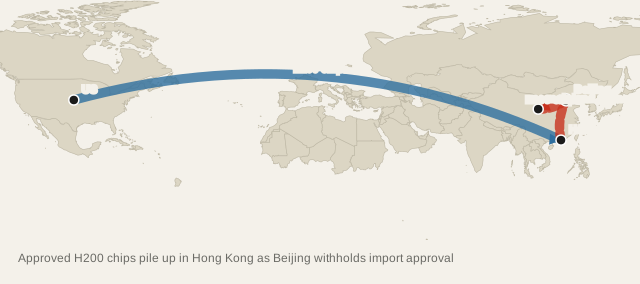
Nvidia's board opened a formal independent probe on Nov 8-9 into reports CEO Jensen Huang was targeted by a Chinese intelligence recruitment effort, with Huang memo acknowledging personal misconduct and pledging cooperation. The move shifts the story from allegation to on-record corporate and congressional scrutiny, while reports of empty-office H200 approvals and 600,000 chips idled in Hong Kong show US export-control enforcement and China's import politics both under strain. Confidence is high on the probe and memo; the spy-recruitment and chip-pile claims remain intelligence and press reporting, not charged or confirmed.
New · researched reported
- Escalated: From Nov 6 allegation to Nov 8-9 on-record action Nvidia board investigation and Huang memo, plus House briefing request for Nov 18
- New: BIS H200 approvals including empty-office New Matrix and ~600,000 chips idled in Hong Kong…
- New: Explicit leadership risk at Nvidia (50-50 job speculation) affecting enforcement of cloud-access limits
- 9 Novtechcrunch.com ↗
- 8 Novtheverge.com ↗
- 7 Novtheverge.com ↗
- channelnewsasia.com ↗
Watch for
- Nov 11 deadline for Huang to accept or propose alternative date for House closed-door briefing
- Nov 18 joint House briefing on Huang-Alice Huang interactions and Nvidia security protocols
- Nov 17 Nvidia Q3 earnings and any update on H200 China revenue (<1% last quarter) and board probe
- Customs/seizure data from Hong Kong and South Korea on HBM smuggling and any BIS vetting changes for H200 handlers
Economies involved · size, trade, energy, arms · annual estimates
Also watching
- Open-weights race: Muse Spark Open, Nemotron, Beam and on-device models No new developments since 2026-11-08.
- AI agents: labor disruption, rogue behavior, and pushback No new developments since 2026-11-08.
- AI economics and capital: valuations, IPOs and bubble debate No new developments since 2026-11-07.
- AI-enabled hacking and agentic cyber offense No new developments since 2026-11-08.
- AI safety governance, evaluation and catastrophic-risk regulation No new developments since 2026-11-07.
- Gemini 4 Argon frontier push and challengers No new developments since 2026-11-06.
Steady
- AI for scientific discovery and biotech drug development AI agents continue to be pitched for end-to-end scientific and drug-discovery work — cheminformatics, wet-lab handling and in-silico drug design — with no new downstream biological results or safety validation beyond the Nov 3-4 executions.
- Neocloud financing stress and chip challengers to Nvidia Debt-funded neoclouds and data-center expansion still face elevated capital costs and broad community siting opposition after the Nov 6 selloff, with no new Texas moratorium, financing deal, or grid rule confirmed and only another local protest against a Google site reported.
- Scraping, licensing and liability for AI training and overviews Google's tying of K-12 Search to AI Overviews/Mode remains contested and licensing liability for AI training remains pressured, with no district defection, Google revision, or regulator action confirmed.
Quiet
- Character.AI bankruptcy and Disney acqui-hire last change Mon, 19 Oct 2026
Situations: each story's living file → · All AI days → · AI benchmarks: the scores behind this report → · Explore →