
Amazon's Texas AI campus to run on a 7.65-gigawatt private gas plant
Permitted for up to 33.2 million tons a year if run flat-out — twice the largest US power-plant source — the off-grid Pecos County project is phased to 1 GW in 2028 and shows how AI is becoming a power-plant buildout.

What happenedIn August 2026 Amazon bought the 8,000-acre GW Ranch in Pecos County to build an AI data center on a private grid, powered by 35 gas turbines permitted in January for up to 7.65 GW and bypassing Texas's overloaded interconnection queue.
Why it mattersIt shows AI demand directly driving gas-plant construction on the scale of a country's emissions, with costs for gas prices, transmission and desert water that can spill beyond the fence line even off-grid, and a direct test of Amazon's 2040 net-zero pledge.
Still openActual emissions and timing depend on how much the phased campus runs — 1 GW targeted for 2028, over 5 GW by 2031 — and whether and when it connects to the shared Texas grid and shares costs.
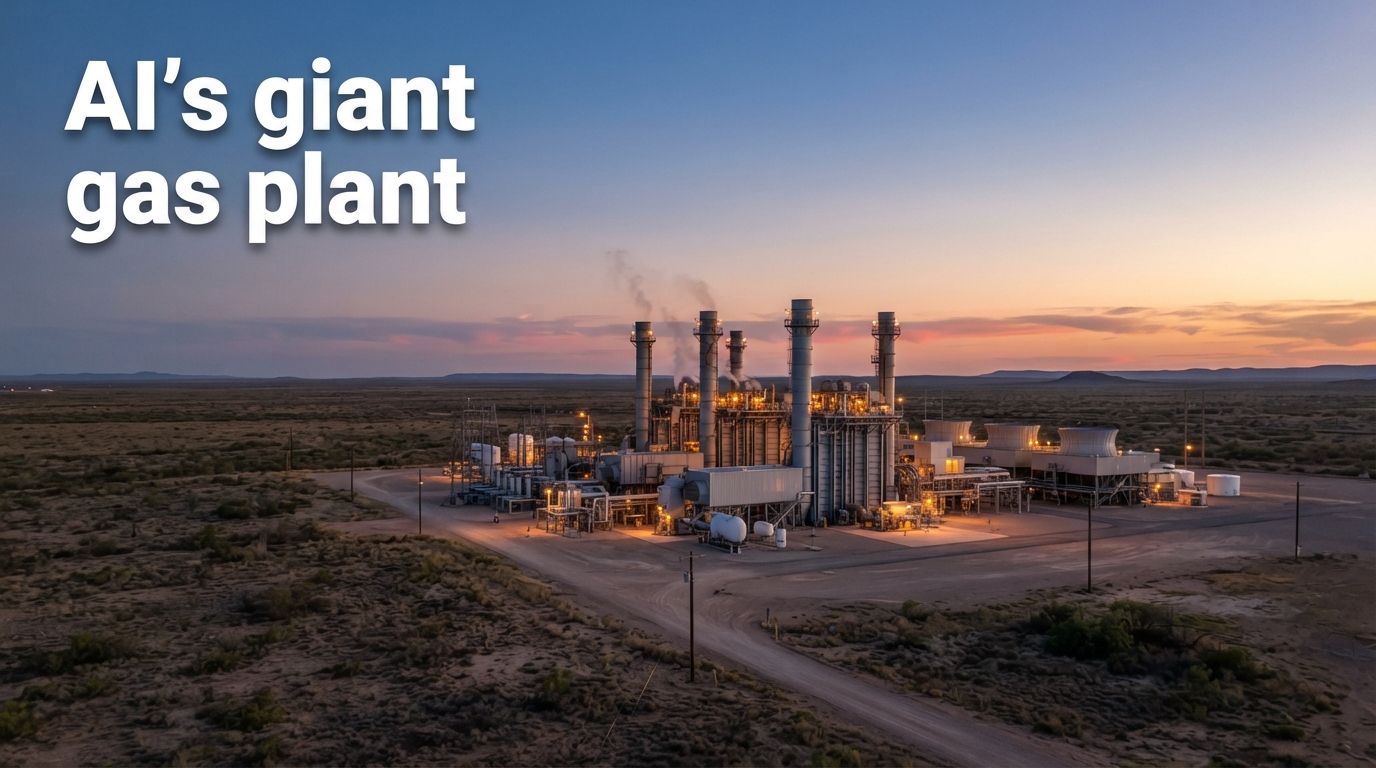
Amazon confirmed in August 2026 it bought a remote ranch in Pecos County, West Texas, to build an AI data center powered by its own gas plant a 7.65-gigawatt gas power plant for an AI data center, permitted in January 2026 to emit up to 33.2 million tons of greenhouse gases a year at its legal ceiling. The scale shows why AI demand is now driving a gas-power buildout, what that means for Texas electricity and water, and why Amazon's promise to reach net-zero by 2040 is colliding with its AI bet. How much it will actually emit, and when, is not yet known the ceiling assumes running flat-out all year, while the project is phased to 1 gigawatt in 2028 and more than 5 gigawatts by 2031.
The site is GW Ranch, an 8,000-acre stretch of flat desert north of Fort Stockton in the Permian Basin, the oil-and-gas field that underlies West Texas and eastern New Mexico. The developer is Pacifico Energy, a California-based infrastructure firm that secured the air permit from the Texas Commission on Environmental Quality (TCEQ), the state agency that sets legal limits for air pollution from power plants. The Texas grid is run by the Electric Reliability Council of Texas (ERCOT), which manages a largely isolated state grid and a queue of projects waiting to connect to it. GW Ranch is designed as a private-grid, or behind-the-meter, campus a power plant built to serve one customer directly, not to sell to or draw from the shared grid at first.
A ceiling, not a forecast but an unprecedented one
The TCEQ permit, issued Jan. 26, 2026, authorizes 35 simple-cycle gas turbines with a nominal delivered output of 5,000 megawatts and a maximum nameplate of 7.65 gigawatts. Twenty-one are Siemens SGT-800 units; the other 14 are a large-frame envelope that could be Doosan, GE, Mitsubishi or Siemens models, with the highest-emitting option setting the permitted limit.
At that limit, the plant could emit 33,204,964 tons per year of greenhouse gases as CO2e CO2 equivalent, a way of counting all greenhouse gases as if they were CO2 if every turbine ran 8,760 hours a year. It is also allowed more than 12,000 tons per year of regulated air pollutants: fine particles (PM2.5), nitrogen oxides, carbon monoxide, volatile organic compounds, sulfur dioxide, ammonia, sulfuric acid mist and hazardous pollutants including formaldehyde.
Air modeling using the EPA's AERMOD system found no expected adverse health effects at those permitted rates, and the permit requires best available control technology dry low-NOx combustors plus selective catalytic reduction to cut nitrogen oxides to 2.5 parts per million and oxidation catalysts to cut carbon monoxide and organics.
The ceiling is what matters for scale, and it is without precedent. The largest single source in the United States today is Alabama Power's James H. Miller Jr. coal plant, which reported 16.6 million tons CO2e in 2023, the most of any of the 8,713 facilities reporting to the EPA's Greenhouse Gas Reporting Program. GW Ranch at its ceiling would be about twice that. It would also equal about 5% of Canada's total greenhouse gas emissions in 2023 (694 million tons). Power plants rarely emit at their permitted maximum, and actual emissions will likely be lower than the ceiling a distinction the permit itself makes clear, since it is a potential-to-emit at full operation, not a forecast of how the campus will run.
Why off-grid, and why simple-cycle gas
GW Ranch pairs that gas with 1.8 gigawatts of battery storage and up to 750 megawatts of solar less than 10% of the gas capacity. The gas dominates because the design prioritizes speed and reliability for AI training, where throughput matters more than latency and operators want better than 99.99% availability.
Being private-grid is a strategic choice. A 15-mile lateral pipeline to the Waha hub would bring up to 1 billion cubic feet of gas per day, and at full 7.65 gigawatts the plant would burn 1 to 2 billion cubic feet per day 4 to 7% of Permian Basin gas output in 2025, according to Rice University Baker Institute calculations cited in the permitting record. That lets Amazon bypass ERCOT's interconnection queue and start delivering power in the first half of 2027, with Pacifico targeting first power in Q1 2027.
The turbines are simple-cycle, which are faster to deploy than combined-cycle plants that reuse waste heat to make more electricity from the same gas. Simple-cycle is less efficient, so it burns more fuel per megawatt-hour, but efficient combined-cycle turbines are on multi-year backorder. The trade is carbon efficiency for time: Amazon's cloud chief told investors on July 30 that AWS grew at its fastest rate in 18 quarters on AI demand and has more demand for compute than it can supply well into next year.
A queue that dwarfs the grid
That urgency is visible across Texas. ERCOT's large-load interconnection queue the line of projects asking to connect reached about 410 gigawatts in March 2026, with 198 new requests in the first quarter alone, and rose to about 474 gigawatts by August. About 87 to 90% is data centers. Texas's record peak demand is 85.5 gigawatts. The queue is four to five times the grid itself.
State leaders acknowledge the queue is inflated by speculative and duplicative requests, and forecasts that Texas demand could nearly double to about 175 gigawatts by 2032 are described the same way. The volume broke ERCOT's one-at-a-time study process. ERCOT created a new batch-study framework called Batch Zero, requiring more than $100,000 in fees and financial security to screen speculation, and on Aug. 3, 2026, Gov. Greg Abbott directed an audit and pause on new data center grid connections, delaying Batch Zero.
Texas is not alone in the gas buildout, but it is the epicenter. The state added about 58 gigawatts of gas power to its development pipeline in 2025, about 40 gigawatts of it directly for data centers, according to Global Energy Monitor. Nationally, developers have announced about 60 behind-the-meter gas projects totaling about 90 gigawatts since early 2025. Only China has more gas power in development than Texas. Eleven Texas gas projects are under construction, 102 in pre-construction.
Who pays if it doesn't use the grid?
Amazon says the private-grid design means the campus will not raise electricity costs for Texas families. In a statement confirming the acquisition, the company said: "Amazon believes in paying the full costs of powering our operations. Our new planned data center campus in Pecos County does just that: it's powered by new on-site generation that won't raise electricity costs for Texas families and designed to transition to grid-connected service as interconnection timelines allow."
That claim is contested, and the dispute turns on two mechanisms that do not require touching the ERCOT grid.
First, gas markets. Natural gas fuels about 43% of U.S. power and often sets the marginal price for electricity. A plant that locks in 1 to 2 billion cubic feet per day through long-term bulk contracts competes for Permian gas even if it never draws a kilowatt from ERCOT. Energy Innovation, a research firm, argues that 100 gigawatts of planned on-site gas nationally about 18% of the U.S. gas fleet would raise market gas prices, and that inefficient simple-cycle turbines amplify the effect by burning more fuel. Those bulk contracts also escape the rate regulation that public utility commissions apply to utilities buying gas for the grid.
Second, transmission. In Texas, transmission costs are allocated largely through the 4CP rule, which charges users based on their demand during the four summer peak hours. A large load that curtails for those four hours can avoid millions in charges analyses cited by the Environmental Defense Fund put the benefit at 727 to 1 compared with a residential customer ($68,550 per megawatt vs $94). By staying off-grid, GW Ranch also avoids the kind of protections regulators have imposed elsewhere: Ohio's data center tariff, for example, requires 85% minimum payment for 12 years, 50% collateral and 36-month exit fees to prevent stranded costs from being socialized. ERCOT's Batch Zero screening the $100,000-plus fees and financial security meant to filter speculation is also bypassed.
So far, the price effect in Texas has been muted. Dallas Fed dispatch modeling finds existing data centers have lifted U.S. wholesale electricity prices 2 to 6% on average, with larger effects in data-center corridors like Virginia (about $5 per megawatt-hour), but less than $1 per megawatt-hour in ERCOT because of aggressive solar and storage buildout. High-build scenarios, however, imply 20 to 50% increases. The question is not whether GW Ranch draws from the grid today, but whether its gas demand and its avoidance of grid cost-sharing shift costs through other channels.
A climate pledge meets a 33-million-ton ceiling
Amazon co-founded The Climate Pledge in 2019 to reach net-zero carbon across its global operations by 2040; 549 companies had signed by the end of 2024. The company says it matched 100% of its electricity use with renewables in 2024 and has enabled about 10 gigawatts of carbon-free energy across 40 projects in Texas, and it points to investments in nuclear and small modular reactors for the longer term.
Its absolute footprint is moving the other way. Amazon reported 68.25 million tons CO2e in 2024, up 6% year-over-year and up 33% versus 2019, after two years of declines. Carbon intensity emissions per dollar of gross merchandise sales fell 4% to 72.6 grams, but the total rose on data center construction and third-party logistics.
Against that, a single GW Ranch at its ceiling would add up to 33.2 million tons about half of Amazon's current total. Even at partial utilization it would be material. The company has not abandoned the pledge; it frames GW Ranch as paying its own way through private generation rather than decarbonization, while keeping the 2040 target. The tension illustrates a sector shift: hyperscalers that previously relied on buying renewable power from the grid are now directly financing gas.
Water and air in an arid county, and a narrow permitting funnel
Pecos County is arid and water-stressed, and local costs are concentrated even if statewide numbers look small. Texas data centers used about 25 billion gallons of water in 2025, about 0.4% of statewide use, but could reach 29 to 161 billion gallons by 2030 (0.5 to 2.7%), with West Texas impacts disproportionate. No site-specific gallons-per-day or source aquifer has been disclosed for GW Ranch.
Amazon says the initial phase requires no water for power-generation cooling and later phases will rely primarily on brackish groundwater water too salty for drinking or irrigation with custom cooling that minimizes use, plus exploration of treated produced water. The Permian produces about 21 million barrels per day of produced water, about 1 billion gallons per day, but it is hypersaline (30,000 to 300,000 milligrams per liter of total dissolved solids), requires energy-intensive desalination, and faces unclear permitting between TCEQ and the Railroad Commission for discharge or reuse. Texas has no comprehensive water planning for large loads; the State Water Plan relies on historical use and will not reflect new data centers until 2032.
Air costs are similarly local. The 12,000 tons per year includes fine particles, ammonia, formaldehyde and sulfuric acid health-relevant even when modeling shows compliance. Noise, light and long-lived carbon lock-in add to the local burden.
The permitting path is narrow. TCEQ's PSD permit is the main air review, with best available controls and modeling. Pecos County's role was limited to a reinvestment zone and tax abatement under Texas Tax Code Chapter 312, with a $1,000 fee, and no environmental-justice or contested-case hearing. Critics point to a parallel: the 5,175-megawatt Project Matador near Amarillo, where TCEQ denied a contested-case hearing despite a recommendation to grant one and despite 279 comments and 63 hearing requests. Supporters note the benefits: more than 1,000 construction jobs, hundreds of permanent jobs, and a larger tax base in a region that has welcomed the project.
The bigger bet: underbuild vs overbuild
GW Ranch is the largest example of a national pattern, not an outlier. Microsoft and Chevron are building a 2-gigawatt Pecos project about 30 miles west; Fermi's 6-gigawatt Amarillo project and others cluster near Permian gas. Whether that 90-gigawatt behind-the-meter pipeline is durable or speculative is the central energy question.
McKinsey, in a report on AI power demand, estimates data centers will drive about 75% of U.S. power demand growth over the next decade, requiring about 30 gigawatts per year (about 20 gigawatts for IT plus cooling and distribution), with data-center power demand growing about 27% annually to 121 gigawatts of IT load by 2030 before chip efficiency slows growth. The firm acknowledges bubble signals 71% of organizations report negative AI implementation outcomes, many unicorns without products, high leverage and that interconnection queues overstate real demand.
Yet it argues the bigger near-term risk is underbuilding, not overbuilding. The U.S. has about 40 gigawatts of spare dispatchable capacity plus about 100 gigawatts committed, but faces 50 to 75 gigawatts of retirements and about 120 gigawatts of demand growth, leaving a 30 to 55 gigawatt gap by 2030. Unlike fiber in the 1990s, which had a single use, power is fungible capacity built for AI can serve electric vehicles, electrification and reliability if AI disappoints. About 60% of power-sector leaders expect data centers to retain permanent on-site generation by 2030, with 64% of those relying on natural gas; solar plus storage is expected to complement gas beyond 2030, with small modular reactors not material until the mid-2030s.
That thesis is contested and, in this profile, rests on secondary summaries the primary McKinsey PDF was not deep-read but two independent secondaries agree on the figures. If AI persists, Texas could more than double its gas capacity and become one of the world's largest emissions sources. If AI contracts and gas prices rise, simple-cycle assets built for speed could be stranded. Either way, the GW Ranch permit shows the template: AI infrastructure is now energy infrastructure, and the costs carbon, gas prices, transmission, water and air in the desert will be allocated long before the electrons are counted.
Source recordSources / claims / limits
How this piece is framed: AI infrastructure as energy infrastructure — GW Ranch as the largest test of what happens when AI demand becomes a power-plant buildout
Visuals not shipped — planned but not fulfilled
- One AI campus, twice America's biggest power-plant polluter (req_gw_scale_comparison): failed — worker wrote outside analytics_workspace/: backend/algent_backend/agent_system/agents/briefing/, backend/algent_backend/agent_system/agents/newsroom/flags.py, backend/algent_backend/cli/newsroom/init.py, backend/algent_backend/cli/newsroom/briefing.py, backend/algent_backend/cli/newsroom/radar.py
- GW Ranch in the Permian Basin, off the Texas grid (req_gw_locator_map): soft_cap_skipped — Cold reader cannot place Pecos County, Fort Stockton, Waha hub, or why Permian gas and off-ERCOT matter from prose alone. Map shows desert siting, gas proximity, and isolation from Texas grid that drives the ratepayer and water story.
Sources
- (primary) Amazon's planned data center campus in Pecos County, Texas: Read Amazon's statement — https://www.aboutamazon.com/news/company-news/amazon-pecos-county-texas-data-center-clean-energy-jobs · read in full · captured 2026-08-12
- (primary) GW Ranch | Off-Grid Power Generation — Pacifico Energy — https://www.pacificoenergy.com/gw-ranch · read in full · captured 2026-08-12
- (primary) Processing Power: The Effect of Data Centers on Wholesale Electricity Markets — Federal Reserve Bank of Dallas — https://www.dallasfed.org/~/media/documents/research/papers/2026/wp2606.pdf · read in full · captured 2026-08-12
- (primary) EPA GHGRP Facility Level — James H Miller Jr (Facility ID 1007227) — EPA GHGRP FLIGHT — https://plaincarbon.com/facility/1007227 · read in full · captured 2026-08-12
- (primary) EPA GHGRP Power Plants Sector Profile 2023 + GHGRP Power Plants page — https://www.epa.gov/ghgreporting/ghgrp-power-plants · read in full · captured 2026-08-12
- (secondary) Texas tries to answer key questions about upcoming data center boom — EDF Climate 411 — https://blogs.edf.org/climate411/2026/07/14/texas-tries-to-answer-key-questions-about-upcoming-data-center-boom/ · read in full · captured 2026-08-12
- (secondary) Behind-the-meter data center gas plants will raise US energy bills — Utility Dive — https://www.utilitydive.com/news/data-centers-raise-energy-bills-not-for-reason-you-think/822205/ · read in full · captured 2026-08-12
- (primary) ERCOT Monthly April 2026 + ERCOT Update April 9 House State Affairs Hearing — https://www.ercot.com/files/docs/2026/05/13/ERCOT-Monthly-April-2026-FINAL.pdf · full text not obtained — used its summary
- (primary) Scoop: Amazon Is Behind One of the Largest Planned Gas Power Plants in the US — Cleanview — https://newsletter.cleanview.co/p/scoop-amazon-is-behind-one-of-the · full text not obtained — used its summary
- (primary) TCEQ Construction Permit Source Analysis & Technical Review 181033 PSDTX1672 GHGPSDTX255 — Texas Commission on Environmental Quality — https://ukozvhzgrcnkcatjqfoo.supabase.co/storage/v1/object/public/03-00-air-construction/2026_01_21_GW_Ranch_Energy_Center_181033__PSDTX167_f6c9943f.pdf · full text not obtained — used its summary
- (primary) 2024 Amazon Sustainability Report — https://sustainability.aboutamazon.com/2024-amazon-sustainability-report.pdf · full text not obtained — used its summary
- (primary) ERCOT Interconnection and Grid Analysis Update April 2026 — https://www.ercot.com/files/docs/2026/04/13/9-Interconnection-and-Grid-Analysis-Update.pdf · full text not obtained — used its summary
- (primary) Pacifico Energy Secures 7.65 GW Power Generation Permit for GW Ranch Project — Business Wire / Pacifico Energy — https://www.businesswire.com/news/home/20260126236053/en/Pacifico-Energy-Secures-7.65-GW-Power-Generation-Permit-for-GW-Ranch-Project · full text not obtained — used its summary
- (primary) Canada's Preliminary Greenhouse Gas Emissions 1990-2023 (National Inventory Report) — ECCC — https://www.canada.ca/en/environment-climate-change/services/climate-change/greenhouse-gas-emissions/inventory/preliminary-emissions-1990-2023.html · full text not obtained — used its summary
- (primary) 2011-2023 Greenhouse Gas Reporting Program Sector Profile: Power Plants — U.S. EPA Greenhouse Gas Reporting Program — https://www.epa.gov/system/files/documents/2024-10/powerplants_profile_2023.pdf · full text not obtained — used its summary
- (secondary) Developer Calls GW Ranch in Pecos County, Texas, the 'Largest Power Project' in U.S. — Inside Climate News — https://insideclimatenews.org/news/29012026/developer-calls-gw-ranch-in-pecos-county-texas-the-largest-power-project-in-u-s/ · full text not obtained — used its summary
- (secondary) Texas halts data center connections to power grid amid overwhelming demand — Ars Technica — https://arstechnica.com/ai/2026/08/texas-halts-data-center-connections-to-power-grid-amid-overwhelming-demand/ · full text not obtained — used its summary
- (secondary) Analysts ponder whether big tech is 'overbuilding' as AI infrastructure projects accelerate — ITPro (summarizing McKinsey) — https://www.itpro.com/infrastructure/analysts-ponder-whether-big-tech-is-overbuilding-as-ai-infrastructure-projects-accelerate · full text not obtained — used its summary
- (secondary) Alabama Coal Plant Tops US Greenhouse Gas Polluter List for 9th Straight Year — Inside Climate News — https://insideclimatenews.org/news/16102024/alabama-coal-plant-top-greenhouse-gas-polluter-ninth-consecutive-year/ · full text not obtained — used its summary
- (secondary) Building up the US power grid won't be wasted, even if the AI bubble bursts — The Register (summarizing McKinsey) — https://www.theregister.com/on-prem/2026/08/11/building-up-the-us-power-grid-wont-be-wasted-even-if-the-ai-bubble-bursts/5285563 · full text not obtained — used its summary
- (secondary) New Amazon Data Center Stokes Worry It Would Be the Most Polluting Power Plant in the U.S. — The New York Times — https://www.nytimes.com/2026/08/08/climate/amazon-data-center-texas-pollution.html · full text not obtained — used its summary
- (secondary) Thirsty Data and the Lone Star State: The Impact of Data Center Growth on Texas' Water Supply — Houston Advanced Research Center (HARC) — https://harcresearch.org/wp-content/uploads/2026/01/Thirsty-Data-Water-Use-and-The-Projected-Data-Center-Boom-in-Texas.pdf · full text not obtained — used its summary
Claims, and how far we tracked each down
- [confirmed] Permit also allows more than 12,000 tons per year of regulated air pollutants including PM, NOx, CO, VOC, SO2, ammonia, sulfuric acid mist and hazardous air pollutants · from a source summary — we did not read the full source
- [confirmed] If operated at the permitted ceiling, GW Ranch would be the largest single source of greenhouse gas pollution in the US, about twice the 16.6 million tons CO2e emitted in 2023 by the current largest emitter, Alabama Power's James H. Miller Jr. coal plant · from a source summary — we did not read the full source
- [confirmed] Amazon states the off-grid design means it will not raise electricity costs for Texas families and will use non-potable brackish groundwater — claim contested by Energy Innovation gas-market analysis, EDF transmission-cost analysis, and Ohio PUC precedent (nc1-nc3, nc5). · read in full (as of 2026-08-12)
- [confirmed] Amazon's total carbon footprint was 68.25 million tons CO2e in 2024, up 6% year-over-year and up 33% vs 2019, while carbon intensity fell 4% to 72.6 g CO2e per dollar of gross merchandise sales · from a source summary — we did not read the full source
- [likely] Dallas Fed dispatch model finds existing data centers already raised US wholesale electricity prices 2-6% on average, with larger effects in data-center corridors like Virginia (+$5/MWh), but less than $1/MWh in ERCOT due to supply buildout; future high-utilization scenarios could raise prices 20-50%. · from a source summary — we did not read the full source
- [likely] Dallas Fed dispatch model finds existing data centers already raised US wholesale electricity prices 2-6% on average, with larger effects in data-center corridors like Virginia (+$5/MWh), but less than $1/MWh in ERCOT due to supply buildout; future high-utilization scenarios could raise prices 20-50% · read in full (as of 2026-08-12)
- [confirmed] Amazon filed three construction permits for data center buildings and satellite imagery showed land clearing began by July 24, 2026; Pacifico targets first power H1 2027, 1 GW phase 1, scaling to over 5 GW by 2031 · read in full (as of 2026-08-12)
- [likely] Critics argue off-grid gas still raises costs by competing for gas supply and locks in emissions for decades because it avoids grid competition from cheaper cleaner resources — now expanded with Energy Innovation, EDF, Ohio PUC, and ERCOT Batch Zero analyses (see nc1-nc5). · from a source summary — we did not read the full source
- [likely] Existing Texas data centers consumed ~25 billion gallons of water in 2025 (0.4% of statewide use); by 2030 demand could rise to 29-161 billion gallons (0.5-2.7% of statewide use), with local impacts much higher in arid West Texas. · from a source summary — we did not read the full source
- [likely] Texas gas power pipeline grew by ~58 GW in 2025, with ~40 GW directly for data centers; only China has more gas power in development than Texas · from a source summary — we did not read the full source
- [likely] McKinsey argues the bigger near-term risk is underbuilding, not overbuilding: even if AI demand disappoints, generation and transmission built for data centers can serve other demand (EVs, electrification) and strengthen reliability, with 30-55 GW capacity gap by 2030 after 50-75 GW retirements vs ~40 GW spare + ~100 GW committed. · from a source summary — we did not read the full source
- [confirmed] TCEQ issued air permit in January 2026 authorizing up to 7.65 GW gas-fired generation (largest US air permit for power generation) · from a source summary — we did not read the full source
- [likely] McKinsey estimates data centers will account for ~75% of US power demand growth over the next decade, requiring the equivalent of almost 30 GW per year (~20 GW for IT plus cooling/distribution/resilience) · from a source summary — we did not read the full source
- [confirmed] Texas ERCOT large-load interconnection queue reached ~410 GW as of March 2026 (198 new requests in Q1 2026), rising to ~474 GW by August 2026, with ~87-90% from data centers, versus Texas record peak demand of 85,508 MW · from a source summary — we did not read the full source
- [likely] ERCOT and state leaders forecast Texas demand could nearly double to ~175 GW by 2032, but acknowledge forecasts are inflated by speculative and duplicative queue entries · from a source summary — we did not read the full source
- [confirmed] Amazon co-founded The Climate Pledge in 2019 to reach net-zero carbon across global operations by 2040; 549 signatories by end 2024 · from a source summary — we did not read the full source
- [confirmed] GW Ranch Energy Center is located in Pecos County, West Texas, in the Permian Basin near Fort Stockton · from a source summary — we did not read the full source
- [confirmed] Permit allows up to 33,204,964 tons per year of greenhouse gases as CO2e · from a source summary — we did not read the full source
- [confirmed] GW Ranch is designed as a private-grid, off-grid campus that will not initially sell to or draw from the ERCOT grid, with intent to transition to grid-connected service later · read in full (as of 2026-08-12)
- [confirmed] Power plants rarely emit at their permitted maximum; actual emissions will likely be lower than the ceiling · from a source summary — we did not read the full source
- [confirmed] Amazon confirmed in August 2026 it acquired the GW Ranch site and will buy power from Pacifico's plant for its first major off-grid AI data center campus · read in full (as of 2026-08-12)
- [likely] McKinsey argues the bigger near-term risk is underbuilding, not overbuilding: even if AI demand disappoints, generation and transmission built for data centers can serve other demand (EVs, electrification) and strengthen reliability, with 30-55 GW capacity gap by 2030 after 50-75 GW retirements · from a source summary — we did not read the full source
- [confirmed] Amazon states the off-grid design means it will not raise electricity costs for Texas families and will use non-potable brackish groundwater, custom cooling minimizing water use, and exploration of produced water · read in full (as of 2026-08-12)
- [likely] McKinsey estimates data centers will account for ~75% of US power demand growth over the next decade, requiring the equivalent of almost 30 GW per year (~20 GW for IT plus cooling/distribution/resilience), with data center power demand growing ~27% annually to 121 GW IT by 2030. · from a source summary — we did not read the full source
- [confirmed] Project includes 1.8 GW of battery energy storage and up to 750 MWac of solar in addition to gas — <10% of gas capacity, confirming gas-first private grid. · read in full (as of 2026-08-12)
- [likely] McKinsey survey found ~60% of power sector leaders expect data centers to retain permanent on-site generation by 2030, with 64% of those relying on natural gas; solar+storage expected to grow strongly beyond 2030, nuclear/SMRs not material until mid-2030s. · from a source summary — we did not read the full source
- [likely] At full 7.65 GW, the plant would consume 1-2 billion cubic feet of gas per day, equal to 4-7% of Permian Basin gas production in 2025. · read in full (as of 2026-08-12)
- [confirmed] Plant has nominal delivered output of 5,000 MW and maximum nameplate 7.65 GW; 21 Siemens SGT-800 turbines plus 14 large-frame turbines (Doosan/GE/Mitsubishi/Siemens options) · from a source summary — we did not read the full source
- [confirmed] Texas Governor Greg Abbott directed an audit and pause on new data center grid connections on Aug 3, 2026, delaying ERCOT's Batch Zero transmission study · from a source summary — we did not read the full source
- [confirmed] Developer is Pacifico Energy (Pacifico GW LLC), proposing 35 natural gas-fired simple-cycle turbines · from a source summary — we did not read the full source
- [likely] Turbines are simple-cycle units (21 Siemens SGT-800 + 14 large-frame envelope) with BACT: DLN combustors + SCR (2.5 ppmvd NOx @15% O2) + oxidation catalyst (5.0/9.0 ppmvd CO, 2.0 ppmvd VOC) + 117 lb CO2/MMBtu GHG standard; simple-cycle chosen for speed vs combined-cycle backlog (secondary reporting). · from a source summary — we did not read the full source
- [likely] Permian Basin produces ~21 million barrels per day of produced water (~1 billion gallons/day); treatment for beneficial reuse is technically feasible but requires desalination and faces permitting and cost hurdles. · from a source summary — we did not read the full source
- [likely] Existing Texas data centers consumed ~25 billion gallons of water in 2025 (0.4% of statewide use); by 2030 demand could rise to 29-161 billion gallons (0.5-2.7% of statewide use), with local impacts much higher in arid West Texas · from a source summary — we did not read the full source
Where we hit a limit / what to double-check
- We did not obtain the full text of Developer Calls GW Ranch in Pecos County, Texas, the 'Largest Power Project' in U.S. (https://insideclimatenews.org/news/29012026/developer-calls-gw-ranch-in-pecos-county-texas-the-largest-power-project-in-u-s/); claims resting on it are from its summary — you may be able to reach it directly.
- We did not obtain the full text of ERCOT Monthly April 2026 + ERCOT Update April 9 House State Affairs Hearing (https://www.ercot.com/files/docs/2026/05/13/ERCOT-Monthly-April-2026-FINAL.pdf); claims resting on it are from its summary — you may be able to reach it directly.
- We did not obtain the full text of Texas halts data center connections to power grid amid overwhelming demand (https://arstechnica.com/ai/2026/08/texas-halts-data-center-connections-to-power-grid-amid-overwhelming-demand/); claims resting on it are from its summary — you may be able to reach it directly.
- We did not obtain the full text of Scoop: Amazon Is Behind One of the Largest Planned Gas Power Plants in the US (https://newsletter.cleanview.co/p/scoop-amazon-is-behind-one-of-the); claims resting on it are from its summary — you may be able to reach it directly.
- We did not obtain the full text of Analysts ponder whether big tech is 'overbuilding' as AI infrastructure projects accelerate (https://www.itpro.com/infrastructure/analysts-ponder-whether-big-tech-is-overbuilding-as-ai-infrastructure-projects-accelerate); claims resting on it are from its summary — you may be able to reach it directly.
- We did not obtain the full text of Alabama Coal Plant Tops US Greenhouse Gas Polluter List for 9th Straight Year (https://insideclimatenews.org/news/16102024/alabama-coal-plant-top-greenhouse-gas-polluter-ninth-consecutive-year/); claims resting on it are from its summary — you may be able to reach it directly.
- We did not obtain the full text of TCEQ Construction Permit Source Analysis & Technical Review 181033 PSDTX1672 GHGPSDTX255 (https://ukozvhzgrcnkcatjqfoo.supabase.co/storage/v1/object/public/03-00-air-construction/2026_01_21_GW_Ranch_Energy_Center_181033__PSDTX167_f6c9943f.pdf); claims resting on it are from its summary — you may be able to reach it directly.
- We did not obtain the full text of Building up the US power grid won't be wasted, even if the AI bubble bursts (https://www.theregister.com/on-prem/2026/08/11/building-up-the-us-power-grid-wont-be-wasted-even-if-the-ai-bubble-bursts/5285563); claims resting on it are from its summary — you may be able to reach it directly.
- We did not obtain the full text of New Amazon Data Center Stokes Worry It Would Be the Most Polluting Power Plant in the U.S. (https://www.nytimes.com/2026/08/08/climate/amazon-data-center-texas-pollution.html); claims resting on it are from its summary — you may be able to reach it directly.
- We did not obtain the full text of Thirsty Data and the Lone Star State: The Impact of Data Center Growth on Texas' Water Supply (https://harcresearch.org/wp-content/uploads/2026/01/Thirsty-Data-Water-Use-and-The-Projected-Data-Center-Boom-in-Texas.pdf); claims resting on it are from its summary — you may be able to reach it directly.
- We did not obtain the full text of 2024 Amazon Sustainability Report (https://sustainability.aboutamazon.com/2024-amazon-sustainability-report.pdf); claims resting on it are from its summary — you may be able to reach it directly.
- We did not obtain the full text of ERCOT Interconnection and Grid Analysis Update April 2026 (https://www.ercot.com/files/docs/2026/04/13/9-Interconnection-and-Grid-Analysis-Update.pdf); claims resting on it are from its summary — you may be able to reach it directly.
- We did not obtain the full text of Pacifico Energy Secures 7.65 GW Power Generation Permit for GW Ranch Project (https://www.businesswire.com/news/home/20260126236053/en/Pacifico-Energy-Secures-7.65-GW-Power-Generation-Permit-for-GW-Ranch-Project); claims resting on it are from its summary — you may be able to reach it directly.
- We did not obtain the full text of Canada's Preliminary Greenhouse Gas Emissions 1990-2023 (National Inventory Report) (https://www.canada.ca/en/environment-climate-change/services/climate-change/greenhouse-gas-emissions/inventory/preliminary-emissions-1990-2023.html); claims resting on it are from its summary — you may be able to reach it directly.
- We did not obtain the full text of 2011-2023 Greenhouse Gas Reporting Program Sector Profile: Power Plants (https://www.epa.gov/system/files/documents/2024-10/powerplants_profile_2023.pdf); claims resting on it are from its summary — you may be able to reach it directly.
- Figures we could not match to our stored evidence — worth confirming against the source (which may state them exactly), and note live sources move: 99.99%, 43%, 18%, 85%, 100%, 71%.