
Bronze Age Greek elites wore rings forged from meteorite iron
A five-year scan of 91 objects finds the rare metal reserved for signet rings for 500 years and gone after about 1200 BCE, but the Egyptian desert source remains a plausible guess without a chemical match.


What happenedA five-year handheld XRF survey of 91 Bronze Age iron objects from 33 sites in Greece and Crete identified about ten 17th- to 12th-century BCE elite signet rings made from nickel-rich meteoritic iron.
Why it mattersIt reveals a 500-year prestige economy that moved rare sky-iron long distances for elite display, then vanished with the palatial collapse that sustained it, clearing the way for everyday smelted iron.
Still openNo trace-element or isotopic fingerprint yet ties the metal to a specific desert strewn field such as Gebel Kamil, and three of thirteen nickel-bearing rings still await confirmatory testing.
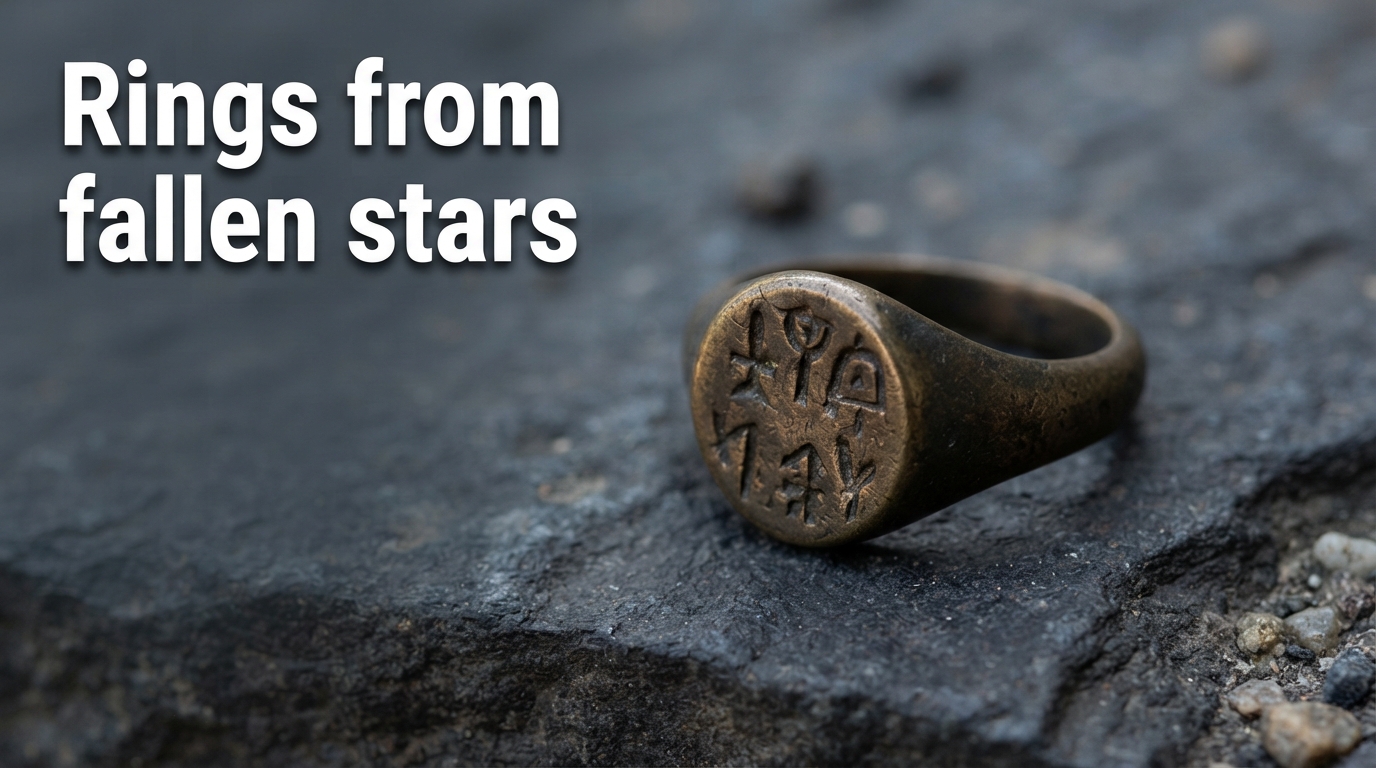
About ten signet rings buried with Bronze Age Greek elites were not made from ore at all, but from iron that fell from space — iron from meteorites — likely carried hundreds of kilometres from desert regions such as Egypt. A five-year study screened 91 iron objects from 33 sites in Greece and Crete and found that this rare sky-iron was reserved for the powerful for about 500 years, then disappeared when the palatial world that sustained it collapsed. Where that sky-iron actually fell remains unproven: no chemical fingerprint yet ties the rings to any specific desert strewn field.
How meteoritic and smelted iron traded places from the 17th to the 11th century BCE. Counts of iron objects from Bronze Age and Early Iron Age Greece and Crete, sorted by the midpoint of each object's published date range into centuries from the 17th to the 11th–10th BCE. Nickel-bearing pieces (13 rings; about 10 of them probably meteoritic) cluster in the palatial centuries and vanish after the Late Bronze Age collapse ~1200 BCE, while nickel-free smelted iron — rare before the collapse — dominates the 12th–10th centuries. — AI-assisted analytic, built only from real cited or sourced data. Source: Arkeonews, Science News, Greek City Times. As of 2026-08-08.
That is the shape of a study by astrophysicist Matthieu Gounelle, of the Muséum national d'Histoire naturelle in Paris — France's national natural-history museum and meteorite collection — and prehistoric archaeologist Eleni Mantzourani, of the National and Kapodistrian University of Athens, published in August 2026 in the Journal of Archaeological Science.
The reader needs only a few footholds to follow it. Iron from meteorites is iron from fragments of asteroid cores; it naturally contains 5 to 50% nickel, while iron smelted from ore contains almost none. X-ray fluorescence, or XRF, is a hand-held, non-destructive technique that reads that surface chemistry. The Mycenaean civilization was the Late Bronze Age palatial culture of southern Greece (about 1700–1100 BCE), centred on fortified palaces such as Mycenae, whose elites were buried in large beehive-shaped tholos tombs and chamber tombs. The Minoan civilization was its earlier counterpart on Crete (about 2700–1450 BCE), with extensive maritime trade. A signet ring is an engraved ring with a flat bezel used to stamp seals on documents — a mark of authority, not just ornament. The Late Bronze Age collapse, around 1200 BCE, was the system-wide crisis that destroyed palaces and long-distance trade across the eastern Mediterranean.
What a five-year hunt actually found
The team identified 140 putative iron objects of Bronze Age date in the literature and was able to test 91 of them, plus other Early Iron Age pieces for a total of 105 artefacts, across 19 museums. The 91 iron objects came from 33 sites on the mainland, the Peloponnese, the Aegean islands and Crete, dated roughly 2000 to 1000 BCE.
About 86% showed no nickel at all — ordinary smelted terrestrial iron. Thirteen objects contained significant nickel, from about 1% to 50%. Every one of those thirteen was a ring or ring fragment, most with large engraved bezels. Of the thirteen, nine are judged very likely meteoritic, one quite likely, and three still need further examination — summarized as about ten probably meteoritic.
The exclusivity is striking. Eleven of the nickel-rich rings came from richly furnished tholos and chamber tombs in the Peloponnese — at Mycenae, Vapheio, Kakovatos, Aidonia and Dendra — buried with gold vessels, amber jewelry, agate and carved stone seals. One came from Phaistos on Crete and one from the Minoan sanctuary of Anemospilia, on the finger of a man archaeologists interpret as a high-ranking priest. Many are polymetallic, combining iron-nickel with gold, silver or bronze; two examples from Mycenae and Phaistos have bezels split half gold, half iron-nickel, finely engraved. The study adds seven new sites with confirmed meteoritic iron in the eastern Mediterranean — Phaistos, Anemospilia, Mycenae, Vapheio, Kakovatos, Aidonia, Dendra — roughly doubling the previously known seven sites across Egypt, Syria, Lebanon and Türkiye, and increasing the known Bronze Age meteoritic rings roughly tenfold.
Tools are notably absent from the tested iron corpus, and weapons are under-represented. That matters for what the pattern can prove.
How you tell sky iron from earth iron — and why the answer stays preliminary
The diagnostic logic is simple in principle and messy in practice. Iron meteorites retain nickel and cobalt from their parent asteroids; early bloomery smelting from terrestrial ore leaves iron with essentially no nickel. Finding nickel is therefore a good tracer of a meteoritic origin, a standard established by work on Tutankhamun's dagger — shown by Daniela Comelli and colleagues in 2016 to contain about 10.8% nickel and 0.58% cobalt — and by Albert Jambon's 2017 survey that found all tested Bronze Age irons from Gerzeh, Alaca Höyük, Umm el-Marra, Ugarit and Shang China were meteoritic.
The Greek team used portable XRF, the now-favoured non-destructive approach for rare, precious finds. But portable XRF is surface-sensitive, and corrosion preferentially leaches nickel during long burial. Jambon showed that even low nickel — well below the 3.8 to 60.8% range of pristine irons — can still be meteoritic if it plots on a corrected Ni/Fe versus Ni/Co alteration field. The authors apply that correction and flag the limits explicitly: metallographic structure would be definitive but is destructive, and bulk methods that would settle the question — trace elements such as gallium, germanium and iridium, osmium isotopes, or techniques such as MIXE, PIXE and neutron tomography — were not used because transporting 91 fragile, precious objects was impractical. That is why three of the thirteen rings remain ambiguous pending scanning electron microscopy, metallography or isotopic work, and why thresholds in this single, paywalled study remain unreplicated. Nickel alone is a strong but preliminary fingerprint, not a final assay.
Only rings, only the rich — or only what survived?
Two readings fit the same exclusivity, and the piece needs both.
The prestige reading is that these were power objects. Every nickel-bearing object is a signet ring — an instrument of sealing and authority — many bimetallic and labour-intensive, clustered with other valuables. The Anemospilia sanctuary find extends the pattern beyond warrior elites to religious authority. Later smelted iron, by contrast, is rarely gilded and rarely elaborate. As Mantzourani frames it, meteoritic iron was a very precious metal for objects of special value and for a high-status group, its celestial rarity and the knowledge that it came from the sky adding to its conspicuous value.
Where the 91 tested objects were found in Greece and Crete, and the desert regions proposed as the source of the meteorites. Eastern Mediterranean locator map of Bronze Age meteoritic-iron findspots: seven newly confirmed Greek and Cretan sites (Phaistos, Anemospilia, Mycenae, Vapheio, Kakovatos, Aidonia, Dendra) sit far from Egyptian desert sources and from earlier comparative finds at Gerzeh, the Tutankhamun area, Alaca Höyük, Umm el-Marra, and Ugarit. Researchers propose the Aegean rings used imported desert iron, because Greece preserves almost no meteorites while Egypt’s Western Desert (including Gebel Kamil) does. Coordinates are published site centroids; the full list of 33 sampled Greek sites is not open-access, so only named places are plotted. — AI-assisted analytic, built only from real cited or sourced data. Source: Science News, Greek City Times, Arkeonews. As of 2026-08-08.
The bias reading is that the corpus itself skews toward survival. The team tested 91 iron objects from 19 museums of 140 identified; iron weapons and tools corrode, get recycled, and are more likely to be lost when tombs are looted, while jewelry in undisturbed elite tombs survives disproportionately. The temple context at Anemospilia also suggests a ritual or apotropaic meaning — protection, cult use — not tested against wealth display alone. The disappearance after the 12th century could therefore reflect preservation and sampling as well as status. Neither reading alone is proven; the pattern is real, its exclusivity as a social rule is not.
Why Egypt is the best guess — and still a guess
Greece is a poor place to find meteorites. The Meteoritical Bulletin, the authoritative catalogue, lists only one confirmed fall on Greek soil, at Serres in 1818. Greece lacks the hot desert pavement that lets iron meteorites survive for millennia on the surface.
Egypt has the opposite taphonomy. The Bulletin lists 129 approved meteorites from Egypt, including the 1.6-tonne Gebel Kamil iron found in 2009 in the East Uweinat Desert, an ungrouped ataxite with 19.8 wt% nickel, and Kharga at 11.0 wt% nickel. Egyptian deserts can preserve irons for millennia, and Egypt already worked meteoritic iron for two millennia before these rings — hammered beads from Gerzeh around 3200 BCE and Tutankhamun's dagger around 1350 BCE.
Late Bronze Age trade makes movement plausible. Mycenaean pottery has been found in Egypt and Egyptian scarabs and alabaster in the Aegean, part of the vibrant interconnectivity that lasted until the 12th–11th century BCE crisis. High-value raw material routinely moved long distances without the source region retaining much, which the authors offer to explain why very few meteoritic objects have been found in Egypt itself.
But that remains an inference, not a sourcing. The paper proposes — the authors' word — an Egyptian desert source based on scarcity and trade plausibility, and reports no trace-element (gallium, germanium, iridium) or osmium-isotope data matching the rings to Gebel Kamil, Kharga or any other strewn field. The same desert preservation applies to other hot deserts — the Atacama, the broader Sahara, the Arabian desert, the Anatolian plateau, Sinai and the Negev — and the modern Bulletin asymmetry reflects recovery bias and aridity, not a Bronze Age supply route. Jambon's broader survey shows meteoritic iron was used locally across the Near East, at Alaca Höyük, Umm el-Marra and Ugarit, not solely exported from Egypt. Weathered Aegean falls now gone also cannot be excluded without isotopic fingerprinting. The hypothesis is coherent; the geochemical tie is missing.
Two irons, opposite histories
Bronze Age Greece did not have one iron. It had two, for different jobs, on inverse chronologies.
Meteoritic iron was early, rare and ornamental. The fashion began in Crete around the 17th century BCE, reached the Peloponnese by the 16th, and ran through the 12th. Smelted iron was almost absent before the collapse: only two reliably dated smelted objects in the Aegean sample predate it, a pendant from Dendra and a ring from Skoura, both 14th or 13th century BCE. That lags Anatolia, where smelted iron circulated in the Early and Middle Bronze Age.
After the palaces fell, the trajectories cross. All 36 Submycenaean and Protogeometric rings examined from about 1075 BCE onward are smelted terrestrial iron with no nickel, and the material shifts to knives, daggers, swords and unworked fragments — practical, rarely paired with precious metals, generally cruder. The meteoritic rings stop; the smelted iron expands. This is not a simple substitution of one iron for the other in the same objects. One was prestige jewelry; the other became utility. Jambon's claim that before about 1200 BCE meteoritic was the sole iron source holds for the tested Near East, Egypt and China corpus, but the Aegean sample itself shows two early smelted exceptions.
Why the fashion ended with the palaces
The chronology is precise; the causation is interpretive and non-exclusive, and the authors present it that way.
Demand broke when the patrons disappeared. The palatial elite who commissioned and displayed these rings lost wealth or vanished after about 1200 BCE. Supply broke when the network that could have carried desert iron — collection in Egyptian deserts, maritime trade via Crete and the Peloponnese — was disrupted during the same crisis that ended Mycenaean-Egyptian contact for centuries. And fashions fade on their own; as Gounelle puts it in the museum's announcement, he likes the idea of a fashion that simply ended, independent of availability.
The Minoan decline earlier — linked in part to the Thera eruption and Middle Bronze Age disruptions — versus the Mycenaean fall shows the fashion spanned both cultures, so its end is tied to the later, broader system collapse, not a single palace's fate. In that sense the rings are a proxy for a fragile globalization: a luxury that depended on both elite demand and long-distance supply, and that vanished when both failed, clearing the way for abundant terrestrial ore and smaller forges to replace palace-controlled bronze networks. What remains open is exactly how Aegean smiths worked brittle meteoritic metal — cold hammering, hot forging, or mixing with terrestrial iron, analogized to Inuit techniques of detaching fragments with basalt but not demonstrated — and whether a larger, more sensitively tested sample of Early Iron Age iron would change the elite-only picture.
Source recordSources / claims / limits
How this piece is framed: Two irons, one fragile globalization: a prestige 'sky-iron' economy and why it vanished with the palaces
Charts & tables — AI-assisted; provenance on each line
- Sky-iron rings flourished with the palaces, then disappeared as smelted iron took over — sourced for this figure · as of 2026-08-08
- From desert fall to palace ring: where the iron was found and where it likely fell — sourced for this figure · as of 2026-08-08
Sources
- (primary) Handheld Laser-Induced Breakdown Spectroscopy (hLIBS): A Valuable Tool for Terrestrial and Extraterrestrial Recognition of Meteorites in the Field — SpectroscopyOnline — https://www.spectroscopyonline.com/view/handheld-laser-induced-breakdown-spectroscopy-hlibs-a-valuable-tool-for-terrestrial-and-extraterrestrial-recognition-of-meteorites-in-the-field · read in full · captured 2026-08-09
- (primary) Iron in Greece in the second millennium B.C.E. (J. Archaeol. Sci. vol.192, 2026, doi:10.1016/j.jas.2026.106622) abstract/preview — Journal of Archaeological Science — https://www.sciencedirect.com/science/article/abs/pii/S0305440326001524 · read in full · captured 2026-08-09
- (primary) Meteoritical Bulletin: Entry for Gebel Kamil (Egypt, ungrouped, Ni 19.8 wt%, 1.6 t) — Meteoritical Bulletin Database — https://www.lpi.usra.edu/meteor/metbull.php?code=52031 · read in full · captured 2026-08-09
- (primary) Egyptian desert expedition confirms spectacular meteorite impact — European Space Agency — https://www.esa.int/Enabling_Support/Operations/Egyptian_desert_expedition_confirms_spectacular_meteorite_impact · read in full · captured 2026-08-09
- (primary) Meteoritical Bulletin: Entry for Kharga (Egypt, IVA, Ni 11.0 wt%) — Meteoritical Bulletin Database — https://www.lpi.usra.edu/meteor/metbull.cfm?code=12290 · read in full · captured 2026-08-09
- (primary) Bagues en mtorites: une mode de l'ge du bronze? — MNHN — https://www.mnhn.fr/fr/actualites/bagues-en-meteorites-une-mode-de-l-age-du-bronze · read in full · captured 2026-08-09
- (secondary) Bronze Age Iron Artifacts Likely Made from Meteoric Iron: Study — Sci.News — https://www.sci.news/archaeology/bronze-age-artifacts-meteoric-iron-05498.html · read in full · captured 2026-08-09
- (secondary) Before the Iron Age, Most Iron Came From Space — Atlas Obscura — https://www.atlasobscura.com/articles/before-iron-age-most-iron-came-from-space-meteorite-egyptian-bronze · read in full · captured 2026-08-09
- (secondary) The blade that lay against King Tut's mummy... (Comelli 2016 + Jambon 2017 deep-dive) — SpaceDaily — https://spacedaily.com/d-the-blade-that-lay-against-king-tuts-mummy-for-three-thousand-years-turned-out-to-be-extraterrestrial-its-metal-matches-the-composition-of-meteorites-meaning-the-boy-king-was-buried-with-a/ · read in full · captured 2026-08-09
- (secondary) Ancient Greek rings may have been made from iron that fell from space — Greek City Times — https://greekcitytimes.com/2026/08/08/ancient-greek-rings-meteoritic-iron · read in full · captured 2026-08-09
- (secondary) Tutankhamun's knife was 'made from meteorite iron' — BBC News — https://www.bbc.com/news/world-middle-east-36432635 · read in full · captured 2026-08-09
- (secondary) Ancient Greek rings may have been forged with iron from meteorites — Science News — https://www.sciencenews.org/article/bronze-age-greek-rings-iron-meteorites · read in full · captured 2026-08-09
- (secondary) Bronze Age Greek Rulers Wore "Space Bling" — Arkeonews — https://arkeonews.net/bronze-age-greek-rulers-wore-space-bling · read in full · captured 2026-08-09
- (secondary) Power Objects in Royal Tombs: The Rings of the Mycenaean and Minoan Elite Were Forged with Meteorite Iron — La Brjula Verde — https://www.labrujulaverde.com/en/2026/07/power-objects-in-royal-tombs-the-rings-of-the-mycenaean-and-minoan-elite-were-forged-with-meteorite-iron · read in full · captured 2026-08-09
- (secondary) Mediterranean Encounters | Egypt and the Classical World — Getty — https://www.getty.edu/publications/egypt-classical-world/02 · full text not obtained — used its summary
- (secondary) King Tut's Dagger and the X-ray Fluorescence Spectrometry Standard — ANSI — https://blog.ansi.org/ansi/king-tuts-dagger-x-ray-fluorescence · full text not obtained — used its summary
Claims, and how far we tracked each down
- [confirmed] Study analyzed 91 iron objects from 33 archaeological sites in southern Greece and Crete dating to 3000-4000 years ago (second millennium BCE, c.2000-1000 BCE). · read in full (as of 2026-08-09)
- [likely] The project took five years, examined 105 Bronze and Early Iron Age artifacts in total (91 iron) across 19 museums. · read in full (as of 2026-08-09)
- [confirmed] Meteoritic iron typically contains high nickel (sometimes up to 50%), while early smelted terrestrial iron contains little or no nickel, making nickel a diagnostic fingerprint. · read in full (as of 2026-08-09)
- [confirmed] Researchers Eleni Mantzourani (University of Athens) and Matthieu Gounelle (Musum national d'Histoire naturelle, Paris) used X-ray fluorescence (XRF) spectrometry to measure elemental composition, especially nickel. · read in full (as of 2026-08-09)
- [confirmed] 13 of the 91 iron objects contained notable nickel traces; all 13 were rings or ring fragments, many with large flat engraved bezels indicating signet rings. · read in full (as of 2026-08-09)
- [confirmed] Of those 13 nickel-bearing rings, 9 show strong evidence of meteoritic origin, 1 is a likely match, and 3 require further study summarized as about 10 probably meteoritic. · read in full (as of 2026-08-09)
- [likely] Nickel content among the 13 rings varied widely from about 1% to 50%, suggesting multiple distinct meteorite sources rather than a single fall. · read in full (as of 2026-08-09)
- [confirmed] Nickel-rich rings came from elite contexts: 11 from Peloponnesian tholos and chamber tombs at Mycenae, Vapheio, Kakovatos, Aidonia and Dendra, plus one from Phaistos (Crete) and one from the Minoan sanctuary of Anemospilia; buried with gold vessels, amber jewelry, agate seals and carved stone seals. · read in full (as of 2026-08-09)
- [confirmed] Many meteoritic rings were polymetallic, combining iron-nickel with gold, silver or bronze; two examples from Mycenae and Phaistos have bezels split half gold, half iron-nickel, indicating high craftsmanship and status display. · read in full (as of 2026-08-09)
- [likely] Study adds seven new sites with confirmed meteoritic iron in the eastern Mediterranean Phaistos, Anemospilia, Mycenae, Vapheio, Kakovatos, Aidonia, Dendra doubling previously known sites (7 across Egypt, Syria, Lebanon, Trkiye) and increasing known Bronze Age meteoritic rings roughly tenfold. · read in full (as of 2026-08-09)
- [confirmed] Greece and Crete are poor in meteorites only one confirmed fall recorded at Serres in 1818 because coastal geography and lack of arid deserts limit preservation, unlike Egyptian deserts. · read in full (as of 2026-08-09)
- [confirmed] Why Egypt as source — quantified Aegean vs Egyptian meteorite finds and confirmed provenance is inferential without trace-element/Os-isotope data. · read in full (as of 2026-08-09)
- [likely] Researchers propose the meteoritic iron was imported, most likely from Egypt, where desert conditions preserve meteorites and where meteoritic iron was already valued. · read in full (as of 2026-08-09)
- [confirmed] Egyptian precedents for meteoritic iron include Gerzeh beads dated to ~3200 BCE and Tutankhamun's iron dagger (~1350 BCE), the latter confirmed by 2016 XRF study (Comelli et al., Meteoritics & Planetary Science) showing high nickel and cobalt matching meteorites within 2000 km of Egypt. · read in full (as of 2026-08-09)
- [likely] Very few meteoritic iron objects have been found in Egypt itself during the Bronze Age, but researchers argue this does not contradict export because valuable raw materials routinely moved long distances in ancient trade without the source region retaining much. · read in full (as of 2026-08-09)
- [confirmed] Meteoritic ring fashion began in Crete around the 17th century BCE, reached the Peloponnese by the 16th century BCE, and disappeared after the 12th century BCE. · read in full (as of 2026-08-09)
- [confirmed] No meteoritic iron rings are found in the region after the 12th century BCE; all 36 Submycenaean and Protogeometric rings examined (from ~1075 BCE onward) were made of smelted terrestrial iron with no nickel. · read in full (as of 2026-08-09)
- [confirmed] Before the 12th century BCE, only two reliably dated smelted iron objects exist in the Aegean sample: a pendant from Dendra and a ring from Skoura, both 14th or 13th century BCE. · read in full (as of 2026-08-09)
- [confirmed] The two iron types had distinct uses: meteoritic iron for elaborate, decorated, polymetallic jewelry; smelted iron for knives, daggers, swords and unworked fragments, rarely paired with precious metals and generally cruder. · read in full (as of 2026-08-09)
- [confirmed] Disappearance coincides with Late Bronze Age collapse (~1200 BCE) that ended Mycenaean palatial civilization; Minoan civilization on Crete had declined earlier, possibly linked to Thera eruption, with related but distinct trajectories. · read in full (as of 2026-08-09)
- [confirmed] Researchers offer multiple non-exclusive explanations for the end of the fashion: collapse of elite demand, disruption of Egyptian supply or Mediterranean trade networks, or simple change in fashion. · read in full (as of 2026-08-09)
- [confirmed] Jambon 2017 tested Bronze Age iron artifacts from Gerzeh, Alaca Hyk, Umm el-Marra, Ugarit, Shang China and Tutankhamun and found all meteoritic, supporting pre-1200 BCE sole-source framing. · read in full (as of 2026-08-09)
- [likely] Before Iron Age smelting (first furnaces ~930 BCE at Tell Hammeh, Jordan; widespread after ~1200 BCE), all iron artifacts in the Near East, Egypt and China tested by Jambon (2017) were meteoritic, indicating meteoritic iron was the sole iron source in the Bronze Age. · read in full (as of 2026-08-09)
- [confirmed] How meteoritic origin was diagnosed: nickel as fingerprint via XRF — now verified against primary data (1-50% Ni, 9/1/3 split, corrosion caveat). · read in full (as of 2026-08-09)
- [confirmed] Portable XRF is surface-sensitive and corrosion alters readings: Jambon 2017 demonstrated preferential Ni loss during long-term burial/corrosion, so low Ni (1-50% range) can still be meteoritic but requires correction via Ni/Fe vs Ni/Co alteration field; authors flag 3 of 13 rings as needing further examination (SEM/metallography/isotopic). Paper itself notes metallographic structure would be definitive but is destructive, and that tomography/MIXE/PIXE/neutron methods were not used due to transport constraints for 91 precious objects. · read in full (as of 2026-08-09)
- [likely] XRF-only diagnosis remains contested without bulk confirmation: independent archaeometallurgists (Martinn-Torres quoted in Atlas Obscura) note p-XRF is favored for non-destructive screening but skepticism persisted historically because Ni abundances in artifacts are lower than in pristine irons; Jambon calibrated by measuring oxidized exterior of Morasko iron to account for this. No independent peer commentary or replication of the Greek dataset is yet published; thresholds and corrosion corrections are single-study. · read in full (as of 2026-08-09)
- [contested] Egypt provenance is inferential, not geochemically sourced: paper proposes (we propose) Egyptian desert source based on scarcity/preservation asymmetry and Late Bronze Age trade plausibility, but reports no trace-element (Ga/Ge/Ir) or osmium-isotope data matching rings to a specific Egyptian strewn field (e.g., Gebel Kamil, Kharga). Alternative desert sources (Anatolian plateau, Levantine/Sinai/Negev, Arabian deserts) are not ruled out in the paper or MNHN summary, and local Aegean falls now weathered away cannot be excluded without isotopic fingerprinting. · read in full (as of 2026-08-09)
- [likely] Standard for provenance requires beyond Ni: archaeometallurgical literature (Senesi review) holds that Ni alone is preliminary; definitive classification uses Ga, Ge, Ir (and Os isotopes for irons) per Wasson-type chemical groups. No such data are reported for the 13 Greek rings, leaving source attribution at hypothesis stage. · read in full (as of 2026-08-09)
- [likely] Desert-preservation argument is not Egypt-unique: ESA Kamil expedition shows Egyptian deserts preserve irons for millennia (<10k yr pristine crater), but same taphonomy applies to other hot deserts (Atacama, Sahara broadly, Arabian). Meteoritical Bulletin asymmetry (129 Egypt vs 1 Greece) reflects modern recovery bias and aridity, not proof of Bronze Age supply route. · read in full (as of 2026-08-09)
- [contested] Elite-signaling exclusivity may reflect sampling/preservation bias, not exclusive use: all 13 Ni-bearing objects are rings from rich tholos/chamber tombs and one sanctuary, but the corpus is 91 iron objects from 19 museums (of 140 identified), with tools notably absent and weapons under-represented; iron weapons/tools are more prone to corrosion, recycling, and looting of tombs, potentially skewing survival toward jewelry in undisturbed elite contexts. Alternative framings ritual/temple function (Anemospilia), apotropaic/celestial symbolism, or simply that rings preserve better are not tested against utilitarian alternatives. · read in full (as of 2026-08-09)
- [likely] Authors explanation for lack of meteoritic finds in Egypt (valuable raw material exported, leaving little behind) is post-hoc rationalization, not tested: no quantitative trade model or Egyptian workshop debris is presented; Jambons broader survey shows meteoritic iron was used locally across the Near East (Turkey, Syria, Lebanon) and not solely exported from Egypt, weakening the necessity of an Egypt-to-Aegean vector. · read in full (as of 2026-08-09)
- [confirmed] Paper is 'Iron in Greece in the second millennium B.C.E.' by Matthieu Gounelle and Eleni Mantzourani, published August 2026 in Journal of Archaeological Science, vol.192, doi:10.1016/j.jas.2026.106622. · read in full (as of 2026-08-09)
Where we hit a limit / what to double-check
- We did not obtain the full text of Mediterranean Encounters | Egypt and the Classical World (https://www.getty.edu/publications/egypt-classical-world/02); claims resting on it are from its summary — you may be able to reach it directly.
- We did not obtain the full text of King Tut's Dagger and the X-ray Fluorescence Spectrometry Standard (https://blog.ansi.org/ansi/king-tuts-dagger-x-ray-fluorescence); claims resting on it are from its summary — you may be able to reach it directly.
- Figures we could not match to our stored evidence — worth confirming against the source (which may state them exactly), and note live sources move: 86%, 10.8%, 0.58%, 60.8%.