
Ceuta’s mass crossings overwhelmed Spain’s border system, but their cause remains unclear
The July surge strained rescue, reception and return procedures in the Spanish city, while key questions remain about Morocco’s role, the disputed legal explanation and how many people actually arrived.


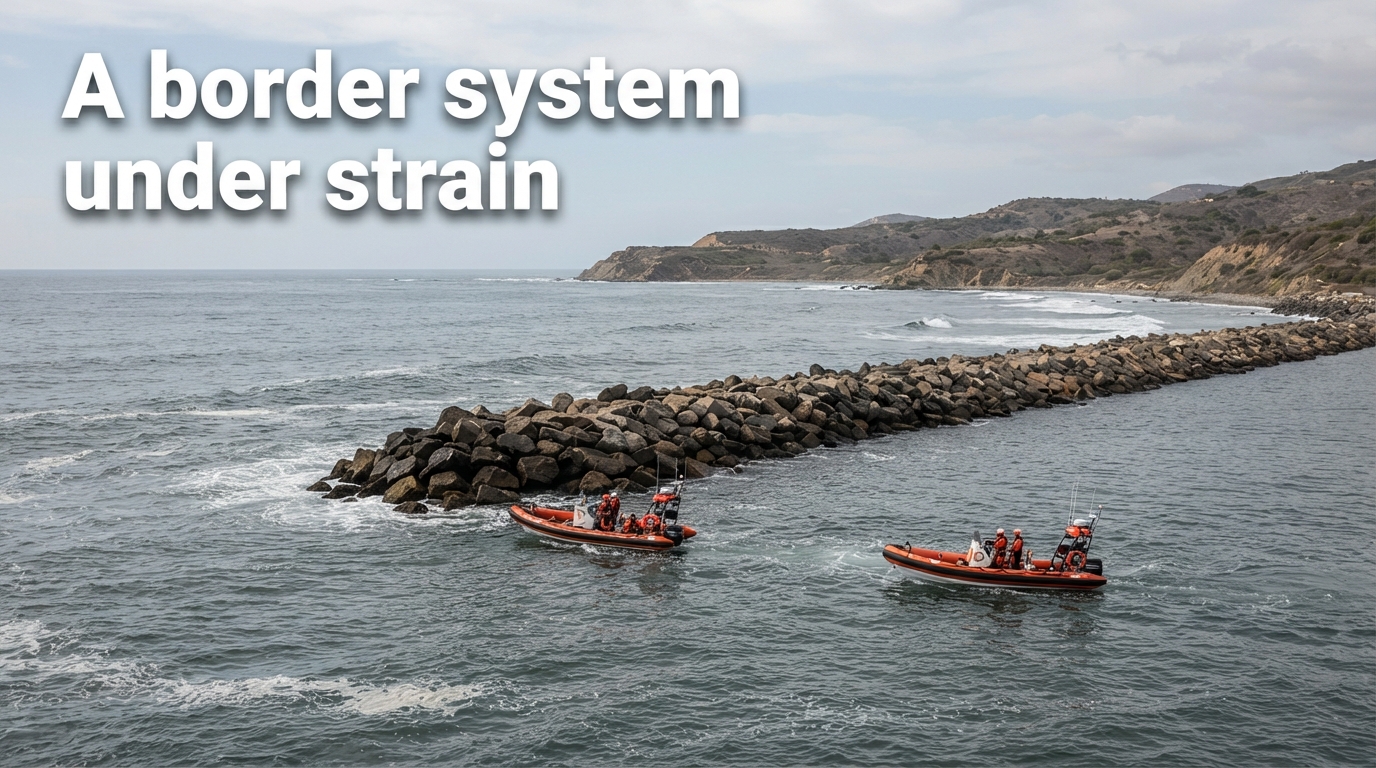
Ceuta is a Spanish autonomous city on Morocco’s northern coast and part of the European Union’s external border. Spain controls what happens after people arrive—border security, reception and legal procedures—but preventing crossings and arranging returns depend heavily on cooperation with Morocco.
That system came under exceptional pressure in late July. More than 1,500 people had reached Ceuta during the preceding week, according to the city government. On July 30 and 31, the movement accelerated: people swam around the Tarajal breakwater, crossed or bypassed land-border infrastructure and reached the city from Morocco. The route involved several kilometres in the water, rocks and improvised flotation devices. Rescue operations continued as reception facilities filled; people were reported sleeping in streets and parks. The latest RTVE update consulted reported 34 deaths, but earlier reports gave lower figures and no reconciled official casualty account was available.
The scale estimates were also unstable. Reports and statements from Spanish authorities put the main episode at roughly 40,000 to 60,000 arrivals. Those numbers may include attempted crossings, repeated entries or people who later returned to Morocco; they should not be read as a settled count of distinct people remaining in Ceuta. For comparison, Spain’s Interior Ministry recorded 2,582 irregular land arrivals into Ceuta during the first half of 2026 and no maritime arrivals. Ceuta has about 84,000 residents. Even the lower July estimate would therefore represent a shock far beyond the city’s ordinary border and reception arrangements, without establishing a permanent increase in its population.
Spain responded by reinforcing the civilian system rather than handing the border to the army. The Armed Forces were placed under the military operations command to support the Guardia Civil, Spain’s force responsible for border and maritime security. The wider reinforcement included additional Guardia Civil personnel, diving and maritime units, a patrol vessel, a helicopter and police reinforcements that were expected to reach about 200 UIP and UPR officers. The exact military personnel total, duration, tasking and rules of engagement for the July operation have not been published in the evidence available here. Nothing established that soldiers independently carried out immigration returns or replaced the Guardia Civil’s command.
The immediate cause of the surge remains disputed. Spain’s Interior Ministry said human-smuggling networks had exploited or misrepresented a Supreme Court ruling issued on July 8. The ruling did not create a general right to remain in Spain. It addressed a narrower question: people intercepted at sea while trying to swim into Ceuta or Melilla cannot be dealt with under the special border-rejection regime designed for people caught while crossing physical border barriers. They must instead go through the ordinary return procedure, which requires an individualized assessment and legal safeguards. The distinction does not apply identically to land crossings.
Some migrants interviewed by the media appeared to believe that reaching Ceuta by sea would protect them from return; others said they had not heard of the ruling. That supports the existence of confusion and rapidly circulating information, but it does not show that a smuggling network organized the July movement or spread the relevant claim. Spain’s documented police operation against a Ceuta-linked smuggling network was announced in June 2025. It involved eight arrests, searches, seized boats and allegations of at least 200 clandestine entries, but the case material does not connect that network to July 2026, the Supreme Court ruling or a misinformation campaign.
A second explanation focuses on Morocco. Reports described Moroccan forces as initially absent, passive or unable to stop large groups, followed by stronger controls. The episode also came about a week after Pedro Sánchez, Spain’s prime minister, visited Algeria, Morocco’s regional rival. Analysts pointed to May 2021, when roughly 9,000 to 12,000 people entered Ceuta during a severe Spain–Morocco dispute after Spain treated Brahim Ghali, the leader of the Polisario Front. That precedent makes Moroccan enforcement and bilateral pressure relevant questions. It does not establish that Rabat deliberately opened the border, ordered the movement or used migration as coercion in July 2026. Other reporting described Moroccan efforts to stop people travelling north and suggested that the security response may itself have been overwhelmed.
The return agreement between Spain and Morocco does not make every return automatic. The 1992 readmission instrument requires a formal request, proof that a person came from Morocco and supporting identity and entry information, normally within 10 days. It also contains exclusions, including for people recognized as refugees or authorized to remain in Spain. Spain and Morocco said they would cooperate on returns after the crossings, but the available records do not establish how many people were returned, under which instrument or how maritime arrivals were processed after the Supreme Court ruling.
Unaccompanied Moroccan minors face an additional framework. The 2007 agreement requires protection under Spanish and international law, prior agreement on each proposed return and the number of minors involved, and arrangements for family reunification or reception by a Moroccan tutelary institution. Ceuta’s official ordinary capacity for its protection and guardianship system for unaccompanied foreign minors was 29 places in 2026. That figure is not the capacity of the city’s main migrant reception centre, known as the CETI, and does not show how many minors arrived or whether the system was full during the surge. No operational record identified in the available material shows how the minors’ agreement was applied to a July case.
The episode therefore left Spain with three separate problems rather than one. It had to restore control and rescue people on a route where deaths were being reported; it had to process arrivals under procedures that differ according to how and where they were intercepted; and it had to rely on Morocco while lacking a settled public account of why Moroccan controls failed or weakened.
The unresolved facts are concrete: the number of distinct arrivals, attempted and repeat crossings, people who remained after returns, deaths and causes of death, the number of minors and asylum applicants, and the legal procedure used for each category. The evidence supports an overwhelmed border-control and reception system. It does not yet settle whether the surge was driven mainly by trafficking-linked information, a breakdown or relaxation of Moroccan control, bilateral signalling, or a combination of those factors.
Source recordSources / claims / limits
How this piece is framed: A border-control system overwhelmed: the July surge was not only a migration spike but a stress test of Ceuta’s physical capacity, Spain’s legal return system and its dependence on Moroccan cooperation. The military deployment is the visible response; the central unresolved question is what caused the opening and how Spain can lawfully manage those who arrived.
Sources
- (primary) Agreement between Spain and Morocco on circulation, transit and readmission of foreigners entering illegally — Agencia Estatal Boletín Oficial del Estado — https://www.boe.es/eli/es/ai/1992/02/13/(1) · read in full · captured 2026-07-31
- (primary) Inmigración irregular 2026: datos acumulados del 1 de enero al 30 de junio — Spanish Ministry of the Interior — https://www.interior.gob.es/opencms/export/sites/default/.galleries/galeria-de-prensa/documentos-y-multimedia/balances-e-informes/2026/12_informe_quincenal_acumulado_01-01_al_30-06-2026.pdf · read in full · captured 2026-07-31
- (primary) El Mando Operativo Terrestre refuerza la vigilancia y el conocimiento del entorno en territorio extra peninsular durante el mes de marzo — Estado Mayor de la Defensa — https://emad.defensa.gob.es/operaciones/operaciones-nacionales/70-OP-PRESENCIA-VIGILANCIA-DISUASION/noticias/listado/260330-ni-mot-balance-marzo.html?__locale=es · read in full · captured 2026-07-31
- (primary) Ceuta: población por municipios y sexo — Instituto Nacional de Estadística — https://www.ine.es/jaxiT3/Tabla.htm?L=0&t=2908 · read in full · captured 2026-07-31
- (primary) Real Decreto 556/2026, de 30 de junio, por el que se aprueba la capacidad ordinaria del sistema de protección y tutela de personas menores de edad extranjeras no acompañadas — Agencia Estatal Boletín Oficial del Estado — https://www.boe.es/diario_boe/txt.php?id=BOE-A-2026-14495 · read in full · captured 2026-07-31
- (primary) Agreement between Spain and Morocco on prevention of irregular emigration by unaccompanied minors, their protection and agreed return — Agencia Estatal Boletín Oficial del Estado — https://www.boe.es/diario_boe/txt.php?id=BOE-A-2013-3140&lang=es · read in full · captured 2026-07-31
- (primary) La Policía Nacional desarticula una red criminal dedicada al tráfico de personas y drogas entre Marruecos y España — Ministerio del Interior / Policía Nacional — https://www.interior.gob.es/opencms/va/detalle/articulo/La-Policia-Nacional-desarticula-una-red-criminal-dedicada-al-trafico-de-personas-y-drogas-entre-Marruecos-y-Espana/ · read in full · captured 2026-07-31
- (primary) El Tribunal Supremo confirma que la ley no permite las devoluciones en caliente de los migrantes que pretenden entrar a nado en Ceuta y Melilla — Consejo General del Poder Judicial / Spanish Supreme Court — https://www.poderjudicial.es/cgpj/es/Poder-Judicial/Noticias-Judiciales/El-Tribunal-Supremo-confirma-que-la-ley-no-permite-las--devoluciones-en-caliente--de-los-migrantes-que-pretenden-entrar-a-nado-en-Ceuta-y-Melilla · read in full · captured 2026-07-31
- (secondary) Spain deploys military to Ceuta after thousands of migrant crossings at Morocco border; at least 34 dead — CBS News / Associated Press — https://www.cbsnews.com/news/spain-deploys-military-ceuta-morocco-border-migrants/ · read in full · captured 2026-07-31
- (secondary) El Gobierno despliega al Ejército en Ceuta para reforzar la seguridad en medio de la crisis migratoria — RTVE — https://www.rtve.es/noticias/20260730/gobierno-despliega-ejercito-ceuta-para-reforzar-seguridad-medio-crisis-migratoria/17174998.shtml · read in full · captured 2026-07-31
- (secondary) About 60,000 migrants enter Ceuta in 24 hours, Spanish territory's leader says — BBC — https://www.bbc.com/news/articles/cx2kp639yx4o · read in full · captured 2026-07-31
- (secondary) La entrada masiva e ilegal de miles de personas en Ceuta, ¿crisis migratoria o coerción política? — RTVE — https://www.rtve.es/noticias/20260731/entrada-masiva-ceuta-crisis-migratoria-coercion-politica/17174616.shtml · read in full · captured 2026-07-31
- (secondary) Ascienden a 34 los migrantes muertos en la crisis migratoria tras la entrada ilegal de más de 60.000 personas a Ceuta — RTVE — https://www.rtve.es/noticias/20260731/crisis-migratoria-19-muertos-ceuta-continuan-entradas-tarajal-crisis-migratoria/17175227.shtml · read in full · captured 2026-07-31
Claims, and how far we tracked each down
- [contested] Estimates for the number of people who entered Ceuta during the main July 30–31 episode ranged from approximately 40,000 to 60,000. · read in full (as of 2026-07-31)
- [confirmed] Under the Supreme Court's ruling, people intercepted at sea in those circumstances must instead be handled under the ordinary individualized return procedure in Spain's immigration law. · read in full (as of 2026-07-31)
- [confirmed] Spanish officials and analysts disagreed over whether the episode reflected trafficking-network activity, a failure or relaxation of Moroccan controls, or deliberate Moroccan political pressure. · read in full (as of 2026-07-31)
- [confirmed] Migrants entered Ceuta from Morocco by swimming around the Tarajal breakwater and by crossing or bypassing land-border infrastructure. · read in full (as of 2026-07-31)
- [confirmed] More than 1,500 people had reached Ceuta during the week before the largest surge. · read in full (as of 2026-07-31)
- [contested] At least 34 people were reported dead in connection with the July 30–31 crossings by the latest RTVE update consulted. · read in full (as of 2026-07-31)
- [confirmed] Spain's Interior Ministry recorded 2,582 irregular land arrivals into Ceuta during January–June 2026. · read in full (as of 2026-07-31)
- [likely] Ceuta has a resident population of approximately 84,000 people. · read in full (as of 2026-07-31)
- [confirmed] Spain deployed Armed Forces units to Ceuta to support the Guardia Civil and maintain security after the mass crossings. · read in full (as of 2026-07-31)
- [confirmed] The Spanish reinforcement package included additional Guardia Civil personnel, maritime and diving units, a patrol vessel, a helicopter, and an eventual deployment of about 200 UIP/UPR police officers. · read in full (as of 2026-07-31)
- [unconfirmed] The primary Defence source reviewed does not establish a special July 30–31 military deployment order, exact personnel number, rules of engagement, duration or recorded incidents connected with the mass crossings. It supports the characterization of the military role as a standing surveillance, protection and civil-support function rather than an independently documented immigration-enforcement mission. · read in full (as of 2026-07-31)
- [confirmed] On July 8, 2026, Spain's Supreme Court ruled that the special border-rejection regime cannot be applied to people intercepted at sea while attempting to swim into Ceuta or Melilla. · read in full (as of 2026-07-31)
- [confirmed] Spain's Interior Ministry attributed the surge to trafficking networks exploiting or misrepresenting the Supreme Court ruling. · read in full (as of 2026-07-31)
- [likely] Some people who crossed into Ceuta did not know about the Supreme Court ruling when they made the crossing. · read in full (as of 2026-07-31)
- [confirmed] The authoritative Interior Ministry police material located for a trafficking network connected to Ceuta concerns a separate operation announced on June 19, 2025, not the July 2026 crossings. It identifies eight arrests, three provisional imprisonments, six searches, two seized boats and a network allegedly responsible for at least 200 clandestine entries from Morocco; it describes logistics through Castillejos, Ceuta and Algeciras, including sea crossings and swimming. It does not identify the Supreme Court ruling, a July 2026 investigation, communications disseminating misinformation about the ruling, or recruitment activity tied to the July crossings. · read in full (as of 2026-07-31)
- [unconfirmed] The primary police material reviewed does not establish that the 2025 Ceuta-linked network was involved in the July 2026 crossings or in disseminating information about the Supreme Court ruling; the July-specific trafficking and misinformation allegation therefore remains unsubstantiated by the authoritative case material located here. · read in full (as of 2026-07-31)
- [likely] Morocco's authorities strengthened security around the border after the crossings, but large groups still reached Ceuta. · read in full (as of 2026-07-31)
- [confirmed] The July episode occurred roughly one week after Pedro Sánchez's visit to Algeria. · read in full (as of 2026-07-31)
- [likely] The July episode was larger than the major Ceuta influx of May 2021, when approximately 9,000–12,000 people entered. · read in full (as of 2026-07-31)
- [confirmed] The Spain–Morocco readmission agreement published in the BOE is the February 13, 1992 agreement. It provides for readmission of third-country nationals who entered Spain illegally from Morocco only after a formal request by the requesting state and proof that the person came from the requested state. The request is to be made within ten days of the illegal entry and must include available identity, documentation and entry-condition information; acceptance is documented by a certificate or equivalent document. · read in full (as of 2026-07-31)
- [confirmed] The 1992 instrument contains exclusions relevant to individualized safeguards: Morocco has no readmission obligation for third-country nationals who share a border with Spain, people later authorized to remain in Spain, people holding or later obtaining a Spanish visa or permit, or people recognized as refugees. Transit for expulsion may also be refused where the person risks ill-treatment or where transit is sought for nationals of Maghreb countries belonging to the Arab Maghreb Union. · read in full (as of 2026-07-31)
- [confirmed] The bilateral agreement specifically covering unaccompanied Moroccan minors requires Spain to provide assistance and equal protection under Spanish and international law, exchange information with Moroccan authorities, and reach prior agreement on each minor and on the number of minors eligible for return. Any Spanish return decision must observe Spanish law, international law and the Convention on the Rights of the Child; return must protect the child's best interests and provide for effective family reunification or delivery to a Moroccan tutelary institution. The agreement also provides for a qualified reception arrangement and a bilateral monitoring committee. · read in full (as of 2026-07-31)
- [unconfirmed] The 2007 Spain–Morocco minors agreement states that its detailed procedural modalities were to be set out in an implementing protocol. The agreement itself establishes safeguards and a framework, but the source reviewed does not show that the framework was used for any particular July 2026 return or identify the implementing protocol or case files. · read in full (as of 2026-07-31)
- [confirmed] The official 2026 ordinary capacity for Ceuta's system of protection and guardianship for unaccompanied foreign minors was 29 places, compared with a national total of 17,081. The decree says the figure is calculated from certified 2025 population and registry data and is used in the statutory contingency-migration framework. · read in full (as of 2026-07-31)
- [confirmed] Spanish and Moroccan authorities agreed to cooperate on returning people who entered Ceuta irregularly. · read in full (as of 2026-07-31)