
Article
China's CATL begins trials at Hungary's huge EV battery gigafactory
The Debrecen site would be Europe's largest once complete, putting Chinese-controlled cell supply beside European car assembly — but the first two lines are only in test runs, with no date yet for full production and local environmental approval still contested.


Pictures in this frame are AI-generated, not photographs.
What happenedOn 22 September 2026 CATL, the Chinese company that makes about 40% of the world's EV batteries, began trial runs on the first two cell lines at its planned 100 GWh plant in Debrecen after receiving occupancy and pollution permits in August.
Why it mattersThe plant would be Europe's largest once complete, giving European carmakers local supply next to Hungary's auto cluster while deepening dependence on Chinese technology and potentially squeezing higher-cost European rivals.
Still openWhether the plant, once ramped in phases, will push European cell prices lower is not settled and depends on its chemistry mix, pricing, how fast European demand absorbs the output and how fully rivals use their own capacity.
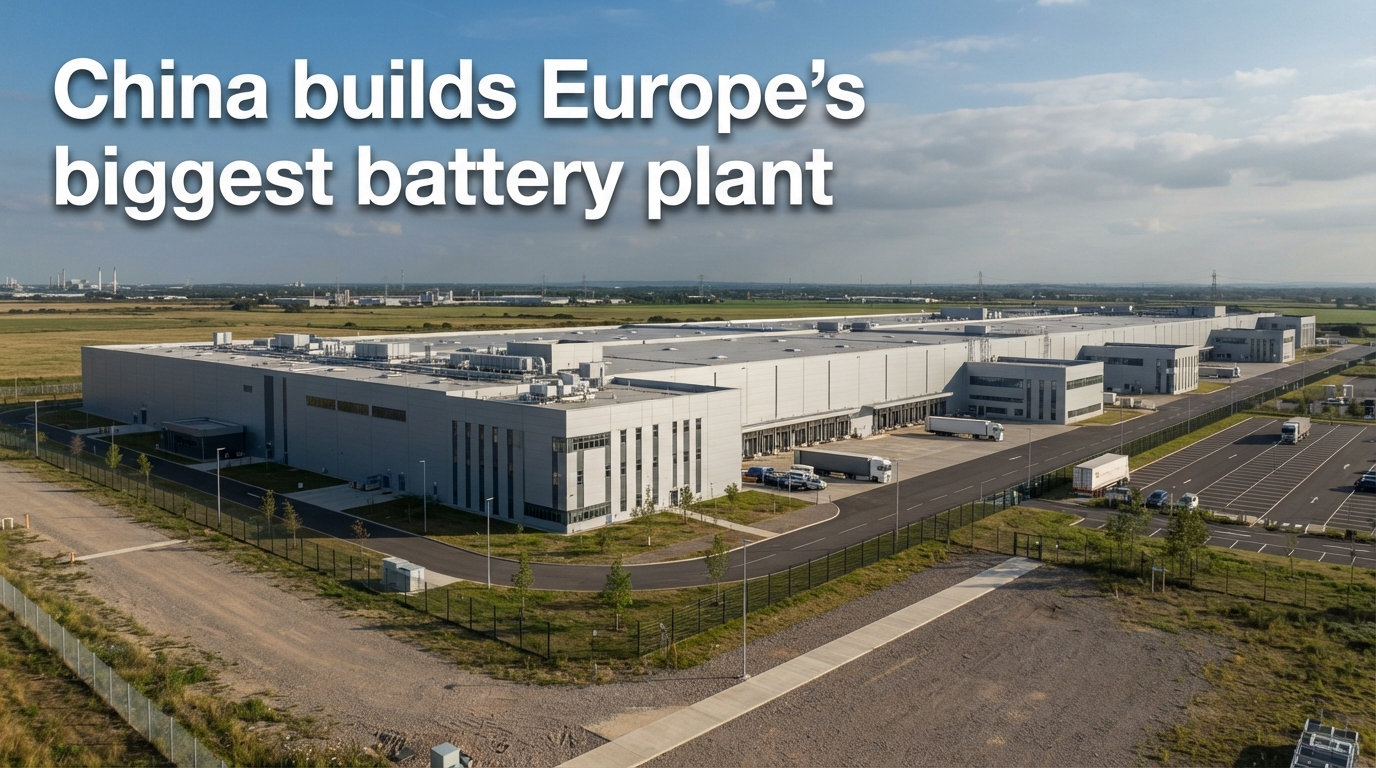
A 100-gigawatt-hour battery gigafactory — enough for about 1.25 million electric cars — has started trial runs in eastern Hungary.
On 22 September 2026, Contemporary Amperex Technology Co. Limited — CATL, the Chinese company that makes about 40% of the world's EV batteries — began testing the first two cell lines at its planned 100 GWh plant in Debrecen, after receiving its occupancy permit in August and clearing the preconditions of its EU pollution permit. The lines are not yet making batteries for sale; whether the plant, once ramped, will push European cell prices lower remains conditional, not settled.
How big is Debrecen's planned 100 GWh against global and European battery scale. CATL's planned Debrecen plant, 100 GWh, equals 91% of the EV batteries Europe produced in 2023, and 4% of world cell-factory capacity that year (2.5 TWh). Trial lines started in September 2026, so the 100 GWh is a target; the demand bars stop at published minimums, and the CATL bar is seven months of installations, not a full year. International Energy Agency, and and ; CATL, ; SNE Research table — AI-assisted analytic, built only from real cited or sourced data. Source: Interesting Engineering, CATL, Wikipedia. As of 2026-09-22.
That distinction matters because trial production is equipment optimisation and process validation before series production. The start had slipped from a late-2025 to early-2026 target cited by CATL's European general manager Matt Shen, a delay the company links to construction and permitting sequencing rather than demand.
What actually started in Debrecen
Debrecen is CATL's second European factory after Arnstadt in Germany, and will be its largest outside China when complete. CATL announced the project in August 2022, began building the first cell building in summer 2023 and finished installing production equipment by spring 2026.
The site has already been assembling battery modules — packs of cells wired together — since autumn 2024, making about 537,000 modules while the cell lines were built. County authorities confirmed the company had fixed deficiencies identified earlier in permitting before the August permit. CATL says it will keep monitoring employee health, safety and environmental indicators during trials and submit results to authorities.
What is not yet known is when series production begins or how the 100 GWh will be phased. The company describes flexible lines tailored to customer requirements without disclosing chemistry, customers or pricing.
How big 100 GWh really is
Against global baselines the scale is system-shaping, but the share depends on the denominator. The plant would be about 5% of global cell manufacturing capacity on the last published total of almost 2,000 GWh in 2023, and about 10-13% of recent EV battery demand, which grew from more than 750 GWh in 2023 to more than 950 GWh in 2024. Until a new global capacity total is published, the capacity share still rests on the 2023 figure.
In European terms the increment is larger. Europe produced 110 GWh of batteries in 2023 against 185 GWh of demand, leaving it import-dependent. Hungary alone accounted for almost 30% of European output and Poland about 60%. A 100 GWh plant in Debrecen would therefore nearly double Hungary's 2023 share of European production and rival total US production of 70 GWh that year. For CATL itself, 100 GWh is about 34% of the 289.6 GWh it installed globally from January to July 2026.
Why Hungary, why now
The logic is localisation: put cell supply next to car assembly and cut logistics, tariffs and lead times compared with importing from China.
Where CATL is putting Europe's biggest battery supply. CATL’s two named China bases sit behind a European footprint anchored by Arnstadt, Debrecen and Zaragoza; Debrecen is the highlighted 100 GWh trial site. The shaded-country context is the IEA’s 2023 estimate: Poland supplied about 60% and Hungary almost 30% of Europe’s 110 GWh EV-battery production; city markers are approximate centroids, not plant boundaries. — AI-assisted analytic, built only from real cited or sourced data. Source: CATL, International Energy Agency, Interesting Engineering. As of 2026-09-22.
Hungary already hosts a cluster of European auto assembly — BMW, Mercedes and BYD, the Chinese automaker, have invested there — and already produced a large share of Europe's batteries. Debrecen sits near that heartland and near CATL's first European plant in Germany. EU and US policy pushes to build near demand centres form the backdrop, though CATL has not cited those policies as its motive for Debrecen.
The plant's chemistry will shape who it serves. NMC offers higher energy density for premium models and remains dominant in Europe and the US, while LFP is about 30% cheaper per kilowatt-hour and dominant in China. CATL makes both globally; for Debrecen it has only said the lines are flexible.
The glut it lands in
The trial comes as the battery industry is awash in capacity. In 2023 China used less than 40% of its maximum cell output, while its capacity to make key active materials was several times global EV cell demand. Supply of key battery minerals exceeded demand, pulling down mineral prices.
That overcapacity has fed an asymmetric price fall. Lithium-ion pack prices fell 20% in 2024, the largest drop since 2017, but nearly 30% in China compared with 10-15% in Europe and the US, widening the China-Europe price gap.
Western gigafactories have already felt the squeeze. Northvolt, the Swedish champion once seen as Europe's answer to CATL, filed for bankruptcy protection in late 2024 with $5.8bn in debts after BMW cancelled a €2bn long-term cell contract for late delivery. Its flagship in Skellefteå aimed for 16 GWh a year by 2026, three years late and far below its 60 GWh nameplate.
Whether Debrecen adds to that pressure is not deterministically established. Additional low-cost CATL supply, once ramped, could weigh on European cell prices — helping automakers and buyers but squeezing higher-cost Western plants such as Northvolt and European ventures ACC and Verkor — but that outcome is conditional on chemistry mix, offtake pricing, how fast European demand absorbs the increment, and how fully competitors use their own capacity. Hungarian battery production actually fell significantly in 2024, and Northvolt's utilisation remains far below nameplate, a reminder that demand and execution, not nameplate alone, set prices.
Who gains, who is exposed — and why the local welcome is contested
If Debrecen ramps smoothly, European automakers get secure local supply and shorter chains, Hungary gains jobs, foreign investment and tax base, CATL gains a tariff hedge and a larger share of the European value pool, and EV buyers could benefit if savings pass through.
The exposure is equally clear and is the core paradox. Geographic localisation is not sovereignty. China controls about 85% of global cell production and, by measures from the International Energy Agency (IEA), nearly 90% of cathode and more than 97% of anode capacity — the two electrodes at the heart of a cell. Core intellectual property, supply chains and profits remain Chinese-controlled. Former European Central Bank president Mario Draghi warned in September 2024 about green-tech competition from China, and analysts have warned that if Europe cannot scale its own cathode-material and cell production, it will become heavily dependent on Asia. Debrecen adds European capacity while entrenching that technology dependence.
Local legitimacy is the other contested edge. Residents and NGOs raised serious worries during permitting, triggering inspections and remediation before the August permit. Concerns centre on water use and monitoring. CATL reports water-saving upgrades and an expanded monitoring network, with a connection to reuse treated wastewater — grey water — planned for summer 2027. Independent experts identified shortcomings in the pollution permit and litigation was pending as of May 2025 with suspension risk. Even with compliance, the social licence remains contested and will depend on ongoing monitoring that CATL says it will submit proactively.
Debrecen therefore holds three truths at once: a genuine industrial win that localises supply next to Europe's auto heartland, a possible price pressure that could help carmakers while hurting their would-be European cell suppliers, and a strategic dependence that grows even as the factory rises on European soil. How those balance will turn on details CATL has not disclosed — chemistry, phasing, customers and pricing — and on whether European demand growth absorbs what the plant will eventually make.
Source recordSources / claims / limits
How this piece is framed: Europe's localization paradox — a Chinese champion building Europe's biggest battery supply on European soil
Charts & tables — AI-assisted; provenance on each line
- One Hungarian plant equals almost all of Europe's 2023 battery output — sourced for this figure · as of 2026-09-22
- CATL's European localization: from China to Hungary and Germany — sourced for this figure · as of 2026-09-22
Sources
- (primary) CATL Debrecen Kicks Off Trial Operations in its New Cell Building — https://www.catl.com/en/news/7000.html · read in full · captured 2026-09-23
- (primary) Global EV Outlook 2025 - Electric vehicle batteries — IEA — https://www.iea.org/reports/global-ev-outlook-2025/electric-vehicle-batteries · read in full · captured 2026-09-23
- (primary) Global EV Outlook 2024 — Trends in electric vehicle batteries — International Energy Agency — https://www.iea.org/reports/global-ev-outlook-2024/trends-in-electric-vehicle-batteries · read in full · captured 2026-09-23
- (primary) CATL kicks off trial production of battery cells in Hungary — PR Newswire — https://www.prnewswire.com/news-releases/catl-kicks-off-trial-production-of-battery-cells-in-hungary-302886085.html · read in full · captured 2026-09-23
- (secondary) CATL Debrecen cell factory ready, awaiting permits; water monitoring details — Világgazdaság — https://www.vg.hu/vilaggazdasag-magyar-gazdasag/2026/07/catl-debrecen-akkumulator-gyar-elindulhat-a-termeles · read in full · captured 2026-09-23
- (secondary) BMW cancels 2 bln euro contract with Northvolt — Reuters — https://www.reuters.com/business/autos-transportation/bmw-cancels-2-bln-contract-with-northvolt-says-handelsblatt-2024-06-20/ · read in full · captured 2026-09-23
- (secondary) Struggling Northvolt stokes fear for Europe's battery future — Reuters — https://www.reuters.com/sustainability/struggling-northvolt-stokes-fear-europes-battery-future-2024-09-13/ · read in full · captured 2026-09-23
- (secondary) CATL starts trial run at its new 100 GWh EV battery plant — Interesting Engineering — https://interestingengineering.com/energy/catl-trial-battery-cell-production-100gwh-plant · read in full · captured 2026-09-23
- (secondary) Newest battery factory in Hungary will soon be operational — Portfolio.hu — https://www.portfolio.hu/en/business/20250526/the-newest-battery-factory-in-hungary-will-soon-be-operational-but-it-will-need-many-filipino-workers-762171 · read in full · captured 2026-09-23
- (secondary) Northvolt files Chapter 11 bankruptcy protection in US — Reuters — https://www.reuters.com/technology/northvolt-files-chapter-11-bankruptcy-us-2024-11-21/ · read in full · captured 2026-09-23
- (tertiary) Electric vehicle battery — Wikipedia — https://en.wikipedia.org/wiki/Electric_vehicle_battery · read in full · captured 2026-09-23
Claims, and how far we tracked each down
- [confirmed] The Debrecen plant received its occupancy permit in August 2026 and completed all pre-conditions required by its IPPC permit prior to starting trial operations on 22 September 2026 · read in full (as of 2026-09-23)
- [confirmed] Western gigafactory stress already manifest: Northvolt filed Chapter 11 in Houston Nov 2024 with $5.8bn debts and ~$30m cash (~1 week runway), after BMW cancelled €2bn ($2.15bn) long-term cell contract June 2024 for late delivery, and after Northvolt cut cathode-active-material production; Skelleftea flagship aimed for 16 GWh/yr by 2026 (3-year delay) vs 60 GWh nameplate, questioning viability of planned gigafactories in Heide, Quebec and Gothenburg. · read in full (as of 2026-09-23)
- [confirmed] Once complete, the Debrecen site is expected to become CATL's largest manufacturing base outside China · read in full (as of 2026-09-23)
- [confirmed] CATL recorded 289.6 GWh of global battery installations from January through July 2026, up 26.6% year-on-year, with global market share rising to 39.9% from 38.0% a year earlier, per SNE Research · read in full (as of 2026-09-23)
- [likely] Assertion that 'Additional low-cost supply from Debrecen, once ramped, will weigh on European cell prices, benefiting automakers but squeezing Western gigafactories (Northvolt, ACC, Verkor)' is inferred conditional scenario, not sourced causal finding: no European offtake pricing or Western gigafactory utilization/cost-curve evidence links Chinese <40% utilization in 2023 to European price impact in 2026+; Hungarian battery factory production fell significantly in 2024 per KSH, and Northvolt utilization remains far below nameplate, indicating demand and ramp execution will determine price effects. · read in full (as of 2026-09-23)
- [confirmed] In 2023 China used less than 40% of its maximum cell output with cathode/anode capacity 4x/9x global EV demand; in 2024 lithium-ion battery pack prices fell 20% (largest drop since 2017), with China prices down nearly 30% vs 10-15% in Europe/US · read in full (as of 2026-09-23)
- [confirmed] Construction of the first cell building at Debrecen began in summer 2023 and production equipment installation was completed by spring 2026 · read in full (as of 2026-09-23)
- [confirmed] In 2023 supply of cobalt and nickel exceeded demand by 6.5% and 8%, and lithium by over 10%, bringing down critical mineral prices and battery costs · read in full (as of 2026-09-23)
- [confirmed] The Debrecen facility has been producing battery modules since autumn 2024 and has produced 537,000 modules so far · read in full (as of 2026-09-23)
- [confirmed] CATL began trial production of battery cells at its Debrecen, Hungary factory on 22 September 2026 · read in full (as of 2026-09-23)
- [confirmed] The Debrecen plant's planned capacity is 100 GWh and will be CATL's largest manufacturing base outside China once all facilities ready · read in full (as of 2026-09-23)
- [confirmed] CATL announced the Debrecen project in August 2022 as its second European battery plant after its facility in Germany · read in full (as of 2026-09-23)
- [likely] At an average EV battery size of 80 kWh in 2023 (range 21-123 kWh), 100 GWh equates to roughly 1.25 million average EVs · read in full (as of 2026-09-23)
- [confirmed] LFP batteries are almost 30% cheaper per kWh than NMC batteries; LFP is main chemistry in China while NMC remains most widely used in US and Europe · read in full (as of 2026-09-23)
- [confirmed] A 100 GWh plant represents about 5% of 2023 global cell manufacturing capacity (almost 2000 GWh) and about 10.5% of 2024 EV battery demand (over 950 GWh) or about 13% of 2023 EV battery demand (more than 750 GWh) · read in full (as of 2026-09-23)
- [confirmed] The Debrecen factory uses flexible production lines designed to meet customer requirements; specific cell chemistry not disclosed · read in full (as of 2026-09-23)
- [confirmed] Trial production will allow CATL to set up, optimise and validate equipment and manufacturing processes before series production · read in full (as of 2026-09-23)
- [confirmed] China represents nearly 90% of global installed cathode active material capacity and over 97% of anode active material capacity · read in full (as of 2026-09-23)
- [confirmed] Prior to issuing the occupancy permit, the Hajdú-Bihar County Government Office carried out regular on-site inspections and confirmed the company had resolved all deficiencies identified earlier in the permitting process · read in full (as of 2026-09-23)
- [confirmed] CATL will continue working with government and authorities during trials, monitoring employee health, safety and environmental indicators and proactively submitting results · read in full (as of 2026-09-23)
- [confirmed] CATL and Hungarian authorities acknowledge Debrecen local inhabitants raised 'serious worries' during permitting, triggering regular on-site inspections by Hajdú-Bihar County Government Office and remediation of deficiencies before August 2026 occupancy permit. · read in full (as of 2026-09-23)
- [confirmed] CATL has not provided a date for full-scale series production at Debrecen · read in full (as of 2026-09-23)
- [confirmed] In 2023 China used less than 40% of its maximum cell output, and cathode and anode active material capacity was almost 4 and 9 times greater than global EV cell demand · read in full (as of 2026-09-23)
- [confirmed] CATL had earlier aimed to start Debrecen production in late 2025 or early 2026, per September 2025 reports citing European general manager Matt Shen · read in full (as of 2026-09-23)
- [confirmed] EU strategic-autonomy warnings: China controls ~85% of global battery-cell production (IEA via Reuters) and ~90% cathode / >97% anode capacity (IEA 2024); former ECB head Mario Draghi warned Sept 2024 of green-tech competition from China; analysts cited by Reuters warn if Northvolt cannot scale 'Europe is going to be incredibly dependent on Asia going forward' and scrapping European CAM production puts Europe 'at a further disadvantage'. · read in full (as of 2026-09-23)
- [confirmed] The Debrecen facility has been producing battery modules since autumn 2024 and has produced 537,000 modules · read in full (as of 2026-09-23)
- [confirmed] Debrecen environmental concerns center on water and monitoring: CATL reports 2025 upgrade cutting potable water demand 30% via adiabatic cooling towers and 3100 m3 buffer for peak use, grey-water connection planned summer 2027; plant currently uses ~200 m3/day and operates 18 geological monitoring points (3 depths) plus 15 groundwater wells and continuous noise monitoring. Independent experts identified shortcomings in IPPC permit and litigation was pending as of May 2025 with suspension risk. · read in full (as of 2026-09-23)
- [confirmed] Battery production in Europe reached 110 GWh and in the United States 70 GWh in 2023; Poland accounted for about 60% and Hungary almost 30% of European EV battery production · read in full (as of 2026-09-23)
- [confirmed] CATL said on September 22, 2026 that the Debrecen plant had fulfilled all preconditions required to commence trial run · read in full (as of 2026-09-23)
- [confirmed] European battery price dynamics (IEA 2025): lithium-ion pack prices fell 20% in 2024 (largest drop since 2017), but declines asymmetric — nearly 30% in China vs 10-15% in Europe/US — widening China-Europe price gap and increasing Chinese producers' competitive advantage; LFP packs ~30% cheaper than NMC, the chemistry dominant in Europe/US. · read in full (as of 2026-09-23)
- [confirmed] Battery production in Europe reached 110 GWh and in the United States 70 GWh in 2023; Poland accounted for ~60% and Hungary ~30% of European EV battery production · read in full (as of 2026-09-23)
Where we hit a limit / what to double-check
- Figures we could not match to our stored evidence — worth confirming against the source (which may state them exactly), and note live sources move: 34%.