
Article
Europe can still reach Jupiter alone — launching its own secure network is the harder test
The EU's planned secure network has grown to 348 satellites with services targeted from 2029, but a crowded Ariane 6 manifest, a 50% cost rise to over €15.6bn and Starlink's scale leave timing uncertain, while a universal-antenna demo is proven but unproven at scale.


Pictures in this frame are AI-generated, not photographs.
What happenedThe EU is growing its planned government satellite network IRIS² to 348 satellites with first launches targeted from 2029, while a Japanese-led demo tested a standards-based antenna to let terminals switch networks instead of locking to Starlink, as Europe's Juice probe shows it can still navigate deep space alone.
Why it mattersWhether Europe can launch, communicate and navigate without SpaceX or US political leverage affects wartime communications, broadband resilience and GPS backup — and the next five years will test if autonomy is affordable and launchable.
Still openWhether Ariane 6 can ramp from 7-8 flights a year to 12 in 2029 while carrying Kuiper and institutional missions, and whether a universal antenna can match Starlink on price and performance at scale.
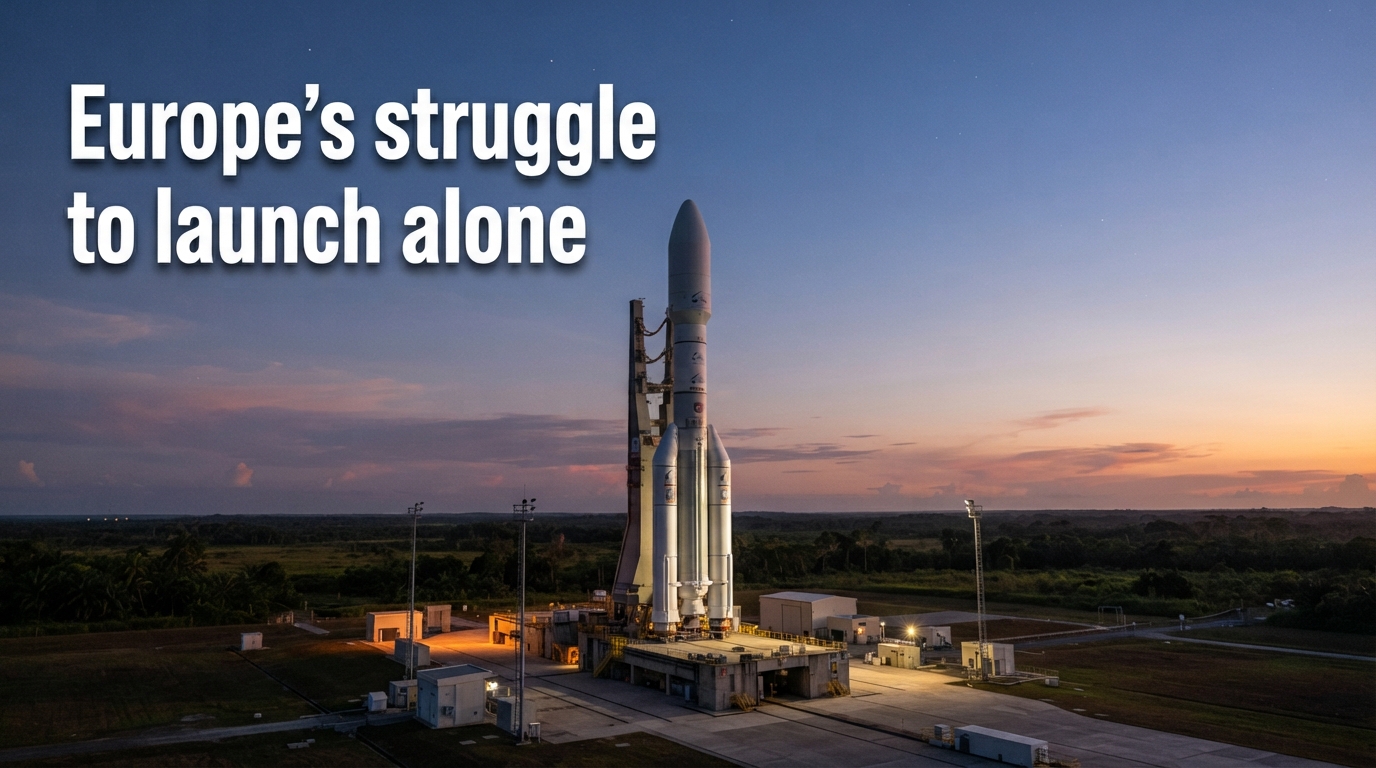
A European spacecraft will skim past Earth on 28 September, 8,640km over the Indian Ocean, stealing about 3.5km/s and a 20-degree bend without burning much fuel. It is Juice, the Jupiter Icy Moons Explorer built by the European Space Agency (ESA), the intergovernmental agency that builds Europe's science missions. A gravity assist like this uses a planet's motion to slingshot a probe outward; without it a direct flight to Jupiter would need enormous fuel to get there and then brake. The flyby proves Europe can still navigate deep space alone. Whether it can launch, stay connected and navigate without leaning on SpaceX and US goodwill is the harder test of the next five years.
How far behind Europe is on launches — and how many Ariane 6 flights it would need to close the gap. In 2025 Europe flew 7 orbital rockets — 4 Ariane 6 and 3 Vega C — while SpaceX flew 165 and every other provider flew 153, out of 325 orbital launches worldwide (BryceTech, the European seven, ESA via RFI, Ariane 6 is still aimed at 7–8 flights in 2026 and 9–10 a year from 2027; ESA says 12 a year is doable by the end of 2029 without a major new outlay and 15 a year after 2030, while 20 a year has only been named as a study, in the same 2029–2031 window when ESA says launch demand peaks (ArianeGroup via La Stampa, Géraldine Naja via La Tribune, Josef Aschbacher via European Spaceflight, Amazon Leo’s contract is 24 Ariane 6 launches, 21 of them still to fly through 2031, which is a backlog rather than a yearly rate; a September technical snag may keep 2026 under the 7–8 aim, the 153 includes one Isar Aerospace launch, and the FAA’s 170 SpaceX launches is marked beside the bar rather than used as its height (Arianespace — AI-assisted analytic, built only from real cited or sourced data. Source: RFI (reporting Financial Times interview), SatelliteToday / BryceTech, SatNews. As of 2026-09-23.
Why dependence became leverage
For Europe the urgency is not industrial policy. It is whether wartime communications, intelligence and navigation can be switched off or bargained away.
On 24 February 2022, hours before Russia's full invasion of Ukraine, a Russian cyberattack on Viasat's KA-SAT satellite broadband network knocked tens of thousands of modems offline across Ukraine and the EU, requiring factory swaps and what Western officials called a huge loss in communications at the war's outset.
In September 2022 Elon Musk refused a Ukrainian emergency request to activate Starlink coverage over Sevastopol in Crimea to enable a drone attack on Russia's Black Sea Fleet, saying SpaceX would be explicitly complicit in a major act of war; the drones lost connectivity and washed ashore.
In February 2025 Reuters reported, citing three sources, that US negotiators pressing Kyiv for critical minerals access raised cutting Ukraine's Starlink access as leverage — Musk denied it and Reuters stood by the reporting. In spring 2025 the Trump administration withheld US military and commercial Maxar satellite data from Ukrainian forces as pressure to negotiate, an episode cited by German and US think-tanks as political instrumentalisation of space.
The doctrine Europe now repeats — "autonomy where it matters, partnerships where they work" — comes from that sequence. Space is treated as a contested battlespace, not a commercial convenience.
What a broadband network does not fix
Rockets and broadband are the visible parts. Analysts at Germany's SWP think-tank and at the Center for Strategic and International Studies (CSIS), a Washington research institute, frame dependence more widely: four core defence capabilities — communications, intelligence, navigation and missile early warning — plus two enablers, launch and space situational awareness, the tracking of what is in orbit and whether it threatens satellites.
Europe leans most on the US for the last three. For situational awareness it uses ground radars and its EU Space Surveillance and Tracking network but still relies in part on US data for operational warnings — illustrated, SWP notes, when a Russian satellite shadowed a German military communications satellite in September 2025.
For navigation Europe has Galileo, its own 24-satellite alternative to US GPS in medium orbit thousands of kilometres up. With fewer satellites, CSIS assesses, accuracy drops, signal gaps grow and failure risks rise if GPS were denied.
IRIS², the EU's planned secure satellite network for government use, helps with secure communications. It does not by itself give Europe independent eyes, early warning or a GPS backup at full strength. Fragmentation makes it harder: ESA's principle of geographic return, allocating contracts in proportion to member contributions, is cited as reinforcing inefficiency.
The rocket bottleneck and the dish
IRIS² at 348 satellites against Starlink's ~9,500 — scale, cost and what IRIS² actually buys. This comparison puts IRIS²’s planned 348-satellite, multi-orbit system beside Starlink’s roughly 9,500 working satellites and its 7,500-satellite FCC-approved addition; IRIS²’s purpose is secure sovereign connectivity, not raw constellation size. The IRIS² investment moved from €10.55bn for a 290-satellite December 2024 concession to more than €15.6bn for 348 satellites after the August 2026 reinforcement, alongside reported secure-government capacity uplifts of 60% in the EU and 54% globally. The public source reports Amazon Leo’s 3,232-satellite target but does not support a zero-deployed count, so no zero bar is shown — AI-assisted analytic, built only from real cited or sourced data. Source: European Space Agency, European Spaceflight, Via Satellite. As of 2026-09-23.
IRIS² is useless if Europe cannot put it up.
Europe flew a handful of times in 2025 — four Ariane 6 and three Vega C flights — versus about 170 SpaceX launches that year, roughly half of all orbital launches globally, putting about 2,500 satellites in orbit. The majority of European satellites now launch on SpaceX.
Ariane 6, financed by ESA member states and built to reach geostationary orbit far above Earth, is still ramping at about 7-8 flights a year, with an ambition of 9-10. ESA Director General Josef Aschbacher, who leads the agency, has warned of a shortage around 2029-2031 as demand peaks from EU institutional missions, EUMETSAT — Europe's weather-satellite agency — science, defence and commercial backlogs. Thirty Ariane 6 launches are already booked, most of them for Amazon's Kuiper broadband constellation, now called Amazon Leo.
ESA is studying whether 12 flights in 2029 is doable with manageable investment, and then 15 or even 20 a year by about 2030. Those higher figures are studied options, not a committed plan. The structural reason is market size: Europe's satellite market is about 1% of the global launch market, SWP estimates, so demand must be consolidated to make a competitive launch market at all. Without Starlink-like internal demand — SpaceX flew well over a hundred Falcon 9s in 2023 versus Ariane 6's single inaugural flight — the economics of reusable rockets do not close. Early efforts to nurture small launchers are too soon to assess. The gap has already forced workarounds: after Ariane 5 retired, Soyuz was lost after the invasion of Ukraine and Vega C was grounded, ESA launched its Euclid and EarthCARE science missions on Falcon 9.
IRIS² is Europe's concrete answer for government use — crisis response, defence, border surveillance, embassies — not a consumer broadband play. The concession was awarded 31 October 2024 and signed 16 December 2024 between the European Commission, the EU executive, and SpaceRISE, a consortium of SES, Eutelsat and Hispasat. ESA oversees development and in-orbit validation, with Airbus, Thales Alenia Space, OHB and Aerospacelab in the industrial team.
The design grew after negotiations from January to August 2026 from about 282 satellites to 348 — most in low orbit a few hundred kilometres up where latency is low, plus a smaller medium-orbit layer for wider coverage — after adding satellites for defence resilience. ESA says that lifts secure governmental capacity by about 60% within the EU and more than half globally. First launches are targeted for 2029, with progressive services from 2029 onwards — targeted, not firm.
Total investment is now reported at more than €15.6bn — about €11.6bn public plus about €4bn private from SpaceRISE — up from €10.55bn at concession, a rise of about 50%. That figure and the assessment that the "acceleration" to 2029 amounts to a handful of months come from European Spaceflight reporting, not an ESA release.
Starlink's moat is not just satellites. It is the terminal. Starlink began 2026 with about 9,500 working satellites, approval from the US regulator the FCC for another 7,500, about 9.2 million users in roughly 155 countries and a de facto monopoly in consumer low-orbit broadband. Its vertical integration — reusable Falcon 9 and planned Starship, mass-produced satellites and dishes — supports plans around $0.30-0.50 per Mbps with further price erosion expected.
The counter-bet is standards. Sharp, the Japanese electronics maker, is pitching an antenna that can connect to multiple networks so users can switch providers instead of being locked to Starlink's proprietary dish, by adapting global mobile-phone standards known as 3GPP so phones and terminals can talk directly to satellites.
In November 2025 at ESA's technical centre in the Netherlands, ESA, chipmaker MediaTek, Eutelsat, Airbus, Sharp and others demonstrated what they called the world's first 3GPP Release-19 5G-Advanced connection over low-orbit satellites, using OneWeb satellites built by Airbus and a Sharp flat-panel antenna. If that stack becomes ubiquitous, any compatible constellation — OneWeb, IRIS², Kuiper — could complement terrestrial 5G and let phones, cars and sensors switch networks. Sharp has not published specs, timeline, pricing or customers. The demo is proven; scale and cost are not. Industry analysis is blunt: Via Satellite, quoting consultant Carlos Placido, says sustainable competition will require differentiated ecosystems rather than undercutting Starlink on cost per bit, and an IEEE Communications Society analysis concludes standardized 5G satellite links "cannot independently offset those scale advantages" — IRIS² remains materially behind Starlink in deployed scale, launch capacity, terminals and service maturity and should be judged as sovereign resilience, not a like-for-like retail challenger.
The slingshot that still works
Juice is the counterpoint. It launched 14 April 2023 from Europe's spaceport in French Guiana on an Ariane 5, carrying 10 science instruments and 85 sq m solar wings. After the first-ever lunar-Earth flyby in August 2024 and a Venus flyby in August 2025, the 28 September 2026 Earth flyby sets up a final Earth flyby in January 2029 for Jupiter arrival in July 2031. It will then make 35 flybys of the ocean-bearing moons Ganymede, Callisto and Europa before becoming the first spacecraft to orbit a moon other than Earth's, Ganymede, in late 2034. The navigation campaign started in mid-August; only one correction burn was needed. The flyby is not without constraint: Juice will pass through Earth's shadow and must run on batteries, so observations are prioritized, with calibrations on Earth and the Moon and magnetotail measurements that can be combined with other missions between late September and early October.
Three headwinds are cited as symmetrically as the ambition. Cost and schedule: the budget growth to more than €15.6bn for a handful of months' acceleration raises fiscal questions, and the 2029 target collides with the rocket bottleneck. Launch capacity: even 12 flights in 2029 leaves IRIS² competing for the same pads as Kuiper and institutional missions, and studying 15-20 flights does not create them. Market maths: reusability only pays with high-frequency low-orbit demand of the kind Starlink creates internally, and standards alone do not erase a cost and scale moat built on about half of global launches and mass-produced terminals.
None of that means IRIS² will fail. It means the outcome is partial and contested: Europe can buy back sovereign resilience for government communications and keep deep-space navigation sovereign, as Juice shows, while remaining dependent on the US for launch surge capacity, for eyes and warning in orbit, and for the cheapest bits in space — unless demand consolidates and terminals truly become interchangeable at Starlink prices, both unproven at scale.
Source recordSources / claims / limits
How this piece is framed: Europe's structural dependence on US space infrastructure — and the multi-front test of whether it can buy autonomy back (rockets, secure networks, standards)
Charts & tables — AI-assisted; provenance on each line
- Europe's launch gap: 7 flights vs SpaceX's 170 — and the cadence Europe needs by 2030 — sourced for this figure · as of 2026-09-23
- 348 vs 9,500: why IRIS² is built for sovereign resilience, not to outnumber Starlink — sourced for this figure · as of 2026-09-23
Sources
- (primary) IRIS² - the European Commission awards the concession contract to SpaceRISE consortium — https://defence-industry-space.ec.europa.eu/iris2-european-commission-awards-concession-contract-spacerise-consortium-2024-10-31_en · read in full · captured 2026-09-23
- (primary) Juice mission factsheet — European Space Agency — https://www.esa.int/Science_Exploration/Space_Science/Juice · read in full · captured 2026-09-23
- (primary) Inside ESA's vision with Josef Aschbacher — SpaceNews — https://spacenews.com/inside-esas-vision-with-josef-aschbacher · read in full · captured 2026-09-23
- (primary) IRIS² reinforced and accelerated as implementation advances — European Space Agency — https://www.esa.int/Applications/Connectivity_and_Secure_Communications/IRIS2_reinforced_and_accelerated_as_implementation_advances · read in full · captured 2026-09-23
- (primary) US could cut Ukraine's access to Starlink internet services over minerals, say sources — Reuters — https://www.reuters.com/business/us-could-cut-ukraines-access-starlink-internet-services-over-minerals-say-2025-02-22 · read in full · captured 2026-09-23
- (primary) ESA, MediaTek, Eutelsat, Airbus, Sharp, ITRI, and R&S Announce World’s First Rel-19 5G-Advanced NR-NTN Connection over OneWeb LEO Satellites — MediaTek / ESA / Eutelsat / Airbus / Sharp / ITRI / Rohde & Schwarz joint release — https://www.mediatek.com/press-room/esa-mediatek-eutelsat-airbus-sharp-itri-and-rs-announce-worlds-first-rel-19-5g-advanced-nr-ntn-connection-over-oneweb-leo-satellites · read in full · captured 2026-09-23
- (primary) SES-led SpaceRISE Signs Concession Contract With EC to Deliver IRIS² — https://www.ses.com/newsroom/ses-led-spacerise-signs-concession-contract-ec-deliver-iris2 · read in full · captured 2026-09-23
- (primary) Russia behind cyberattack against satellite internet modems in Ukraine -Western officials — Reuters — https://www.reuters.com/world/europe/russia-behind-cyberattack-against-satellite-internet-modems-ukraine-eu-2022-05-10 · read in full · captured 2026-09-23
- (primary) Juice to fly past Earth for third gravity assist — European Space Agency — https://www.esa.int/Science_Exploration/Space_Science/Juice/Juice_to_fly_past_Earth_for_third_gravity_assist · read in full · captured 2026-09-23
- (primary) Musk says he refused Kyiv request for Starlink use in attack on Russia — Reuters — https://www.reuters.com/world/europe/musk-says-he-refused-kyiv-request-use-starlink-attack-russia-2023-09-08 · read in full · captured 2026-09-23
- (secondary) Arianespace fights back – possibly! — SatNews — https://satnews.com/2026/06/21/arianespace-fights-back-possibly · read in full · captured 2026-09-23
- (secondary) Sharp takes aim at Starlink dominance with universal satellite antenna — Nikkei Asia — https://asia.nikkei.com/business/technology/sharp-takes-aim-at-starlink-dominance-with-universal-satellite-antenna · read in full · captured 2026-09-23
- (secondary) Coping with Starship — The Space Review — https://www.thespacereview.com/article/4825/1 · read in full · captured 2026-09-23
- (secondary) The Coming Wave of Competition in LEO Constellations — Via Satellite — https://www.satellitetoday.com/connectivity/2026/02/23/the-coming-wave-of-competition-in-leo-constellations · read in full · captured 2026-09-23
- (secondary) BryceTech Report Shows SpaceX Accounted for 50% of Launches in 2025 — SatelliteToday / BryceTech — https://www.satellitetoday.com/launch/2026/04/10/brycetech-report-shows-spacex-accounted-for-50-of-launches-in-2025 · read in full · captured 2026-09-23
- (secondary) Strategic Ambition vs Structural Dependency: Why Europe Can’t Stand Alone in Space — Center for Strategic and International Studies (CSIS) — https://www.csis.org/blogs/europe-corner/strategic-ambition-vs-structural-dependency-why-europe-cant-stand-alone-space · read in full · captured 2026-09-23
- (secondary) European Autonomy in Space - Space Systems as a Pillar of European Defence — Stiftung Wissenschaft und Politik (SWP) — https://www.swp-berlin.org/publikation/european-autonomy-in-space · read in full · captured 2026-09-23
- (secondary) Non Terrestrial Network (NTN) - IRIS² / Starlink analysis — IEEE Communications Society Technology Blog — https://techblog.comsoc.org/category/non-terrestrial-network-ntn · read in full · captured 2026-09-23
- (secondary) IRIS2 Gets Green Light With More Money and More Satellites — European Spaceflight — https://europeanspaceflight.com/iris2-gets-green-light-with-more-money-and-more-satellites · read in full · captured 2026-09-23
- (secondary) The Missing Rocket: An Economic and Engineering Analysis of the Reusability Dilemma in the European Space Sector — Intereconomics — https://www.intereconomics.eu/contents/year/2025/number/2/article/the-missing-rocket-an-economic-and-engineering-analysis-of-the-reusability-dilemma-in-the-european-space-sector.html · read in full · captured 2026-09-23
- (secondary) ESA Sees 12 Ariane 6 Launches Doable In '29, Effort Needed For More — Aviation Week — https://aviationweek.com/space/commercial-space/esa-sees-12-ariane-6-launches-doable-29-effort-needed-more · read in full · captured 2026-09-23
- (secondary) Europe faces rocket shortage by 2030 as satellite demand surges — RFI (reporting Financial Times interview) — https://www.rfi.fr/en/international/20260814-europe-faces-rocket-shortage-by-2030-as-satellite-demand-surges · read in full · captured 2026-09-23
- (primary) Juice rerouted to Venus in world's first lunar-Earth flyby — European Space Agency — https://www.esa.int/Science_Exploration/Space_Science/Juice/Juice_rerouted_to_Venus_in_world_s_first_lunar-Earth_flyby · full text not obtained — used its summary
- (secondary) Rocket Lab Establishes German Subsidiary (citing FT interview) — European Spaceflight — https://europeanspaceflight.com/rocket-lab-establishes-german-subsidiary · full text not obtained — used its summary
- (secondary) ESA weighs boosting Ariane 6 launch cadence as satellite demand seen peaking in 2030 — BigGo Finance (aggregating AJPAE Paris event) — https://finance.biggo.com/news/b724b71f-cebc-47b7-873e-f1256e1ddfa3 · full text not obtained — used its summary
- (secondary) Inside Europe’s push for space autonomy with Josef Aschbacher — SpaceNews — https://spacenews.com/inside-europes-push-for-space-autonomy-with-josef-aschbacher · full text not obtained — used its summary
Claims, and how far we tracked each down
- [confirmed] IRIS² will comprise 348 satellites (330 in low Earth orbit and 18 in medium Earth orbit) after adding 66 LEO satellites in the August 2026 implementation agreement · read in full (as of 2026-09-23)
- [confirmed] Sharp's flat-panel antenna was used in the world's first 3GPP Release 19 5G-Advanced NR-NTN connection over Eutelsat OneWeb LEO satellites at ESA's ESTEC in the Netherlands · read in full (as of 2026-09-23)
- [confirmed] Arianespace's Ariane 6 order book stands at 30 launches including 18 for Amazon's Project Kuiper (now Amazon Leo). · read in full (as of 2026-09-23)
- [confirmed] 3GPP 5G NTN standards path (Rel-17/18/19) adopted by OneWeb and Telesat Lightspeed for interoperability, but IEEE ComSoc analysis concludes IRIS² is 'materially behind Starlink in deployed scale, launch capacity, terminals and service maturity' and standardized 5G NR-NTN 'cannot independently offset those scale advantages'; IRIS² should be assessed as sovereign-connectivity/resilience program, not like-for-like retail broadband challenger. · read in full (as of 2026-09-23)
- [confirmed] In 2025 Europe conducted seven launches — four Ariane 6 and three Vega C — according to ESA, versus SpaceX 170 launches placing ~2,500 satellites (FAA figure); independent BryceTech data shows 325 global orbital launches in 2025 with SpaceX 165 (51% of global total). · read in full (as of 2026-09-23)
- [confirmed] Sharp plans to develop a universal antenna that can connect to multiple different satellite communications networks to allow users to switch providers instead of relying on SpaceX's Starlink · read in full (as of 2026-09-23)
- [confirmed] In February 2025 US negotiators pressing Kyiv for critical minerals access raised possibility of cutting Ukraine's Starlink access as leverage (Reuters, 3 sources); Musk denied ('Reuters is lying'), Reuters stood by reporting; Poland pays ~$50m/year for Ukraine's Starlink subscriptions. · read in full (as of 2026-09-23)
- [confirmed] Closest approach on 28 September 2026 will be over the Indian Ocean at 13:45 CEST (11:45 UTC) · read in full (as of 2026-09-23)
- [confirmed] IRIS² first launches targeted 2029 with progressive services from 2029, but Ariane 6 near-term goal is only up to 10/year (still uncertain), with 30 launches already booked including 18 for Amazon Kuiper/Leo, creating 2029-2031 peak-demand bottleneck that ESA studies raising to 15-20/year may not resolve. · read in full (as of 2026-09-23)
- [confirmed] Ariane 6 cadence is currently 7-8 launches per year, with Arianespace ambition to reach 9-10 annually, and ESA studying increases to 12 (doable in 2029 with manageable investment), then 15 and potentially 20 per year by ~2030. · read in full (as of 2026-09-23)
- [confirmed] After the September 2026 flyby, Juice will make a final Earth flyby in January 2029 to reach Jupiter in July 2031 · read in full (as of 2026-09-23)
- [confirmed] Juice launched on 14 April 2023 from Europe's Spaceport in French Guiana on an Ariane 5 · read in full (as of 2026-09-23)
- [confirmed] Juice's cruise includes a lunar-Earth flyby in August 2024 and a Venus flyby in August 2025 before the two Earth flybys in 2026 and 2029 · read in full (as of 2026-09-23)
- [confirmed] Galileo (24 satellites in MEO) is Europe's independent alternative to US GPS, but CSIS notes with fewer satellites accuracy drops, signal gaps grow and failure risks rise if GPS denied, jeopardizing military/civilian resilience. · read in full (as of 2026-09-23)
- [unconfirmed] SWP/CSIS deep-reads do not detail a European space-grade semiconductor/chips strategy; chips as distinct autonomy gap remains unconfirmed in primary reports (SWP focuses on SSA, reconnaissance, navigation resilience, early warning). · read in full (as of 2026-09-23)
- [confirmed] Juice's 10 science instruments will be switched on between 23 September and 3 October 2026 to collect calibration data on Earth and the Moon · read in full (as of 2026-09-23)
- [confirmed] ESA Director General Josef Aschbacher warned Europe faces a launcher shortage around 2029-2031 as satellite launch demand peaks · read in full (as of 2026-09-23)
- [confirmed] Starlink's vertical integration advantage: ~9,500 working satellites early 2026 (+7,500 FCC approved), 9.2m users in ~155 countries, de facto consumer monopoly, $0.30-0.50 per Mbps plans with further price erosion expected, 51% of global launches (SpaceX 165/325 in 2025), reusable Falcon 9 and planned Starship (150t at ~1/10 Falcon 9 per-kg cost) and V3 satellites (10x capacity). · read in full (as of 2026-09-23)
- [confirmed] Europe's satellite market is ~1% of global launch market (SWP), and reusability is economically sustainable only with high-frequency LEO demand (SpaceX 138 Falcon 9 flights in 2023 vs Ariane 6 one inaugural flight); without Starlink-like internal demand, Europe lacks market to justify reusable economics, making 15-20/year cadence dependent on demand consolidation via European Launcher Challenge / Flight Ticket Initiative — both still early stage, too soon to assess. · read in full (as of 2026-09-23)
- [confirmed] Juice will be in Earth's shadow from 21:24 CEST on 27 September to 06:03 CEST on 28 September and must operate on battery power · read in full (as of 2026-09-23)
- [confirmed] The 28 September 2026 Earth flyby will deflect Juice's trajectory by about 20 degrees and increase velocity by about 3.5 km/s · read in full (as of 2026-09-23)
- [confirmed] Sharp's flat-panel antenna was used in the world's first 3GPP Release 19 5G-Advanced NR-NTN connection over Eutelsat OneWeb LEO satellites at ESA ESTEC, using 50 MHz Ku-band, conditional handover, transparent transponders (Ku service / Ka feeder), Earth-moving beams, MediaTek NR-NTN chipset and ITRI gNB. · read in full (as of 2026-09-23)
- [confirmed] IRIS² first launches are planned by 2029 with progressive deployment of operational connectivity services from 2029 onwards · read in full (as of 2026-09-23)
- [confirmed] Industry analysis (Via Satellite, quoting consultant Carlos Placido) advises competition should no longer be assessed solely on transport cost per bit; sustainable competition requires differentiated ecosystems/verticals rather than undercutting Starlink on cost — Starlink is 'exceptionally difficult competitor to challenge.' · read in full (as of 2026-09-23)
- [confirmed] ESA's Jupiter Icy Moons Explorer (Juice) will fly past Earth on 28 September 2026 at a closest approach of 8640 km · read in full (as of 2026-09-23)
- [confirmed] ESA geographic-return principle (allocating contracts proportional to member contributions) reinforces inefficiency and fragmentation, per CSIS/SWP, undermining cost competitiveness of IRIS² and launch market. · read in full (as of 2026-09-23)
- [confirmed] The reinforced IRIS² architecture will increase secure governmental capacity by 60% within the EU and 54% globally · read in full (as of 2026-09-23)
- [confirmed] On 24 Feb 2022, hours before Russia's full invasion, Russia launched cyberattack on Viasat's KA-SAT network that took tens of thousands of modems offline across Ukraine and EU, required factory swap, caused 'huge loss in communications' at war outset and was attributed by US, UK, EU, Canada, Estonia as intended to disrupt Ukrainian command and control. · read in full (as of 2026-09-23)
- [confirmed] ESA Director General Josef Aschbacher warned Europe faces a launcher shortage around 2030, with a peak in launch requirements around 2029-2031: 'If we add up all the satellites that need to be launched from current and planned constellations and missions... we see that there's a peak of launch requirements around 2029, 2030, 2031' and 'The ESA currently forecasts that Europe will face a shortage of launchers around 2030' (FT interview via RFI). · read in full (as of 2026-09-23)
- [confirmed] In spring 2025 Trump administration withheld satellite data from Ukrainian forces — including US military and commercial Maxar data — as leverage to pressure Ukraine into negotiations with Russia under unfavourable conditions, cited by SWP as political instrumentalisation of space capabilities. · read in full (as of 2026-09-23)
- [confirmed] Juice carries 10 science instruments, 85 m2 solar wings, and is planned to make 35 Jovian moon flybys before orbiting Ganymede in 2034 · read in full (as of 2026-09-23)
- [likely] Microlauncher viability skepticism: European Launcher Challenge requires orbital launch by 2027 but structural transformation requires consolidated demand and long-term political commitment; Intereconomics suggests Europe may be better served by distinct strategy rather than blindly copying SpaceX reusability model. · read in full (as of 2026-09-23)
- [confirmed] In September 2022 Elon Musk refused Ukrainian emergency request to activate Starlink coverage to Sevastopol, Crimea to enable drone attack on Russian Black Sea Fleet, stating SpaceX would be 'explicitly complicit in a major act of war'; Ukrainian drones lost connectivity and washed ashore. · read in full (as of 2026-09-23)
- [confirmed] Sharp plans to develop a universal antenna that can connect to multiple satellite communications networks to let users switch providers instead of relying on Starlink. · read in full (as of 2026-09-23)
- [confirmed] IRIS² cost grew from €10.55bn at Dec 2024 concession (290 sats, initial capacity 2030) to >€15.6bn after Aug 2026 Rendez-vous 1 (348 sats: 330 LEO + 18 MEO; €11.6bn public + ~€4bn private SES/Eutelsat/Hispasat); European Spaceflight notes 'acceleration' to 2029 amounts to handful of months while budget grew ~50%. · read in full (as of 2026-09-23)
- [confirmed] SWP identifies four core satellite-based defence capabilities — communications, intelligence, navigation and missile early warning — plus enablers launch and space situational awareness (SSA); Europe remains highly dependent on the US particularly in intelligence, navigation and early warning. · read in full (as of 2026-09-23)
- [confirmed] Starlink began 2026 with roughly 9,500 working satellites in orbit and FCC approval for an additional 7,500, with customer base nearly doubled to 9.2 million users in about 155 countries, maintaining a de facto monopoly in consumer NGSO broadband. · read in full (as of 2026-09-23)
- [confirmed] IRIS² is implemented via a 12-year concession contract signed 16 December 2024 between the European Commission and the SpaceRISE consortium (SES, Eutelsat, Hispasat) · read in full (as of 2026-09-23)
- [confirmed] For SSA, Europe uses ground-based radars and EU SST but relies in part on US data for operationally relevant warnings (e.g., hostile satellite approaches); SWP cites September 2025 German report of Russian satellite shadowing a Bundeswehr communications satellite as illustration. · read in full (as of 2026-09-23)
- [likely] Starlink had roughly 9,500 working satellites in early 2026 with FCC approval for an additional 7,500 and about 9.2 million users in ~155 countries, holding a de facto monopoly in consumer LEO broadband · read in full (as of 2026-09-23)
- [confirmed] Europe's satellite market accounts for approximately 1% of the global launch market, limiting demand for indigenous launch services · read in full (as of 2026-09-23)
- [confirmed] The 5G-Advanced NTN trial used 50 MHz channel bandwidth over Ku-band with conditional handover, using MediaTek NR-NTN chipset and ITRI gNB, via Airbus-built OneWeb satellites with transparent transponders · read in full (as of 2026-09-23)
- [confirmed] IRIS² concession is a 12-year public-private partnership awarded 31 Oct 2024 and signed 16 Dec 2024 between European Commission and SpaceRISE (SES, Eutelsat, Hispasat) for >290 satellites plus ground segment to provide governmental services by 2030 while enabling commercial services. · read in full (as of 2026-09-23)
- [confirmed] After Rendezvous 1 negotiations (Jan-Aug 2026), IRIS² architecture was confirmed at 348 satellites (330 LEO + 18 MEO) after adding 66 LEO for defence/security, with total investment now >€15.6bn (€11.6bn public EC+ESA, ~€4bn private SpaceRISE), targeting first launches 2029 and progressive operational services from 2029. · read in full (as of 2026-09-23)
- [confirmed] BryceTech 2025 Year in Review: 325 orbital launches and 4,544 spacecraft deployed in 2025 (+25% launches, +54% spacecraft vs 2024); US providers ~60% of launches; SpaceX 165 launches (51% global), CASC 68, Rocket Lab 18, Roscosmos 17; small satellites (<1,200kg) 98% of spacecraft. · read in full (as of 2026-09-23)
- [confirmed] Poland, Hungary and Spain have committed €656 million, €500 million and €1.6-2 billion respectively to IRIS² beyond the EU budget · read in full (as of 2026-09-23)
- [confirmed] The majority of European satellites are currently launched by SpaceX, making Europe highly dependent on a single US commercial provider · read in full (as of 2026-09-23)
Where we hit a limit / what to double-check
- We did not obtain the full text of Rocket Lab Establishes German Subsidiary (citing FT interview) (https://europeanspaceflight.com/rocket-lab-establishes-german-subsidiary); claims resting on it are from its summary — you may be able to reach it directly.
- We did not obtain the full text of ESA weighs boosting Ariane 6 launch cadence as satellite demand seen peaking in 2030 (https://finance.biggo.com/news/b724b71f-cebc-47b7-873e-f1256e1ddfa3); claims resting on it are from its summary — you may be able to reach it directly.
- We did not obtain the full text of Inside Europe’s push for space autonomy with Josef Aschbacher (https://spacenews.com/inside-europes-push-for-space-autonomy-with-josef-aschbacher); claims resting on it are from its summary — you may be able to reach it directly.
- We did not obtain the full text of Juice rerouted to Venus in world's first lunar-Earth flyby (https://www.esa.int/Science_Exploration/Space_Science/Juice/Juice_rerouted_to_Venus_in_world_s_first_lunar-Earth_flyby); claims resting on it are from its summary — you may be able to reach it directly.