
Article
Four space clocks show why staying put matters as much as launching
Curiosity nears 5,000 Martian days while climbing Mount Sharp, Juice borrows Earth's momentum on 28 September for Jupiter, a 222-metre lunar crater is dated to spring 2024 and a distant ring system has thinned in a decade — the lunar record is the largest yet found by modern orbiters, not proven the largest ever formed.
Pictures in this frame are AI-generated, not photographs.
What happenedLate September 2026 brings four coinciding milestones — a Mars rover nearing 5,000 Martian days, a Jupiter probe's Earth flyby on 28 September, a 222-metre lunar crater dated to spring 2024, and a decade-scale change in a distant ring system — all without a new launch.
Why it mattersIt shows exploration advances through endurance, precise timing and reuse of old spacecraft, not just new rockets.
Still openWhether the new lunar crater is the largest ever formed or just the largest modern orbiters have caught, and what process thinned the distant rings.
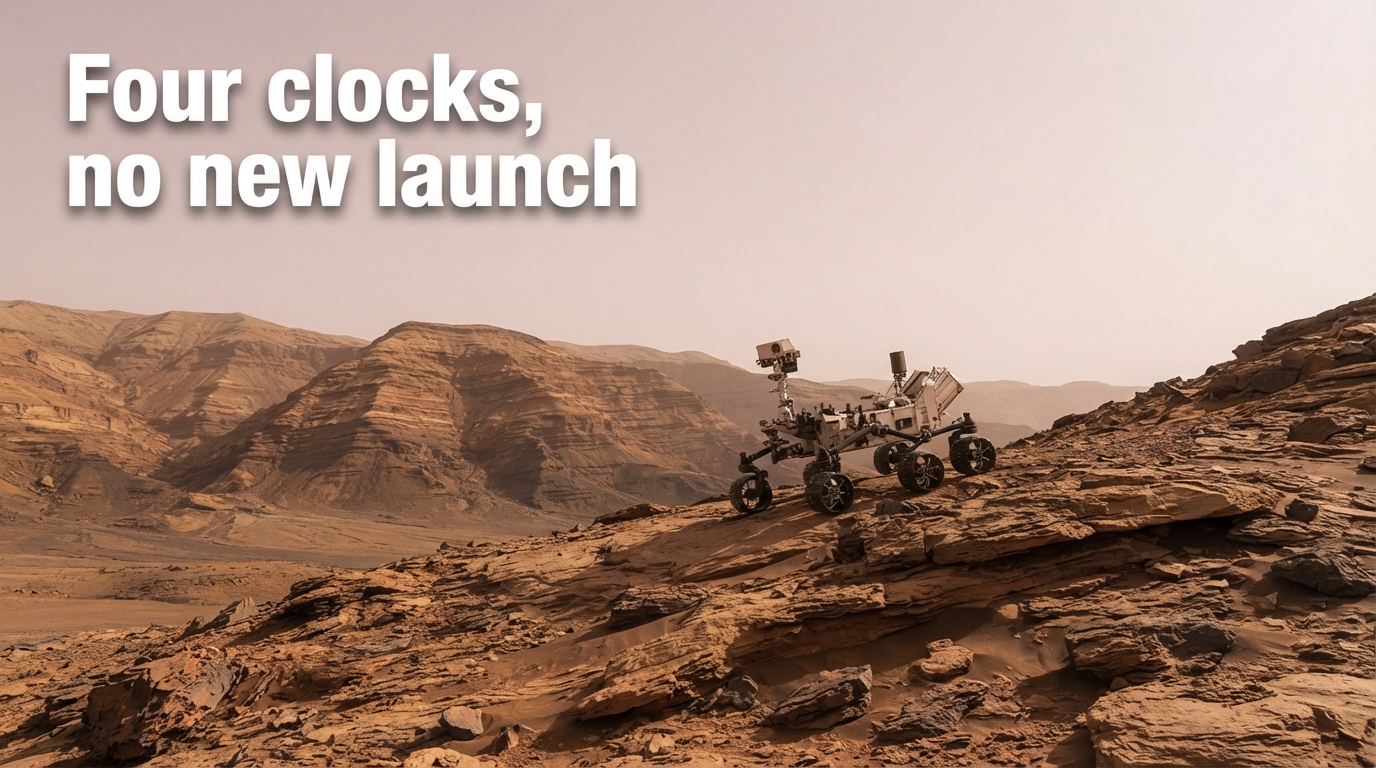
In late September 2026 a Mars rover hit 5,000 Martian days, a Jupiter probe was due to slingshot past Earth, a new 222-metre Moon crater was confirmed and a distant ring system had visibly changed. None was a new launch. Together they show how planetary science advances by staying put and being in the right place at the right time.
Juice's 8-year route to Jupiter, borrowing momentum from four flybys. Juice reaches Jupiter in 2031 by using four planetary flybys to reshape and speed its route, including a planned Earth assist in September 2026 that adds about 3.5 km/s and bends the trajectory by about 20 degrees. The timeline uses the mission dates and details supplied by ESA; the 2026 calibration window is shown as a planned operating period, not an additional flyby. — AI-assisted analytic, built only from real cited or sourced data. Source: ESA. As of 2026-09-23.
The coincidence is editorial, not physical. Each runs on its own clock — a rover's decade-long climb, an eight-year cruise, a 17-year watch that caught a once-a-century impact, and a ring system that evolved in ten years — and each needs its own mechanism to make sense.
A rover still climbing after 14 years
NASA's Curiosity has been counting time in sols — one Martian day, about 24 hours 39 minutes — since it landed in Gale Crater in August 2012. By late September 2026 that count was approaching 5,000 sols, about 14 Earth years, far beyond its prime mission.
The milestone is not just endurance. On 26 August 2026 the rover passed one kilometre of elevation gain as it climbs Mount Sharp, the layered mountain at the centre of the crater, to read Mars' water history. A NASA update in early September put the mark at 5,000 sols; the mission's pages noted sol 4,740 fell on 6 December 2025. The work is familiar: hunting rocks formed in water, drilling — 42 holes to date — and looking for organics.
Fourteen years on, Curiosity is still doing field geology, just very slowly, on another planet.
Borrowing Earth's momentum
To reach Jupiter you can carry all the fuel, or you can borrow momentum from planets — a gravity assist, using a planet's motion to gain speed without burning much fuel.
The European Space Agency's Jupiter Icy Moons Explorer, Juice — the agency's first Large-class mission in its Cosmic Vision programme, built with contributions from NASA, Japan's JAXA and Israel's space agency to complement NASA's Europa Clipper — is doing it the second way. It launched on 14 April 2023 from Europe's Spaceport in French Guiana on an Ariane 5, then began an eight-year cruise using successive flybys before reaching Jupiter in July 2031 and later orbiting Ganymede.
The Earth pass briefed on 23 September is operationally simpler than the double flyby Juice made in 2024, so its ten instruments can point freely. Closest approach is predicted for the afternoon of 28 September, about 8,600 km over the Indian Ocean, passing over Australia shortly before. The deflection is predicted at about 20 degrees with a gain of about 3.5 km per second.
A navigation campaign opened in mid-August; only the earliest correction burn was needed and an emergency slot on the 28th was reserved but not expected to be used. The spacecraft was planned to spend the night of 27-28 September in Earth's shadow on battery power, and to use the window to calibrate instruments and measure Earth's magnetotail in coordination with Smile, the joint ESA-Chinese mission. At the time of writing the flyby was still upcoming.
A crater caught by watching for 17 years
AI-generated image — not a photograph
With no atmosphere to burn them up, impacts hit the Moon constantly, but large ones are rare. NASA's Lunar Reconnaissance Orbiter has been circling for more than 17 years, carrying cameras that build monthly global maps and a heat-sensing instrument called Diviner.
How big McGetchin is, how far its blast fluffed the surface, and how rare it is. McGetchin is 222 metres (728 feet) wide—about two football fields—and its 10–20-metre impactor left a 7-kilometre (about 4-mile) nighttime cold spot in fluffed lunar soil. A crater this large is expected only about once every 132 years, compared with roughly 140 new craters a year at the small-crater scale; measurements are from the NASA Science account and the cited Science Advances studies — AI-assisted analytic, built only from real cited or sourced data. Source: NASA Science, NASA APOD, Science Advances. As of 2026-09-23.
That long baseline is why a new crater named McGetchin, after Apollo-era lunar scientist Tom McGetchin, was caught at all. Image-processing specialist Robert Wagner spotted a bright spot with a dark halo on a routine comparison of before-and-after global maps, then confirmed it with narrow-angle images. The crater is 222 metres wide and about 43 metres deep.
It formed between 11 April and 22 May 2024, when a comet or asteroid 10 to 20 metres across hit. Two papers in Science Advances on 16 September 2026 reported it. One documents the crater; the other reports what Diviner saw: a cold spot about seven kilometres wide, 8 to 9 kelvin cooler at night than its surroundings. The impact fluffed the upper regolith, reducing its density so it holds less heat, an anomaly extending more than 1,000 crater radii from the rim. Cold spots like this fade as the soil compacts again, on timescales of about 100,000 to two million years.
How rare is it? The orbiter has found at least 1,000 new craters and flagged more than 100,000 surface changes; at about nine metres wide, about 140 new craters form per year. McGetchin is two orders of magnitude rarer. The papers' model predicts a crater this size forms on average about once every 132 years; NASA's feature hedges that as "about once in a century or even longer."
How big a record is it? NASA's headline called it the "largest, newly formed crater ever found in the solar system" without qualification. The Science Advances paper is careful: the largest contemporary impact crater discovered anywhere in the solar system — meaning the largest new crater instrumentally observed in the space-age monitoring era, with the orbiter's monthly global imaging since 2010 and, for comparison, NASA's Mars Reconnaissance Orbiter since 2006. Larger ancient craters exist, and undetected contemporary craters could exist outside monitored areas and times. The current Mars comparator supports the qualified claim: the two largest fresh Martian craters found in 16 years, both formed in late 2021, are more than 130 metres across with the largest about 150 metres — still smaller than McGetchin's 222 metres — but that does not prove no larger new crater ever formed elsewhere unobserved. The honest ceiling is "largest discovered in the modern watch," not "largest ever formed."
The practical stake is Artemis, NASA's programme to return astronauts to the Moon. If a single impact can modify regolith miles beyond its rim, that changes rover trafficability and landing-site properties, and the orbiter's data is the map future lunar activity will rely on.
Rings that changed in a decade
AI-generated image — not a photograph
Before 2013, rings were thought to belong only to giant planets. Then a stellar occultation — watching a star blink as a distant object passes in front of it — revealed that Chariklo, a small dark body about 250 km across orbiting unstably between Saturn and Uranus, has rings at all.
Chariklo is a Centaur, a small icy body on an unstable orbit between the giant planets. Its system is delicate: two narrow rings only a few kilometres wide, called C1R and C2R, circling at 390 and 405 kilometres from its centre.
A new occultation observed with the James Webb Space Telescope by Pablo Santos-Sanz and colleagues found that system has changed on a roughly ten-year timescale. Compared with visible-light observations from 2013, the inner dense ring C1R had become significantly more opaque in Webb's near-infrared view, while the outer ring C2R showed a much weaker signature, nearly vanished.
Why is unknown. The study reports the change; it does not settle the cause. Hypotheses in the field and the possibility that the difference is partly wavelength-dependent opacity rather than material loss are not mutually exclusive, and the authors' quoted line is "We don't know exactly why." Small-body rings, also seen at Haumea and Quaoar, pose a puzzle of confinement and longevity, and Chariklo shows they can evolve visibly in a decade. Detailed measurements of optical depth and width were not yet published in detail, so this account stays at the level the reporting supports.
Why staying matters
None of these is a new launch. Curiosity is part of NASA's long-running Mars Exploration Program alongside Perseverance; Juice is an eight-year cruise that reuses Earth itself for navigation and calibration; the lunar orbiter's Diviner, built to map temperature, was repurposed for impact physics; Webb, built to see the early universe, was repurposed to time a star blink behind a 250-km rock.
That reuse is the through-line. Planetary science advances not only when a new spacecraft leaves Earth, but when an old one keeps climbing, when a trajectory borrows a planet's momentum at the right hour, when a 17-year archive lets a bright spot become a dated crater, and when a sensitive telescope is pointed at the right star at the right second. The clocks are different — sols, years, centuries, decades — but the method is shared: stay long enough, and be in the right place at the right time.
Source recordSources / claims / limits
How this piece is framed: Survey of four clocks: a roundup that uses four concurrent milestones to show how planetary exploration actually advances — by patient, long-baseline watching and borrowed momentum, not only by new launches. Each member is a different timescale made visible in late September 2026.
Charts & tables — AI-assisted; provenance on each line
- Juice takes eight years and four planetary swings to reach Jupiter — from claims clm_308b015e87, clm_b61216f897, clm_b193a000df, clm_9a23470e17, clm_23c49b264f, clm_57ed92b907, clm_48aaa3b6b6, clm_099ef1cdee · as of 2026-09-23
- A whale-sized rock made a two-football-field crater that cooled miles of Moon — from claims clm_588ce02c64, clm_1717c40a3a, clm_b6574d0ae8, clm_4ebc46f2d4, clm_6b5974b243, clm_88ca07cc4c, clm_a6e3c6e598 · as of 2026-09-23
Sources
- (primary) Juice to fly past Earth for third gravity assist — ESA — https://www.esa.int/Science_Exploration/Space_Science/Juice/Juice_to_fly_past_Earth_for_third_gravity_assist · read in full · captured 2026-09-23
- (primary) Mars Science Laboratory: Curiosity Rover — NASA Science — https://science.nasa.gov/mission/msl-curiosity/ · read in full · captured 2026-09-23
- (primary) New lunar crater reveals extensive distal regolith modification - Science Advances DOI 10.1126/sciadv.aeh9568 — https://www.science.org/doi/10.1126/sciadv.aeh9568 · read in full · captured 2026-09-23
- (primary) Posiolova et al. Science 2022 DOI 10.1126/science.abq7704 — https://www.science.org/doi/10.1126/science.abq7704 · read in full · captured 2026-09-23
- (primary) JWST occultation reveals unforeseen complexity in Chariklo's ring system — arXiv — https://arxiv.org/search/?query=Santos-Sanz+Chariklo+JWST+occultation&searchtype=all · read in full · captured 2026-09-23
- (primary) Juice - Jupiter Icy Moons Explorer — ESA — https://www.esa.int/Science_Exploration/Space_Science/Juice/ · read in full · captured 2026-09-23
- (primary) APOD: 2026 September 23 – A New Lunar Crater: McGetchin — NASA APOD — https://science.nasa.gov/image-article/apod-2026-september-23-the-mcgetchin-crater/ · read in full · captured 2026-09-23
- (primary) A new 222-m diameter lunar crater - Science Advances DOI 10.1126/sciadv.aeh7812 — https://www.science.org/doi/10.1126/sciadv.aeh7812 · read in full · captured 2026-09-23
- (primary) NASA’s Moon Orbiter Spots New, ‘Once-in-Century’ Moon Crater — NASA Science — https://science.nasa.gov/solar-system/moon/nasas-moon-orbiter-spots-new-once-in-century-moon-crater/ · read in full · captured 2026-09-23
- (primary) Curiosity Rover Updates - Mission Updates Index — NASA JPL — https://mars.nasa.gov/msl/mission-updates/ · read in full · captured 2026-09-23
- (secondary) ScienceAdviser: Once-in-a-century crater discovered on the Moon DOI 10.1126/science.aem6455 — https://www.science.org/doi/10.1126/science.aem6455 · read in full · captured 2026-09-23
- (secondary) Rings around a tiny body have changed over the past decade — Ars Technica — https://arstechnica.com/science/2026/09/rings-around-a-tiny-body-have-changed-over-the-past-decade/ · read in full · captured 2026-09-23
- (secondary) Curiosity's top 10 photos after 5,000 days on Mars (seed URL) — Live Science — https://www.livescience.com/space/mars/curiositys-top-10-photos-after-5-000-days-on-mars · read in full · captured 2026-09-23
Claims, and how far we tracked each down
- [confirmed] Curiosity reached a 1-kilometer elevation gain climbing Mount Sharp on 26 August 2026, marking a pinnacle of its 14-year mission · read in full (as of 2026-09-23)
- [confirmed] A new lunar crater named McGetchin after Apollo-era lunar scientist Tom McGetchin formed on the Moon's eastern edge between 11 April and 22 May 2024 · read in full (as of 2026-09-23)
- [confirmed] The cause of the change in Chariklo's rings is not yet known · read in full (as of 2026-09-23)
- [confirmed] Juice's 10 instruments will be switched on between 23 September and 3 October 2026 to collect calibration data on Earth and the Moon, and to measure Earth's magnetotail · read in full (as of 2026-09-23)
- [confirmed] Science Advances Robinson et al. abstract states 'This is the largest contemporary impact crater found in the Solar System' and introduction states 'the largest contemporary impact crater discovered anywhere in the Solar System' — qualified to instrumentally observed new craters in space-age monitoring era (LRO WAC monthly imaging since 2010), not largest crater ever formed in solar-system history. NASA feature paraphrases as 'largest, newly formed crater ever found in the solar system' without 'contemporary/discovered' qualifier. · read in full (as of 2026-09-23)
- [confirmed] Juice launched on 14 April 2023 from Europe's Spaceport in French Guiana on an Ariane 5 · read in full (as of 2026-09-23)
- [confirmed] Primary study 'JWST occultation reveals unforeseen complexity in Chariklo's ring system' by Pablo Santos-Sanz et al. (IAA, Granada) reports near-infrared JWST stellar occultation of (10199) Chariklo: inner dense ring C1R became significantly more opaque than previous visible-light observations (replenishment/dynamical restructuring), outer ring C2R shows much weaker near-infrared signature than earlier detections (possible material loss/transient or wavelength-dependent opacity); scenarios not mutually exclusive · read in full (as of 2026-09-23)
- [confirmed] Impactor was comet or asteroid 10-20 m (30-60 ft) across, described as 3-6 story building-sized (NASA feature) / humpback-whale-sized (APOD); discovery via routine temporal comparison of WAC image sets under similar lighting enabling automated change detection, followed by NAC photometric/topographic analysis documenting surface changes extending >1000 crater radii · read in full (as of 2026-09-23)
- [confirmed] Before 2013, rings were thought to exist only around giant planets; Chariklo's rings were a surprise · read in full (as of 2026-09-23)
- [confirmed] NASA's Curiosity rover, part of Mars Science Laboratory, was the largest and most capable rover at launch, is car-sized with a 7-foot arm, 10 instruments and 17 cameras, and explores Gale Crater and Mount Sharp · read in full (as of 2026-09-23)
- [confirmed] Juice carries 10 science instruments, 85 m2 solar wings, and is planned to make 35 flybys of Jovian moons before entering orbit around Ganymede in 2034 · read in full (as of 2026-09-23)
- [confirmed] LRO has operated for more than 17 years, identifying at least 1,000 new impact craters and flagging 100,000+ surface changes; smallest distinguishable craters are ~30 feet wide from ~43-inch impactors, with ~140 new craters of that scale per year · read in full (as of 2026-09-23)
- [confirmed] Frequency estimate is model-dependent: Robinson et al. crater production model predicts once every 132 years on the Moon on average; NASA feature hedges as 'about once in a century or even longer' and APOD states 'only expected once every 132 years.' Conflation of 'once-in-a-century' (100 years) and 132 years reflects uncertainty range/hedging. · read in full (as of 2026-09-23)
- [confirmed] Juice will be in Earth's shadow from 21:24 CEST on 27 September to 06:03 CEST on 28 September and must operate on battery power · read in full (as of 2026-09-23)
- [confirmed] McGetchin crater is 728 feet (222 m) wide and 141 feet deep, spanning two football fields, created by an impactor 10-20 meters (30-60 feet) across, described as humpback-whale-sized or 3-6 story building-sized · read in full (as of 2026-09-23)
- [confirmed] Largest fresh Martian craters discovered by MRO/HiRISE in contemporary era are smaller than McGetchin: Posiolova et al. Science 2022 reports 'Two >130-meter-diameter impact craters formed on Mars during the later half of 2021. These are the two largest fresh impact craters discovered by the Mars Reconnaissance Orbiter since operations started 16 years ago' including ~150-m crater on 24 Dec 2021, both smaller than McGetchin's 222 m. · read in full (as of 2026-09-23)
- [confirmed] LRO's Diviner thermal instrument found a 4-mile-wide cold spot around McGetchin that is about 16°F cooler at night because the impact fluffed up regolith, reducing density and heat retention · read in full (as of 2026-09-23)
- [confirmed] NASA Mars mission update dated 4 Sept 2026 (Benjamin Tutolo) states Curiosity has marked 5,000 sols on Mars, 14 years on Mars, and 1 km elevation gain since landing; NASA Science MSL page confirms sol 4,740 was 6 Dec 2025 (MAHLI nighttime LED image) and 1-km gain on 26 Aug 2026 · read in full (as of 2026-09-23)
- [confirmed] Chariklo is a small dark body about 250 km across orbiting between Saturn and Uranus, discovered in 2013 to have two narrow rings (C1R and C2R) at 390 and 405 km from its center, only a few km wide and ~7 km apart, via stellar occultation · read in full (as of 2026-09-23)
- [confirmed] Powell et al., Science Advances 12(38) 16 Sep 2026 DOI 10.1126/sciadv.aeh9568, reports Diviner nighttime temperatures reveal ~7-km-wide (~4-mile) cold spot around McGetchin 8-9 K (~16F) cooler than surroundings, consistent with decompaction of upper centimeters to decimeters of regolith reducing thermal inertia; all newly formed craters >~30m produce detectable cold spots, anomaly increases with crater size; cold spots fade on ~100 ka to ~2 Ma timescales · read in full (as of 2026-09-23)
- [confirmed] McGetchin is the largest newly formed crater ever found in the solar system, discovered by Robert Wagner (Intuitive Machines/LROC) during a routine LRO data-quality check comparing before/after images · read in full (as of 2026-09-23)
- [confirmed] The 28 September 2026 Earth flyby will deflect Juice's trajectory by about 20 degrees and increase its velocity by about 3.5 km/s · read in full (as of 2026-09-23)
- [confirmed] Robinson et al., Science Advances 12(38) 16 Sep 2026 DOI 10.1126/sciadv.aeh7812, reports 222-m (728-ft) McGetchin crater at 1.3536N 67.1765E formed spring 2024, discovered via LROC WAC monthly global imaging and confirmed with LROC NAC meter-scale images; largest contemporary impact crater discovered anywhere in Solar System, exceeding previous 70-m record; energy 6.5e10 kJ; crater production models predict once every 132 years on the Moon · read in full (as of 2026-09-23)
- [confirmed] ESA's Jupiter Icy Moons Explorer (Juice) will fly past Earth on 28 September 2026 within 8,640 km to perform a gravity assist en route to Jupiter · read in full (as of 2026-09-23)
- [confirmed] Juice's cruise includes flybys in August 2024 (Lunar-Earth), August 2025 (Venus), September 2026 (Earth), January 2029 (Earth), with Jupiter arrival in July 2031 · read in full (as of 2026-09-23)
- [confirmed] An impact creating a crater of McGetchin's size is expected only about once per century (once every 100-132 years) on the Moon · read in full (as of 2026-09-23)
- [likely] Superlative should be framed as 'largest discovered/known contemporary crater' rather than largest ever formed: LRO WAC since 2010 and MRO/HiRISE since 2006 provide baseline; larger ancient craters exist, and undetected contemporary craters could exist outside monitored areas/times. ScienceAdviser paraphrase as 'Solar System's largest known impact crater to have recently formed' captures 'known/discovered' limitation. · read in full (as of 2026-09-23)
- [confirmed] Live Science URL https://www.livescience.com/space/mars/curiositys-top-10-photos-after-5-000-days-on-mars returns 404 and no corrected URL was retrieved; specific image descriptions (alien sunsets, stone structures) cannot be verified and should not be carried · read in full (as of 2026-09-23)
- [confirmed] A recent study by Pablo Santos-Sanz and colleagues using JWST to observe a new stellar occultation by Chariklo found one ring had grown denser and the other had almost vanished · read in full (as of 2026-09-23)