
Italy and Japan sign intent on biomanufacturing cooperation, without a published funding plan
Italy’s CNR says the declaration targets joint bioproduction using microorganisms and enzymes, while separate Japanese official records place it within a broader action-plan relationship that also covers other science and technology areas.


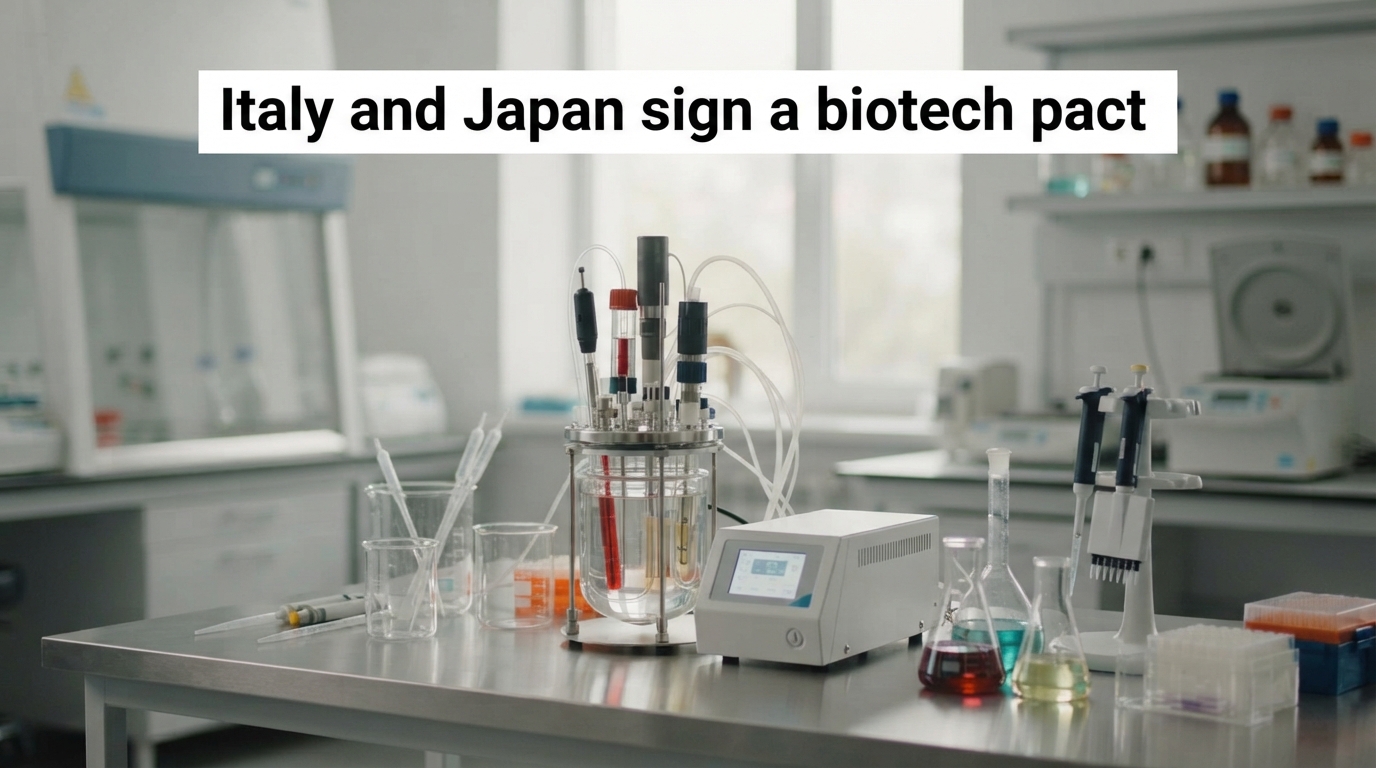
Italy and Japan have signed a dichiarazione di intenti to strengthen scientific cooperation, open new collaborations and develop joint initiatives, according to a press note from Italy’s National Research Council, the CNR.
The declaration is a starting signal for joint biomanufacturing research and pilot-style collaboration, not a funded treaty. In practical terms, it is about turning biomass and waste into useful products through biological processes, and about beginning a joint pipeline for proposals and cooperation.
The Italian note says the deal names biomanufacturing as a strategic priority. It identifies the signatories as Marco Mancini, a senior official at Italy’s university and research ministry, and Yasuyoshi Kakita, a vice minister at Japan’s education, science and technology ministry.
The substance is narrower and more concrete than a generic “science partnership.” The CNR says the intent opens the way to joint research and innovation projects in bioproduction, using microorganisms and enzymes to turn organic waste and biomass into higher-value products such as materials, molecules, active ingredients, bioplastics, biopolymers, biodegradable plastics and biofuels.
In plain terms, biomanufacturing means using biological systems or processes to make useful products, rather than relying only on conventional industrial chemistry. Both sides want that because it can turn waste and biomass into higher-value materials and chemicals.
The available record does not establish the legal or financial architecture behind the declaration. The CNR note does not set out a dedicated budget, timetable or annexed implementation plan, and the underlying signed text was not available in this run.
There is, however, broader bilateral context. Japan’s foreign ministry says the Japan-Italy Action Plan was launched at the G7 summit in Apulia in June 2024, and later official Japanese language in a 2026 joint statement describes the two countries’ relationship as a “Special Strategic Partnership” under a 2024-2027 Action Plan. That joint statement says the two leaders wanted to deepen scientific and technological cooperation in advanced areas including AI robotics, semiconductors and biomanufacturing, alongside industrial partnerships, investment and trade.
So the relationship has two layers: a specific Italy-Japan intent centered on biomanufacturing and bioproduction, inside a wider diplomatic relationship that already had an action-plan framework and later broadened official language. What the record does not yet show is a verified all-sector research program, a binding treaty, or the funding and execution machinery that would turn the intent into a full bilateral scheme.
The phrase “Rome-Tokyo axis” is best treated as a geopolitical gloss, not as a document-backed label for a single integrated program.
What’s in the Italy–Japan science package (by named sector)
Which technology sectors are explicitly named in official Italy–Japan documents—and which one is concrete vs broader framing? This figure lists the technology and industry terms explicitly named in the supplied Italy–Japan documents, separating the concrete biomanufacturing note from the wider diplomatic framing. The biomanufacturing note names a focused set of production pathways and outputs, while the Joint Statement names additional domains including AI robotics, semiconductors, pharmaceuticals, energy, space, information technologies, industrial partnerships, investments, and trade flows. The bars show presence only—each bar means one term was named, not a measure of funding, scale, or activity. — AI-assisted analytic, built only from real cited or sourced data. Source: Notizie Geopolitiche, Consiglio Nazionale delle Ricerche, Ministry of Foreign Affairs of Japan. As of 2026-07-26.
Timeline of Italy–Japan diplomatic vs science/tech steps (2024–2026)
How did Italy–Japan diplomacy (action plan, summit-level steps) and the biomanufacturing science intent move over time? This timeline places Italy–Japan diplomatic milestones alongside the January 2026 joint statement and the CNR’s July 9, 2026 press note on a biomanufacturing declaration of intent. The record shows diplomatic scaffolding before the narrower science-focused announcement; the Bluebook reports the November ACSA milestone only to the month, and the G7 event only as a June 13–15 summit window. Sources: Japan’s Ministry of Foreign Affairs, Diplomatic Bluebook 2025 and Japan–Italy Joint Statement (https://www.mofa.go.jp/policy/other/bluebook/2025/en_html/chapter2/c020502.html; https://www.mofa.go.jp/mofaj/files/100962633.pdf); Consiglio Nazionale delle Ricerche, press note dated 09/07/2026 (https://www.cnr.it/en/press-note/n-14493/italia-e-giappone-uniti-per-il-biomanufacturing). — AI-assisted analytic, built only from real cited or sourced data. Source: Ministry of Foreign Affairs of Japan, Consiglio Nazionale delle Ricerche. As of 2026-07-26.
Source recordSources / claims / limits
How this piece is framed: A two-layer story: the directly documented new cooperation is a sector-specific Italy-Japan intent declaration centered on biomanufacturing and joint bioproduction projects, while separate official Japanese and Italian records show a broader multi-track bilateral relationship that also includes science and technology. The reader should understand the science instrument on its own terms first, then place it inside the wider diplomatic context without assuming the exact nesting, budget, or execution architecture is established here.
Charts & tables — each built only from the cited claims below, by an AI tool
- What’s in the Italy–Japan science package (by named sector) — from claims clm_bb4a0df4a8, clm_5898495f14, clm_2cb7bdd1f6, clm_fd92f5ea69, clm_e24bcc4829 · as of 2026-07-26
- Timeline of Italy–Japan diplomatic vs science/tech steps (2024–2026) — from claims clm_ca8e176d6b, clm_2cb7bdd1f6, clm_fd92f5ea69, clm_e24bcc4829, clm_54e237371b · as of 2026-07-26
Sources
- (primary) Diplomatic Bluebook 2025, Chapter 2: Regional Situations in Europe — Ministry of Foreign Affairs of Japan — https://www.mofa.go.jp/policy/other/bluebook/2025/en_html/chapter2/c020502.html · read in full · captured 2026-07-26
- (primary) Italia e Giappone uniti per il biomanufacturing — Consiglio Nazionale delle Ricerche — https://www.cnr.it/en/press-note/n-14493/italia-e-giappone-uniti-per-il-biomanufacturing · read in full · captured 2026-07-26
- (primary) Japan-Italy Joint Statement (January 16, 2026) — Ministry of Foreign Affairs of Japan — https://www.mofa.go.jp/mofaj/files/100962633.pdf · read in full · captured 2026-07-26
- (secondary) Giappone, asse Roma-Tokyo: diplomazia scientifica motore di nuova partnership — Notizie Geopolitiche — http://www.notiziegeopolitiche.net/giappone-asse-roma-tokyo-diplomazia-scientifica-motore-di-nuova-partnership/ · read in full · captured 2026-07-26
Claims, and how far we tracked each down
- [confirmed] Italy and Japan have signed a dichiarazione di intenti to strengthen scientific cooperation, launch new collaborations, and develop joint initiatives. · read in full (as of 2026-07-26)
- [confirmed] The CNR note says the intent opens the way to joint research and innovation projects in bioproduction, including microbial and enzymatic conversion of biomass and organic waste into high-value materials, molecules, active ingredients, bioplastics, biopolymers, biodegradable plastics, and biofuels. · read in full (as of 2026-07-26)
- [likely] The CNR press note does not mention a dedicated budget, timetable, or named funding instrument for the bilateral biomanufacturing cooperation. · read in full (as of 2026-07-26)
- [confirmed] The strongest official pro-broader-program reading is that Japan and Italy are describing the partnership as extending beyond biomanufacturing into a wider bilateral package of cooperation “in all sectors,” with science and technology explicitly listed among several strands. · read in full (as of 2026-07-26)
- [confirmed] The same Japan-Italy Joint Statement explicitly names multiple tech and industrial domains alongside biomanufacturing: AI robotics, semiconductors, pharmaceuticals, energy, space, information technologies, and industrial partnerships, investments, and trade flows. · read in full (as of 2026-07-26)
- [confirmed] The official Bluebook account of Japan-Italy relations also frames the relationship as multi-track, noting cooperation in security, GCAP, ACSA negotiations, and the launch of the Japan-Italy Action Plan at the 2024 G7 Apulia Summit, rather than a single science-only initiative. · read in full (as of 2026-07-26)
- [confirmed] Even so, the Italian-side official biomanufacturing note remains narrower than the broadest diplomatic framing: it says the intent is to strengthen scientific cooperation and launch new collaborations, but it centers the concrete priority on biomanufacturing and bioproduction. · read in full (as of 2026-07-26)
- [confirmed] The cooperation described in the article is centered on biomanufacturing. · read in full (as of 2026-07-26)
- [confirmed] CNR’s press note identifies the signatories as Marco Mancini, Sottosegretario del Ministero dell'Università e della ricerca (Mur), and Yasuyoshi Kakita, Viceministro dell'Istruzione, cultura, sport, scienza e tecnologia del Giappone (Mext). · read in full (as of 2026-07-26)
- [confirmed] Japan's foreign-ministry record shows a Japan-Italy Action Plan was announced at the June 2024 G7 Apulia Summit. · read in full (as of 2026-07-26)