
Mars Express image of “metallic waves” in Kaiser Crater is frost-lit sand dunes, not metal
ESA and DLR say HRSC data show dark aeolian dunes whose sheen comes from winter hoarfrost on slopes, while clay and gully clues to older water-related processes remain limited to the broader crater terrain.
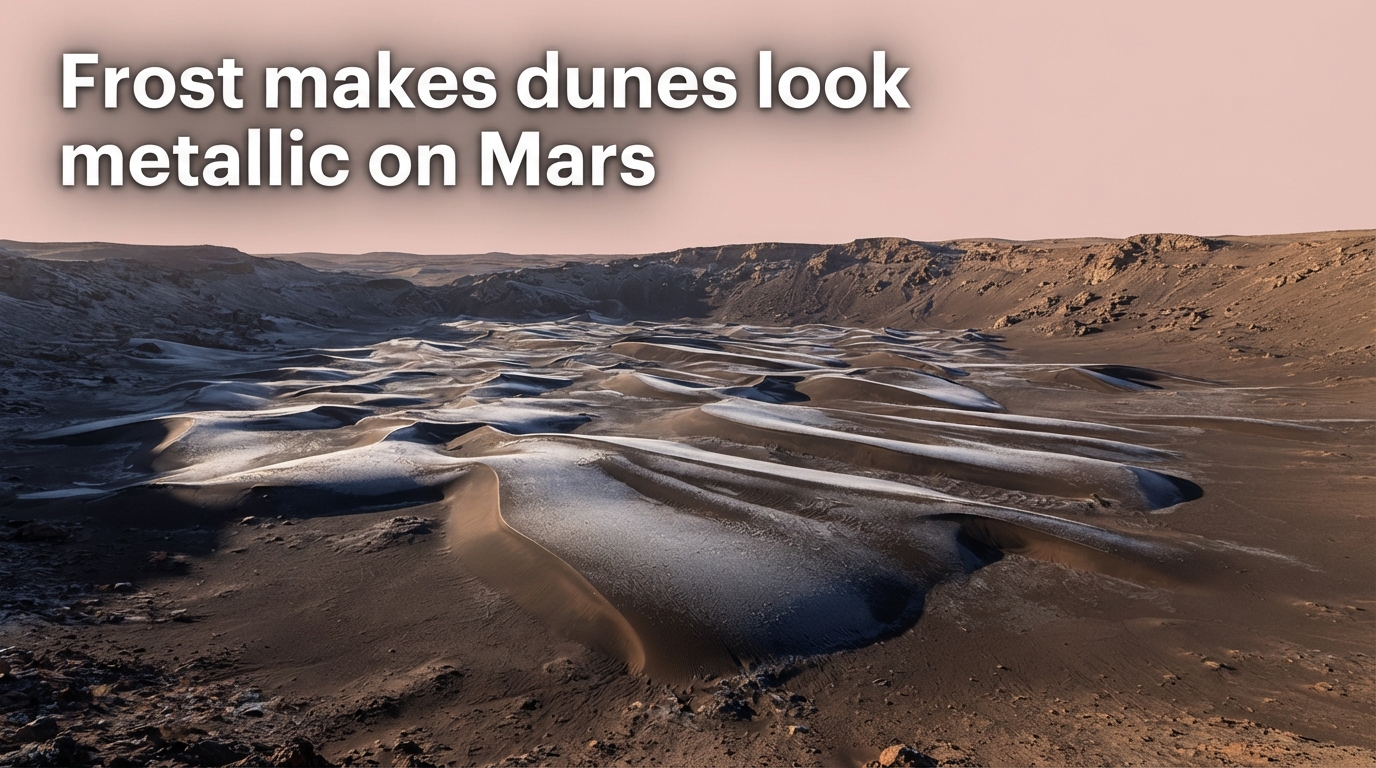
Mars Express is not showing literal metal on Mars. It is showing a dune field on the floor of Kaiser Crater, an impact basin in Noachis Terra, one of Mars’s oldest and most heavily cratered regions. ESA says the craters and worn terrain are part of the ancient southern highlands; DLR adds that Kaiser Crater is about 180–200 km across and that the scene was captured by the High Resolution Stereo Camera on 5 October 2025 during Mars Express orbit 27,461, at roughly 17 metres per pixel, centered near 48°S, 19°E. The metadata locate the scene. They do not, by themselves, prove the later interpretation.
Map: Kaiser Crater in Noachis Terra (with south-polar frost context)
Where Kaiser Crater sits in Mars’s southern highlands, and where it lies relative to the region that can get seasonal south-polar frost This map places the Kaiser Crater scene center (about 48°S, 19°E) within the USGS-mapped named extent of Noachis Terra and marks the south pole for orientation. The inset shows the late-winter seasonal frost reach schematically to about 55°S, as described by ESA; it is a latitude-band guide, not an exact ice boundary or topographic map. Sources: German Aerospace Center (DLR), Kaiser Crater scene release; USGS Planetary Names, Noachis Terra; European Space Agency, “Cryptic Mars, a land shaped by ice”. — AI-assisted analytic, built only from real cited or sourced data. Source: German Aerospace Center (DLR), European Space Agency. As of 2026-07-26.
What looks like “metallic waves” is a set of dark dunes. ESA describes them as sand dunes sculpted by wind, and DLR says the individual dunes include barchans, barchanoid ridges, and transverse dunes. Both releases treat the shape as an aeolian story: sand moved and accumulated under prevailing winds. DLR says the wind in this part of Mars blows predominantly from the west, and ESA says the dune field can be thought of as dunes that have been moulded by martian winds. That is the physical mechanism the image is meant to convey.
The shiny look comes from frost, not metal. ESA says bright frost deposits on the dunes’ south-facing slopes create the metallic appearance, and DLR says the image was taken in the second half of southern winter, when hoarfrost can extend to mid-latitudes. Hoarfrost is a thin frost layer, and here it is being used as the visual explanation for the sheen.
The crater’s broader context is more tentative. Both mission pages mention light-toned or bright deposits in parts of the scene that expose clay minerals, which they say likely formed when basalt weathered in the presence of water. They also mention gullies on steeper walls of some smaller nearby craters. But they keep that discussion separate from the dune field itself: the metallic-looking dunes are explained by dune shape plus frost, while the clay-mineral and gully clues sit in other parts of the crater terrain and do not directly explain the sheen on the dunes. DLR says the gully mechanism is not conclusively established; dry landslides are the main explanation, while meltwater or temporary groundwater is only a possibility for some older gullies. ESA makes the same split. That means the water-related language belongs to the broader crater terrain, not to the metallic-looking dunes.
The observation matters because the camera and orbit details are the basis for tying this reading to that exact patch of Kaiser Crater rather than to Mars in general. Kaiser Crater is an old Martian landscape where wind still moves sand, winter frost can change how that sand looks, and nearby crater walls may preserve clues to older water-related processes. The image does not show a metallic surface, and it does not, on its own, turn the dune field into evidence for a wet Mars.
Source recordSources / claims / limits
How this piece is framed: A mission-image interpretation story about a specific Mars Express HRSC scene in Kaiser Crater: dark dunes shaped by wind, a seasonal hoarfrost sheen that makes them look metallic, and a cautious side note about nearby gullies and clay minerals in the broader crater terrain. The load-bearing reality is the landscape mechanics and the limits of the water-related inference, not the headline phrase or the mission release itself.
Charts & tables — each built only from the cited claims below, by an AI tool
- Map: Kaiser Crater in Noachis Terra (with south-polar frost context) — from claims clm_00913f71ea, clm_0fd49a9e45, clm_5d2e5a0d54, clm_5ef7aedd5f · as of 2026-07-26 · ⚠ figures not all matched to the cited claims: 19.0, 48.0, 0.0, 90.0, 60.0, 4.94, 80.0, 84.94, 55.0
Sources
- (primary) Piled up by wind god Aeolus – dunes in Kaiser Crater on Mars — German Aerospace Center (DLR) — https://www.dlr.de/en/latest/news/2026/piled-up-by-wind-god-aeolus-dunes-in-kaiser-crater-on-mars · read in full · captured 2026-07-26
- (primary) Metallic waves on ancient Mars — European Space Agency — https://www.esa.int/Science_Exploration/Space_Science/Mars_Express/Metallic_waves_on_ancient_Mars · read in full · captured 2026-07-26
Claims, and how far we tracked each down
- [confirmed] ESA’s “metallic waves” story refers to dune fields in Kaiser Crater on Mars, not metallic waves in the atmosphere. · read in full (as of 2026-07-26)
- [confirmed] The feature is in Kaiser Crater in Noachis Terra, an ancient region in Mars’s southern highlands. · read in full (as of 2026-07-26)
- [confirmed] The relevant imagery was taken by the High Resolution Stereo Camera (HRSC) on Mars Express. · read in full (as of 2026-07-26)
- [confirmed] The DLR release says the HRSC image was taken on 5 October 2025 during Mars Express orbit 27,461. · read in full (as of 2026-07-26)
- [confirmed] The dune field’s metallic appearance is caused by bright hoarfrost deposits on south-facing slopes. · read in full (as of 2026-07-26)
- [confirmed] The dunes are composed of dark volcanic material and are shaped by wind. · read in full (as of 2026-07-26)
- [confirmed] The dune field includes barchans, barchanoid ridges, and transverse dunes. · read in full (as of 2026-07-26)
- [confirmed] The wind in the area came predominantly from the west. · read in full (as of 2026-07-26)
- [confirmed] ESA’s release says the metallic-looking waves are sand dunes shaped by Martian winds, and that the shiny appearance comes from bright frost deposits on south-facing slopes. · read in full (as of 2026-07-26)
- [likely] DLR says the image was taken during the second half of southern winter, when hoarfrost cover extends from the South Pole to some mid-latitudes. · read in full (as of 2026-07-26)
- [likely] Wind erosion exposed light-toned clay minerals that likely formed through interaction between basalt and water. · read in full (as of 2026-07-26)
- [confirmed] DLR says the exposed bright deposits indicate clay minerals, which typically form through weathering of basalt in contact with water, while some older gullies may have formed with meltwater or temporary groundwater and many active gullies are best explained by dry landslides. · read in full (as of 2026-07-26)
- [confirmed] DLR’s Kaiser Crater release ties the gully interpretation to some of the smaller craters near the dune field, not to the dunes themselves, and says the channel formation is not conclusively established. · read in full (as of 2026-07-26)
- [likely] The DLR release mentions meltwater or temporary groundwater only as a possible explanation for some older gullies, not as established evidence for the immediate Kaiser dune field. · read in full (as of 2026-07-26)
- [confirmed] The ESA release separately describes small gullies and narrow channels on steeper crater walls, saying they were likely formed by dry landslides, while older gullies may reflect melting ice or buried groundwater reservoirs. · read in full (as of 2026-07-26)
- [confirmed] Both mission releases separate the dune-field story from the gully discussion: the dunes are explained by wind and frost, while gullies are treated as nearby crater-wall features with tentative formation hypotheses. · read in full (as of 2026-07-26)
- [confirmed] The release does not establish that the dunes themselves preserve evidence of Mars’s lost atmosphere. · read in full (as of 2026-07-26)