
Small forest-floor animals can carry viable seeds, but forest regeneration is unproven
A 2026 review brings together evidence that slugs, beetles, crickets, earwigs and woodlice can sometimes pass intact, viable seeds—but the studies rarely show whether those seeds germinate and become adult plants.


What happenedA 2026 review brings together evidence that some slugs, beetles, crickets, earwigs and woodlice can ingest seeds and later pass at least some intact and viable, while the accessible evidence does not establish how often this produces new plants; freshwater crabs are included in the review's reported scope but their case-level evidence was not independently verified.
Why it mattersThe reader can separate a newly documented route of short-range seed movement from proven forest regeneration: invertebrates may supplement local dispersal in particular forest-floor settings, but their value cannot yet be measured as an equivalent substitute for larger vertebrate dispersers or used as an established restoration intervention.
Still openHow often do seeds that survive invertebrate gut passage move to suitable sites, germinate and recruit into adult plants, and can that process compensate for lost vertebrate dispersal? Grounded in clm_77087d4f56, clm_15ac0d7e2c, clm_a6b0690a61 and clm_e8f498bb33.
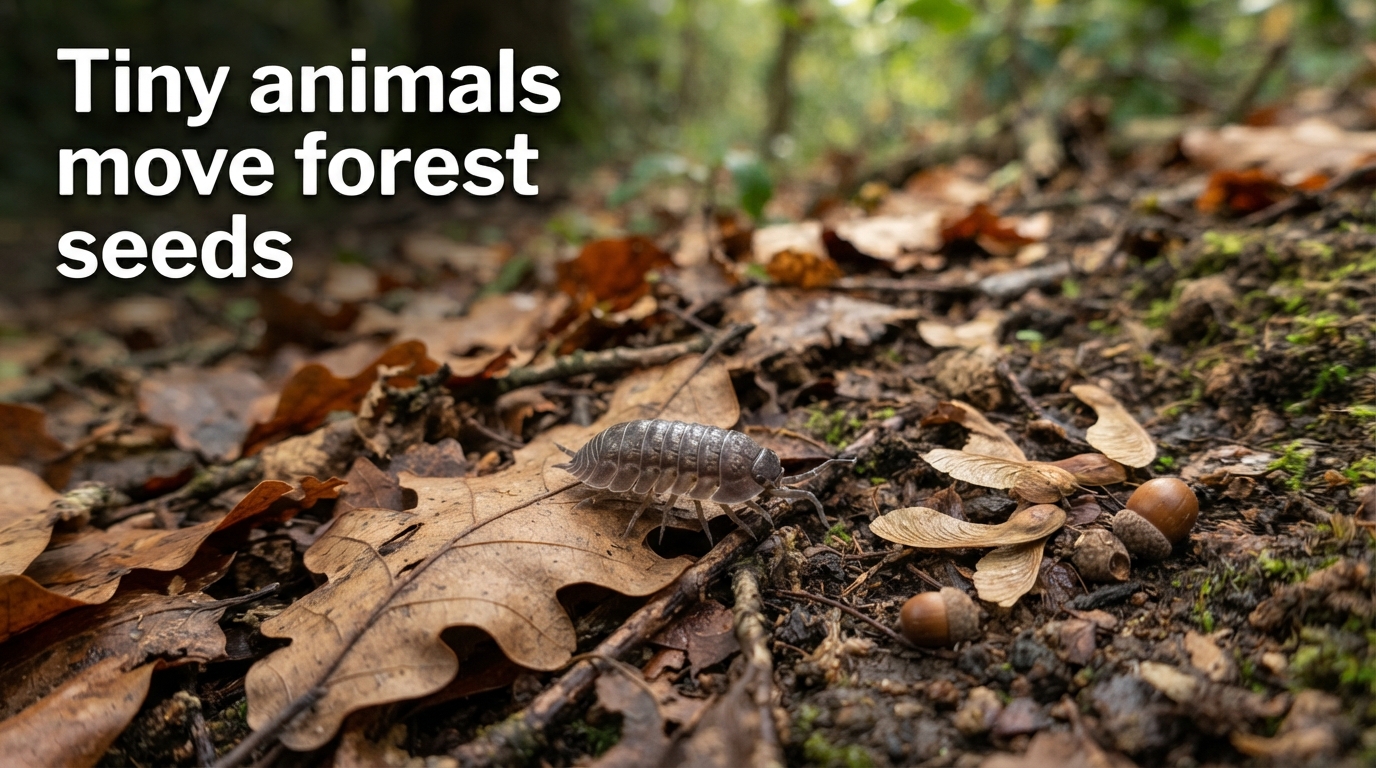
A 2026 review brings together evidence that some slugs, beetles, crickets, earwigs and woodlice eat seeds and later pass at least some of them intact and viable. The finding establishes a possible route for short-range seed movement across the forest floor, not a demonstrated replacement for the birds and mammals that disperse seeds over longer distances or proof that new forests result.
The missing steps come after the seed survives
Small forest-floor animals sometimes carry plant seeds through their guts and release some of them elsewhere. Ecologists call this invertebrate endozoochory: internal seed dispersal by an invertebrate that eats a seed and later defecates it, potentially away from the parent plant.
The biological sequence is longer than ingestion and passage. A seed must survive digestion, move away from the parent plant, land in a suitable forest-floor microsite—such as soil, leaf litter, sheltered debris or a burrow—remain viable, germinate and eventually recruit into an adult plant. Seed-dispersal effectiveness measures that fuller outcome, including how many seeds move, where they are deposited and whether they produce new plants.
The strongest evidence in the review’s case base reaches the first part of that chain: consumption, gut passage and, in some cases, viable seeds in faeces. The available evidence does not establish how often the entire chain ends in adult-plant recruitment at ecosystem scale.
Camel crickets left far more seeds intact than woodlice or earwigs
In the Japanese study, what share of recovered seeds remained intact after passage through camel crickets, woodlice and earwigs? This chart shows the share of recovered seeds that remained intact after passage through camel crickets, woodlice and earwigs in one controlled Monotropastrum humile study. Camel crickets had the highest intactness result (83.8%), while woodlice and earwigs were near one-third; intactness does not demonstrate movement distance, recruitment or new-plant production. — AI-assisted analytic, built only from real cited or sourced data. Source: Plants, People, Planet / Wiley. As of 2026-08-04.
What the 2026 review adds
The review, published in Trends in Plant Science by researchers including Si-Chong Chen of the University of Hong Kong and Japanese plant ecologist Kenji Suetsugu, synthesises evidence from 43 peer-reviewed publications involving at least 51 invertebrate species and 186 plant taxa across Oceania, Asia, Europe and North America. Seed-dispersal research has traditionally centred on birds and mammals, with ants as the familiar invertebrate example. The synthesis argues that this picture is incomplete: other small, ground-dwelling animals can also be potential seed vectors.
The publisher preview does not include the full methodology or the group-by-group evidence table, so the review’s overall scope is clear but the published material does not show how each case was assessed for intactness, viability, movement, deposition and recruitment.
The reported cases also share a plausible ecological pattern. They often involve very small or dust-like seeds, relatively durable seed coats and fruits close to the ground. The woodlouse Porcellio scaber, for example, is about 8–11 millimetres long and was identified in the Japanese research as the smallest recorded internal seed-dispersal agent. These traits are consistent with a recurring “invertebrate endozoochory syndrome,” but they do not prove that plants evolved specifically to use these animals.
One plant, three animals, three outcomes
A controlled Japanese study of the forest-floor plant Monotropastrum humile shows why “invertebrate” is too broad a category to predict the result. Camel crickets, woodlice and earwigs all consumed the plant’s fruits, and some faecal pellets contained intact seeds.
Of the seeds recovered after passage, 83.8% were intact after camel-cricket consumption, compared with 31.2% after woodlouse passage and 33.5% after earwig passage. Chemical staining used to test viability found no significant difference between recovered seeds and seeds taken directly from fruits. But woodlice and earwigs destroyed a larger share of the seeds they consumed, making them less effective partners in this experiment than camel crickets.
The study demonstrates gut passage and uneven seed damage under controlled conditions. It does not show how far the animals moved the seeds in the wild, where they deposited them, how many germinated in forest soil or whether any became adult plants.
The direction can also reverse. In a controlled experiment involving four gastropod species and seeds from five plant species, the invasive slug Arion lusitanicus—also referred to in some literature as Arion vulgaris—damaged more seeds and reduced germination more than the native gastropods tested. The net result depends on the particular animal–plant pairing, seed traits, gut processing and local abundance. Some invertebrates can provide passage; others can function mainly as seed predators.
Field studies show removal, not yet recruitment
Evidence from German beech forests moves the question out of the laboratory but stops short of proving dispersal. Researchers surveyed 105 beech-dominated plots across three German regions and ran a 47-plot experiment using seeds of Anemone nemorosa and Asarum europaeum. After three days, gastropod access accounted for most of the observed removal, while insects made only a marginal contribution.
The result challenges an ant-only model of seed movement in shaded forests where ants are uncommon. Gastropods may supplement—or in some settings partially substitute for—ants. But the study did not track the removed seeds’ movement, germination or seedling recruitment. Its authors explicitly said the fate of those seeds was unknown. A seed disappearing from a depot is not yet a seed establishing elsewhere.
A possible supplement, not a replacement
The conservation question arises as defaunation, the loss or reduction of animal populations, removes large birds and mammals from forests and habitat fragmentation breaks dispersal networks. Short-range movement by animals in soil and leaf litter could still help some plants avoid remaining concentrated beneath their parent. Its value will depend on the species, the distance, the deposition site and the surrounding landscape.
It cannot yet be treated as equivalent compensation for the loss of vertebrate dispersers. A global analysis links vertebrate defaunation with reduced forest regeneration, especially after the loss of primates and birds, but does not show that invertebrates restore the same long-distance dispersal, gene flow or carbon-storage functions. Nor does a Bornean study showing insects and fungi compensating for lost seed predation demonstrate replacement of seed dispersal; those are different ecological processes.
The durable finding is therefore narrower and more useful: small animals on the forest floor can sometimes move seeds through their guts without destroying them. Whether that pathway produces enough surviving seedlings to alter plant populations or regenerate forests remains an empirical question, one that requires field measurements of deposition, germination and adult-plant recruitment.
Source recordSources / claims / limits
How this piece is framed: Small forest-floor animals can sometimes carry viable seeds, but the evidence is strongest for a biological pathway and weakest at the point that matters most: whether those seeds are deposited, germinate and produce new plants. The 2026 review is the news-bearing synthesis that brings this evidence ladder into view.
Charts & tables — AI-assisted; provenance on each line
- Camel crickets left far more seeds intact than woodlice or earwigs — from claims clm_1662d80373, clm_99426c29de, clm_77f17b3c9a · as of 2026-08-04
Sources
- (primary) Invertebrate endozoochory: An overlooked pathway of seed dispersal — Trends in Plant Science / Elsevier — https://www.sciencedirect.com/science/article/pii/S1360138526001858 · read in full · captured 2026-08-04
- (primary) Earwigs and woodlice as some of the world's smallest internal seed dispersal agents: Insights from the ecology of Monotropastrum humile — Plants, People, Planet / Wiley — https://nph.onlinelibrary.wiley.com/doi/full/10.1002/ppp3.10519 · read in full · captured 2026-08-04
- (primary) Gastropod Seed Dispersal: An Invasive Slug Destroys Far More Seeds in Its Gut than Native Gastropods — PLOS ONE / PubMed Central — https://pmc.ncbi.nlm.nih.gov/articles/PMC3783466/ · read in full · captured 2026-08-04
- (primary) Fungi and insects compensate for lost vertebrate seed predation in an experimentally defaunated tropical forest — Nature Communications — https://www.nature.com/articles/s41467-021-21978-8 · read in full · captured 2026-08-04
- (primary) HKU-led Review Highlights Hidden Seed Dispersers in Forest Regeneration — The University of Hong Kong — https://www.hku.hk/press/news_detail_29253.html · read in full · captured 2026-08-04
- (primary) Quantifying the impacts of defaunation on natural forest regeneration in a global meta-analysis — Nature Communications — https://www.nature.com/articles/s41467-019-12539-1 · read in full · captured 2026-08-04
- (primary) Are Gastropods, Rather than Ants, Important Dispersers of Seeds of Myrmecochorous Forest Herbs? — The American Naturalist / University of Chicago Press; author-hosted copy at Technical University of Munich — https://www.lss.ls.tum.de/fileadmin/w00bds/toek/05_Publikationen/PDF_Mittarbeiter/PDF_Publikationen/2012-01.pdf · read in full · captured 2026-08-04
- (primary) New record holder for smallest dispersers of ingested seeds: Woodlice — Kobe University — https://www.kobe-u.ac.jp/en/news/article/20240509-65288 · read in full · captured 2026-08-04
- (primary) Seed dispersal effectiveness in fragmented and defaunated landscapes — Ecosphere — https://esajournals.onlinelibrary.wiley.com/doi/10.1002/ecs2.4658 · read in full · captured 2026-08-04
- (primary) Invertebrate endozoochory: An overlooked pathway of seed dispersal — Trends in Plant Science / Elsevier — https://www.sciencedirect.com/science/article/abs/pii/S1360138526001858 · read in full · captured 2026-08-04
Claims, and how far we tracked each down
- [confirmed] Invertebrates including orthopterans, gastropods and beetles can function as internal seed dispersers by ingesting seeds and later defecating at least some seeds intact and viable. · read in full (as of 2026-08-04)
- [confirmed] The 2026 review synthesised evidence from 43 peer-reviewed publications involving at least 51 invertebrate species and 186 plant taxa. · read in full (as of 2026-08-04)
- [likely] Plants involved in invertebrate endozoochory often produce small or dust-like seeds with durable coats and fruits positioned near the ground. · read in full (as of 2026-08-04)
- [confirmed] The 2026 review describes this recurring combination of plant traits as an invertebrate endozoochory syndrome. · read in full (as of 2026-08-04)
- [confirmed] In the Japanese Monotropastrum humile study, camel crickets, woodlice and earwigs consumed fruits and some of their faecal pellets contained intact seeds. · read in full (as of 2026-08-04)
- [confirmed] In the Monotropastrum humile study, 83.8% of seeds recovered after camel-cricket passage were intact, compared with 31.2% after woodlouse passage and 33.5% after earwig passage. · read in full (as of 2026-08-04)
- [confirmed] In the Monotropastrum humile study, TTC staining found no significant difference in viability between seeds excreted by camel crickets, woodlice or earwigs and seeds taken directly from fruits. · read in full (as of 2026-08-04)
- [confirmed] Woodlice and earwigs were less efficient seed dispersers than camel crickets in the Monotropastrum humile study because they destroyed a larger share of consumed seeds. · read in full (as of 2026-08-04)
- [confirmed] The invasive slug Arion lusitanicus damaged more seeds and reduced germination more than the native gastropods tested in the controlled experiment. · read in full (as of 2026-08-04)
- [confirmed] Invertebrate seed consumption can have either mutualistic or antagonistic effects depending on the animal–plant combination. · read in full (as of 2026-08-04)
- [confirmed] The German beech-forest study sampled 105 beech-dominated plots across three German regions. Vegetation was measured in 20 × 20 m core areas, while ants and gastropods were sampled with three pitfall traps per plot from May through October 2008. Ant abundance was represented by the proportion of pitfall samples containing ants, and ant and gastropod species were not identified in those surveys. · read in full (as of 2026-08-04)
- [confirmed] The removal experiment used seeds of Anemone nemorosa and Asarum europaeum. In 47 plots, batches of 10 seeds were placed on sheltered 10 × 10 cm wooden depots under four access treatments: all animals; rodents and insects; gastropods and insects; or insects only. Gastropods were excluded with slug-repellent paste and rodents with a metal cage. · read in full (as of 2026-08-04)
- [confirmed] After three days, 26% of all exposed seeds had been removed: 598 Anemone nemorosa seeds, or 17%, and 1,299 Asarum europaeum seeds, or 35%. The analysis included 722 of 752 depots after excluding depots destroyed by animals and depots where gastropod exclusion failed. Gastropod access accounted for most removal, while insects contributed only marginally; the pattern was consistent across regions and forest-management types. · read in full (as of 2026-08-04)
- [confirmed] The authors explicitly state that the fate of seeds removed in their experiment was unknown and that they could only speculate about whether the seeds had been dispersed. They nevertheless conclude that gastropods may substitute for ants as seed dispersers in mature, shaded beech forests where ants are rare or absent. · read in full (as of 2026-08-04)
- [confirmed] Established seed-dispersal effectiveness research defines effective dispersal more strictly than intact seed passage: it combines the number of dispersal events with the probability that a dispersed seed produces a new adult, with deposition habitat and spatial scale affecting the outcome. · read in full (as of 2026-08-04)
- [likely] Invertebrate dispersal generally operates over shorter distances than dispersal by birds and mammals, but short-range deposition can still reduce concentration near the parent plant or place seeds in suitable microsites. · read in full (as of 2026-08-04)
- [confirmed] The available evidence does not establish how much invertebrate-mediated seed dispersal contributes to adult plant recruitment at ecosystem scale. · read in full (as of 2026-08-04)
- [confirmed] The 2026 review presents invertebrates as complementary to, rather than replacements for, vertebrate seed dispersers. · read in full (as of 2026-08-04)
- [confirmed] A global meta-analysis found that observed real-world vertebrate defaunation was associated with reduced forest regeneration, especially after loss of primates and birds; the authors present replacement by smaller or abiotic dispersal modes as a possible compositional shift, not as proof of equivalent restoration of long-distance dispersal or carbon-storage functions. · read in full (as of 2026-08-04)
- [confirmed] Short-range movement can contribute to local recruitment, but its value is species- and landscape-dependent: a spatially explicit study found that severe fragmentation reduced short- and intermediate-distance seed-dispersal effectiveness, while defaunation effects varied by disperser and spatial scale. · read in full (as of 2026-08-04)
- [likely] The independent discussion landscape supports describing invertebrate endozoochory as an overlooked potential pathway, but does not support treating viable passage as demonstrated ecosystem-scale restoration or recruitment service. · read in full (as of 2026-08-04)
- [confirmed] In a Bornean field experiment involving five tree species, reduced large-vertebrate seed predation was compensated by insects and fungi, leaving overall seed survival unchanged and producing no defaunation effect on seedling establishment. · read in full (as of 2026-08-04)
- [confirmed] The publisher preview of the 2026 review exposes its abstract, highlights, section snippets and reference list, but not the full article or a group-by-group evidence table. It supports the review's broad thesis and stated scope, but does not permit independent auditing of the reported 43 publications, 51 invertebrate species, 186 plant taxa, geographic coverage, or the evidence thresholds used for individual crab and beetle cases. · read in full (as of 2026-08-04)
- [confirmed] The accessible review preview describes endozoochory as ingestion followed by gut passage and defecation and says that the review applies a seed-dispersal-effectiveness framework while identifying recruitment gaps. Its accessible text does not provide enough case-level detail to determine whether all records counted in the headline totals documented intact seeds, viability, movement, deposition context and recruitment consistently. · read in full (as of 2026-08-04)