
Article
Turkey reports new fragment of world's oldest peace treaty at Hattusa
The piece is said to preserve a 3,300-year-old clause that homes not be destroyed after fugitives were sent back — protection after forced return, not a right to remain — and the reading still awaits a published transcription and peer review.


Pictures in this frame are AI-generated, not photographs.
What happenedTurkey's culture minister said a one-face clay fragment from Hattusa's Buyukkale citadel, studied for about a year, is a new Akkadian copy of the 13th-century BC Hittite-Egyptian Kadesh treaty preserving its fugitive-return articles.
Why it mattersThe clause protects homes and families after people were forced back to the other kingdom — unusually humane for the Bronze Age but the opposite of modern asylum — so quoting it as timeless refuge misreads how the treaty worked.
Still openNo Akkadian transcription, named epigrapher or script analysis has been published, so it is unclear whether 'homes not be destroyed' is a new variant or duplicates known lines, and whether the reading survives peer review.
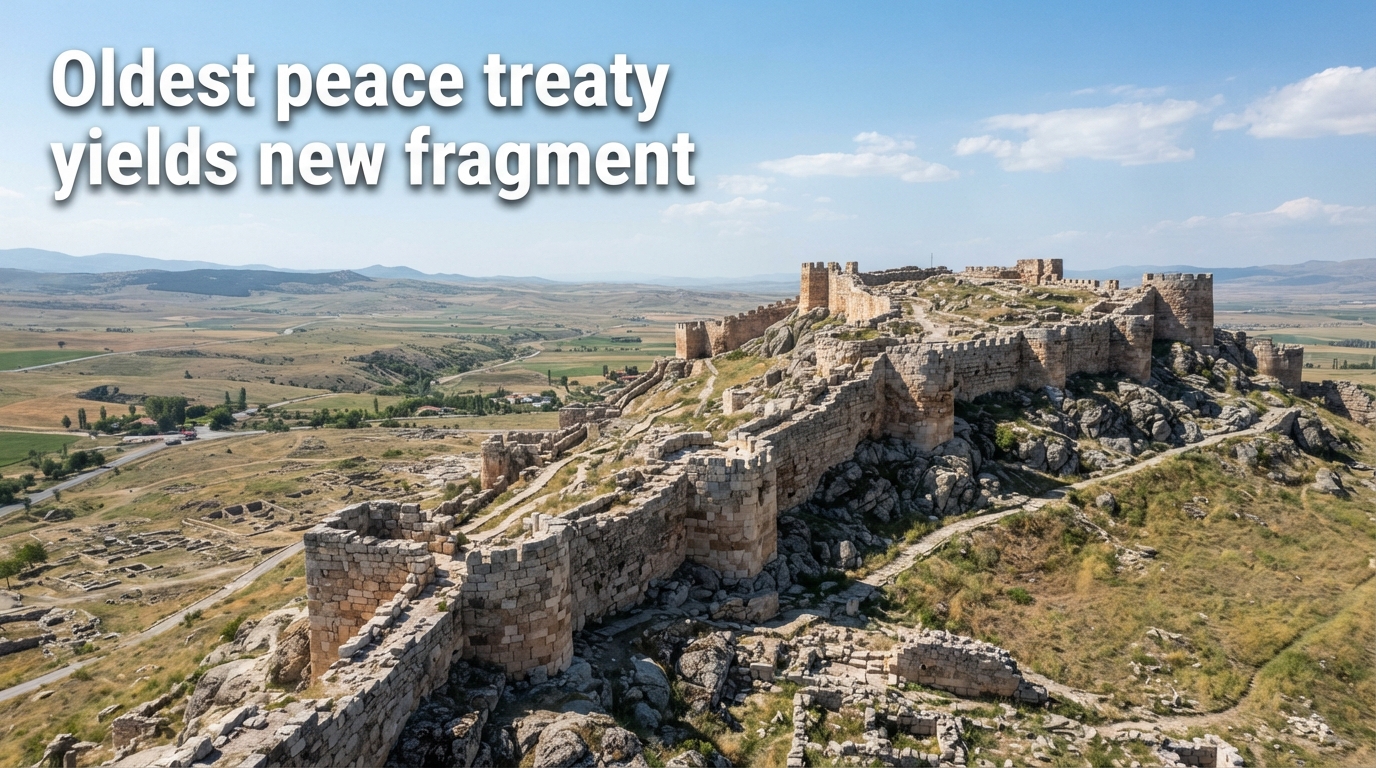
On 21 September 2026, World Peace Day, Turkey's culture and tourism minister Mehmet Nuri Ersoy said a clay fragment found on the royal citadel of Hattusa had been identified after about a year of study as a new copy of the Kadesh Peace Treaty, the 13th-century BC agreement between the Hittite Empire and Egypt that is the oldest surviving written peace treaty. The piece is said to preserve the section on people who fled from one kingdom to the other, including wording that their homes not be destroyed. No Akkadian transcription, specialist name or script analysis has been published, so whether that wording is new or duplicates known lines cannot yet be judged.
Forced return with protections, not asylum: what the new fragment adds
| What the treaty says (Articles 12–20, scholarly reading) | How it is being framed (Ministry / media) | |
|---|---|---|
| Who is covered | People who fled Egypt for Hatti, or Hatti for Egypt. | He expressed hope for peace and safety for Palestinians and all people. |
| Obligation | Each king must return fugitives to the other side. | “We have found traces of peace dating back thousands of years in the soil of Anatolia.” |
| Protection | Returned persons and their families are not to be punished, and their homes are not to be destroyed. That limit applies after they are sent back. | The words on destruction of homes “carry a powerful message from thousands of years ago to the present.” |
| Modern analogue | Bronze Age interstate extradition and control: two kings agree to send fugitives back. Not modern asylum or non-refoulement (a ban on returning someone to danger). | Linked to a present-day responsibility to protect human life and dignity. |
What the fugitive clauses actually require — and what they are being presented as meaning. The table sets the Kadesh treaty’s fugitive rules (Articles 12–20) next to how Culture and Tourism Minister Mehmet Nuri Ersoy described the new Hattusa fragment on 21 September 2026. The clauses send people who fled between Egypt and Hatti back to the other king, and only then forbid punishment of those people, their families, and their homes; the announcement treats the homes line as a timeless message of peace and human dignity. The full Akkadian transcription is not yet published, so this follows the ministry summary: the fragment is reported to name the Egypt–Hatti flights and the homes line, while the return duty and the ban on punishing families are the scholarly reading of the wider articles. — AI-assisted analytic, built only from real cited or sourced data. Source: Yeni Şafak, Türkiye Today, News.az. As of 2026-09-22.
Hattusa, near the modern village of Boğazkale in central Turkey's Çorum Province, was the Hittite capital from about 1650 BC. Its palace and temple archives held about 25,000 clay tablets in cuneiform — wedge-shaped writing pressed into clay — now a UNESCO World Heritage Site and Memory of the World archive.
The new piece came from Büyükkale, the fortified royal citadel at the city's heart, near a structure called Building E. Only one face survives; the rest is broken away. That palace context fits the pattern: Hattusa's diplomatic copies were stored there. If confirmed, it would join Akkadian copies first excavated at Hattusa in 1906-1912 and now dispersed among museums in Istanbul, Ankara, Berlin and St Petersburg after the early practice of dividing finds between excavators and host country. Excavations at Büyükkale, currently led by the Istanbul branch of the German Archaeological Institute under Prof. Andreas Schachner, are continuing in hopes of finding joining pieces. No dimensions, condition report, conservation location or display plan has been announced.
How it was identified is also narrow. The clay was not scientifically dated. The treaty is dated historically to about 1259 BC, some 15 years after the Battle of Kadesh around 1274 BC, by Hittite-Egyptian chronology. According to the ministry, attribution rests on language — Akkadian, the diplomatic lingua franca of the Late Bronze Age Near East — plus handwriting style and overlap with known manuscripts. The ministry described this only as "bilimsel incelemelerle belirlendi" — determined by scientific examinations — thanking the excavation team and scientists without naming an Assyriologist or publishing the analysis. No peer-reviewed publication or institute bulletin on the fragment has appeared. Until a transcription is published, the identification remains a ministry claim, not an independently authenticated reading. The ministry said the fragment had undergone about a year of detailed examination before the 21 September unveiling — a communications choice, not a scientific date.
Forced return, not refuge
What the fragment is said to preserve is Articles 12-20, the section regulating people who fled the lands of Egypt and Hatti. In the ministry summary, readable lines refer to people fleeing and include that their homes not be destroyed.
In the treaty as previously known, those articles imposed a reciprocal obligation: each king must return fugitives to the other side, and neither side may punish or harm the returned persons and their families. The newly highlighted home-protection wording sits inside that framework. It is unusually humane for the Late Bronze Age in explicitly protecting persons and property after return, but it is a Bronze Age interstate control mechanism, not a right to remain.
That distinction is the core dispute. Scholarship summarized by Arkeonews on the same material cautions: "These were diplomatic obligations negotiated between two ancient rulers, rather than asylum protections comparable to modern refugee law." The clause protects people after forced return; it does not protect them from return. Modern refugee law centres on not sending people back to danger and on an individual's right to seek asylum — ideas with no counterpart in the Kadesh framework, which has no notion of double criminality or a political-offence exception.
The two empires that made the treaty, the battlefield between them, and the citadel where the new piece was found. This locator map places the Hittite capital at Hattusa, the Battle of Kadesh site in Syria, the Egyptian treaty inscriptions at Karnak and the Ramesseum, and modern Ankara and Istanbul; the inset shows the UNESCO-tagged Hattusa site boundary and Büyükkale citadel. The geography makes the story legible at a glance: the treaty's battlefield lay between the two imperial centers, while the newly identified fragment was found at the Hittite capital. Building E is not marked because no verified coordinate was supplied; plotted coordinates come from Wikidata country outlines from Natural Earth and the Hattusa boundary from OpenStreetMap's UNESCO-tagged site relation cross-checked against UNESCO — AI-assisted analytic, built only from real cited or sourced data. Source: Yeni Şafak, Türkiye Today, News.az. As of 2026-09-22.
The inversion is visible in how the announcement was heard. SyriacPress headlined the same fragment as containing "provisions on the treatment of asylum seekers," describing "individuals seeking asylum" — a natural modern gloss on people who fled, but one that installs a legal status the treaty does not grant. Arkeonews, working from the same ministry material, warned against that reading. The ministry's own emphasis — detaching the home-protection line from the forced-return obligation and presenting it as timeless humanitarian protection — makes the presentist reading easy to reproduce. The full Akkadian phrasing has not been released, so it is not possible to say whether the "homes not be destroyed" wording adds anything new or duplicates lines already known.
From battlefield to parity — and a World Peace Day stage
The Kadesh treaty ended decades of rivalry over Syria after the Battle of Kadesh, an indecisive clash around 1274 BC between Egyptian pharaoh Ramesses II and Hittite king Muwatalli II, predecessor of Hattusili III. About fifteen years later Hattusili III and Ramesses II concluded a parity treaty — unusual for its time in addressing the two kings as equals and pledging "good peace and good fraternity forever."
Beyond ending war, it set mutual non-aggression, mutual assistance against third parties, and the extradition provisions now in focus. Originals were inscribed on silver tablets, now lost. What survives is both sides' copies: Egyptian hieroglyphs carved on temple walls at Karnak and the Ramesseum, and Hittite copies in Akkadian cuneiform on clay at Hattusa. That dual survival makes it the only Late Bronze Age treaty with both parties' versions extant, and the reason an enlarged copy is displayed at United Nations Headquarters in New York as a symbol of diplomacy. The new fragment does not rewrite that framework. At most it enriches one section — a rare Bronze Age example of interstate law regulating individuals, not just rulers — and shows the Hattusa archive is still incomplete.
The International Day of Peace, observed by the United Nations on 21 September as World Peace Day, provided the stage. Ersoy said the statements concerning destruction of homes "carry a powerful message from thousands of years ago to the present," presenting the home-protection wording as a message about protecting human life and dignity and linking it explicitly to hope that Palestinians can live in safety.
Taken on its own terms, the ministerial reading steelmans to this: Anatolia has been a land of peace for millennia, and even Bronze Age great powers recognised that homes and families should not be destroyed when people were sent back — a humane element worth recalling when heritage is quoted for present diplomacy.
The scholarly counter-reading steelmans differently: the humane element is real, but it cannot be detached from forced return. The treaty obliges return; the protection applies after. Presenting home-protection as if it were early asylum misdescribes the mechanism and obscures that the treaty offers no right to remain.
A third reading, from heritage-diplomacy analysts, notes pattern rather than motive. Researchers have documented how Turkish archaeology is often framed with superlatives — "oldest," "first," centring Anatolia — and how cultural heritage has become a political resource. In that light, analysts argue, a year-long study unveiled on World Peace Day with foreign-policy messaging should be read also as state soft-power communication, not purely scholarly publication. That is a plausible analogy drawn from reporting on other heritage rollouts, not direct evidence that this date was chosen for soft power, and no independent response from the German Archaeological Institute or Egyptian antiquities authorities to the Articles 12-20 reading or the Palestine-linked framing has appeared to test it.
What remains open is philological, not political: the exact Akkadian text, whether it joins an existing tablet in Istanbul, Ankara, Berlin or St Petersburg or represents a separate copy, where it will be conserved and when it will be accessible. Until the transcription and criteria are published, the fragment is best held as a promising archival addition whose most quoted line — homes not destroyed — is genuine in its humane impulse and limited in its legal meaning: protection after return, not protection from return.
Source recordSources / claims / limits
How this piece is framed: A new piece of the world's oldest peace treaty — and the gap between what it actually says and what it's being made to say
Charts & tables — AI-assisted; provenance on each line
- Forced return with protections, not asylum: what the new fragment adds — from claims clm_9ef956e4c9, clm_5b624383b6, clm_a07c259973, clm_ccb1b50287, clm_8f18a73da9, clm_566eb5761c, clm_4a47199765, clm_8bd158eb0c, clm_f1c627064a · as of 2026-09-22
- Where the world's oldest peace treaty was made — and where its new piece was found — sourced for this figure · as of 2026-09-22
Sources
- (primary) Hattuşa'da bulunan çivi yazılı tablet parçasının Kadeş Barış Antlaşması'nın nüshalarından olduğu belirlendi — Anadolu Ajansı (AA) Turkish — https://www.aa.com.tr/tr/kultur/hattusada-bulunan-civi-yazili-tablet-parcasinin-kades-baris-antlasmasinin-nushalarindan-oldugu-belirlendi-/4063172 · read in full · captured 2026-09-22
- (primary) Tablet fragment found in Türkiye adds piece to world's oldest known peace treaty — Anadolu Agency (AA) English — https://www.aa.com.tr/en/culture/tablet-fragment-found-in-turkiye-adds-piece-to-world-s-oldest-known-peace-treaty/4063280 · read in full · captured 2026-09-22
- (primary) Newly discovered tablet fragment expands Kadesh Peace Treaty record — Milliyet — https://www.milliyet.com.tr/news/newly-discovered-tablet-fragment-expands-kadesh-peace-treaty-record-7664794 · read in full · captured 2026-09-22
- (secondary) Discovery of 8,600-Year-Old Bread Gives Rise to Half-Baked Claims — Hyperallergic — https://hyperallergic.com/discovery-of-8600-year-old-bread-gives-rise-to-half-baked-claims · read in full · captured 2026-09-22
- (secondary) New cuneiform fragment from the Treaty of Kadesh found, contains provisions on the treatment of asylum seekers — SyriacPress — https://syriacpress.com/blog/2026/09/22/new-cuneiform-fragment-from-the-treaty-of-kadesh-found-contains-provisions-on-the-treatment-of-asylum-seekers · read in full · captured 2026-09-22
- (secondary) Ancient peace treaty fragment found at Hittite capital in Türkiye — News.az — https://news.az/news/ancient-peace-treaty-fragment-found-at-hittite-capital-in-turkiye · read in full · captured 2026-09-22
- (secondary) Fragment of Kadesh Peace Treaty discovered at Hattusa — HeritageDaily — https://www.heritagedaily.com/2026/09/fragment-of-kadesh-peace-treaty-discovered-at-hattusa/159359 · read in full · captured 2026-09-22
- (secondary) Türkiye discovers new Kadesh Peace Treaty fragment — Yeni Şafak — https://en.yenisafak.com/life/turkiye-discovers-new-kadesh-peace-treaty-fragment-3723515 · read in full · captured 2026-09-22
- (secondary) Hattusa'da Kadeş Antlaşması'nın Yeni Bir Nüshası Bulundu — Arkeofili — https://arkeofili.com/hattusada-kades-antlasmasinin-yeni-bir-nushasi-bulundu · read in full · captured 2026-09-22
- (secondary) Çorum'da Kadeş Barış Antlaşması'nın parçası bulundu — Diken — https://www.diken.com.tr/corumda-kades-baris-antlasmasinin-parcasi-bulundu · read in full · captured 2026-09-22
- (secondary) New Fragment of One of the World's Oldest Peace Treaties Found in Türkiye Reveals Ancient Rules for Fugitives — Arkeonews — https://arkeonews.net/new-fragment-of-one-of-the-worlds-oldest-peace-treaties-found-in-turkiye-reveals-ancient-rules-for-fugitives · read in full · captured 2026-09-22
- (secondary) Cuneiform fragment found at Hattusa identified as part of Kadesh Peace Treaty — Türkiye Today — https://www.turkiyetoday.com/culture/cuneiform-fragment-found-at-hattusa-identified-as-part-of-kadesh-peace-treaty-3228616 · read in full · captured 2026-09-22
- (secondary) Hattuşa'da Kadeş Barış Antlaşması'nın bir nüshası bulundu — Bianet — https://bianet.org/haber/hattusada-kades-baris-antlasmasinin-bir-nushasi-bulundu-323636 · read in full · captured 2026-09-22
- (secondary) Hattusa'da barışın binlerce yıllık izi: Çivi yazılı tablette ne diyor — Odatv — https://www.odatv.com/kultur-sanat/hattusada-barisin-binlerce-yillik-izi-civi-yazili-tablette-ne-diyor-120163547 · read in full · captured 2026-09-22
- (secondary) Hattuşa'da Kadeş Barış Antlaşması'na ait yeni tablet parçası bulundu — Anka Haber — https://ankahaber.net/haber/hattusa-da-kades-baris-antlasmasi-na-ait-yeni-tablet-parcasi-bulundu-da1ce9d6 · read in full · captured 2026-09-22
- (secondary) Turkey's heritage power grab: new law threatens Istanbul's opposition-run cultural sites — The Art Newspaper — https://www.theartnewspaper.com/2026/02/20/turkeys-heritage-power-grab-new-law-threatens-istanbuls-opposition-run-cultural-sites · read in full · captured 2026-09-22
- (tertiary) Extradition — Encyclopaedia Britannica — https://www.britannica.com/topic/extradition · read in full · captured 2026-09-22
- (primary) Return and Restitution under the aegis of the ICPRCP / Boğazköy Archive — UNESCO — https://www.unesco.org/en/fight-illicit-trafficking/return-and-restitution-under-icprcp · full text not obtained — used its summary
- (secondary) The Hittite Empire transformed the world—and then the world forgot it — National Geographic — https://www.nationalgeographic.com/history/article/hittite-ancient-empire-disappear-mystery · full text not obtained — used its summary
Claims, and how far we tracked each down
- [confirmed] A cuneiform tablet fragment was discovered near Building E at Büyükkale, the fortified royal citadel area of Hattusa, near Boğazkale in Çorum Province, central Türkiye · read in full (as of 2026-09-22)
- [confirmed] The fragment is an Akkadian-language cuneiform clay tablet copy of the Kadesh Peace Treaty, with only one face preserved and other parts broken/missing · read in full (as of 2026-09-22)
- [confirmed] The fragment was subjected to detailed scientific examination for approximately one year before researchers confirmed its identification as part of the Kadesh Peace Treaty · read in full (as of 2026-09-22)
- [confirmed] The newly identified fragment preserves lines corresponding to Articles 12 to 20 of the treaty, which regulate the treatment of people who fled from one kingdom and sought refuge in the other · read in full (as of 2026-09-22)
- [confirmed] Readable sections of the fragment refer to people fleeing the lands of Egypt and Hatti and include wording related to preventing the destruction of their homes · read in full (as of 2026-09-22)
- [likely] The broader treaty's fugitive provisions established reciprocal obligations to return fugitives and prohibited punishment and harm to returned individuals and their families · read in full (as of 2026-09-22)
- [confirmed] The identification was announced on September 21, 2026, timed to coincide with World Peace Day / International Day of Peace · read in full (as of 2026-09-22)
- [confirmed] The announcement was made by Türkiye's Culture and Tourism Minister Mehmet Nuri Ersoy via statement/social media post · read in full (as of 2026-09-22)
- [confirmed] Announcement was made on 21 September 2026 (World Peace Day) via Culture and Tourism Minister Mehmet Nuri Ersoy's social-media post, with verbatim wording: "Barışın binlerce yıllık izini Anadolu'nun toprağında bulduk! Çorum Hattuşa'daki Büyükkale kazılarında bulunan çivi yazılı tablet parçasının, Kadeş Barış Antlaşması'nın nüshalarından birine ait olduğu bilimsel incelemelerle belirlendi" / English: "We have found traces of peace dating back thousands of years in the soil of Anatolia... Scientific examinations have determined that a fragment... belongs to one of the copies of the Kadesh Peace Treaty." · read in full (as of 2026-09-22)
- [confirmed] Fragment was found during archaeological excavations near Building E at Büyükkale, the royal citadel area of Hattusa (Boğazkale, Çorum). · read in full (as of 2026-09-22)
- [confirmed] Only one face of the cuneiform fragment is preserved; text is fragmentary with broken/missing sections. · read in full (as of 2026-09-22)
- [confirmed] Identification followed approximately one year of detailed scientific examination before researchers confirmed attribution to the Kadesh treaty. · read in full (as of 2026-09-22)
- [confirmed] New fragment preserves lines corresponding to Articles 12-20 of the treaty, regulating treatment of persons who fled one kingdom for the other; readable sections mention people fleeing Egypt and Hatti and include provisions that their homes not be destroyed (evlerin tahrip edilmemesine ilişkin ifadeler). · read in full (as of 2026-09-22)
- [confirmed] Authentication is described only as bilimsel incelemelerle belirlendi / scientific examinations / researchers determined with thanks to kazı ekibi ve bilim insanları — no named epigrapher, Assyriologist, university, or DAI-affiliated scholar is identified in the Ministry statement or AA verbatim reproduction; no paleographic criteria, Akkadian philological analysis, or peer-reviewed publication is provided, leaving independent peer review pending. · read in full (as of 2026-09-22)
- [contested] Scholarly caution: Articles 12-20 fugitive provisions are reciprocal extradition obligations between monarchs to return persons who fled, not modern refugee asylum or humanitarian protection. Arkeonews: 'These were diplomatic obligations negotiated between two ancient rulers, rather than asylum protections comparable to modern refugee law.' · read in full (as of 2026-09-22)
- [likely] What treaty actually requires vs ministerial gloss: broader fugitive clauses oblige each side to return fugitives and prohibit punishment/harm to returned individuals and families; the newly highlighted 'homes not be destroyed' wording sits inside that forced-return framework. This is a Bronze Age interstate control mechanism, not a right to remain or modern non-refoulement. Ersoy's framing as timeless protection of homes/human dignity inverts the clause's function (protection after forced return, not protection from return). · read in full (as of 2026-09-22)
- [likely] The fugitive/home-protection clauses were diplomatic extradition obligations between rulers, not asylum protections comparable to modern refugee law, but they offer insight into Bronze Age regulation of cross-border movement and treatment · read in full (as of 2026-09-22)
- [confirmed] The full scholarly transcription and translation of the newly identified fragment has not yet been publicly released by the Ministry · read in full (as of 2026-09-22)
- [likely] The new fragment's reference to preventing destruction of homes adds wording not emphasized in previously published summaries of the treaty, highlighting protection of property alongside persons · read in full (as of 2026-09-22)
- [confirmed] Ersoy said 'We have found traces of peace dating back thousands of years in the soil of Anatolia' and that statements concerning destruction of homes carry a powerful message from thousands of years ago to the present · read in full (as of 2026-09-22)
- [confirmed] Ersoy linked the ancient text to contemporary responsibility to protect human life and dignity and expressed hope for peace and security for Palestinians and all people to live in safety · read in full (as of 2026-09-22)
- [confirmed] Hattusa was the capital of the Hittite Empire and is a UNESCO World Heritage Site inscribed in 1986 · read in full (as of 2026-09-22)
- [confirmed] Archaeological excavations at Hattusa began in 1906 (first systematic excavations 1906-1912) and continue today; current investigations at Hattusa are conducted by the Istanbul branch of the German Archaeological Institute under Prof Dr Andreas Schachner · read in full (as of 2026-09-22)
- [confirmed] Previously discovered fragments of the Kadesh Peace Treaty's Akkadian clay-tablet copies from Hattusa are held in the Istanbul Archaeological Museums, the Museum of Anatolian Civilizations in Ankara, the Vorderasiatisches Museum (Museum of the Ancient Near East) in Berlin, and the State Hermitage Museum in St Petersburg · read in full (as of 2026-09-22)
- [confirmed] The Egyptian version of the treaty was inscribed in hieroglyphs on temple walls (Karnak and Ramesseum), while the original diplomatic documents were on silver tablets which have not survived; Hittite copies were in Akkadian cuneiform on clay · read in full (as of 2026-09-22)
- [confirmed] The Kadesh Peace Treaty is widely regarded as one of the earliest known written peace treaties and the oldest surviving parity treaty between major powers, describing the rulers as equals · read in full (as of 2026-09-22)
- [confirmed] The Boğazköy/Hattusa cuneiform archive comprises nearly 25,000 tablets and was inscribed on UNESCO's Memory of the World Register in 2001 · read in full (as of 2026-09-22)
- [confirmed] The newly identified fragment is expected to help reconstruct the Hattusa clay-tablet copies of the treaty, and excavations at Büyükkale are continuing in hopes of finding additional missing fragments · read in full (as of 2026-09-22)
- [confirmed] No conservation location, dimensions, condition report, or future display venue for the new fragment is announced in the Ministry statement; sources state only that the find will contribute to efforts to reconstruct the clay tablet copies and that excavations at Buyukkale are ongoing hoping to find additional missing fragments. · read in full (as of 2026-09-22)
- [unconfirmed] No German Archaeological Institute Istanbul excavation bulletin or Andreas Schachner-authored report on the 2026 Büyükkale Building E tablet was located; Ministry/AA attribution does not state whether identification is joint Ministry-DAI scholarly statement or Ministry claim alone. · read in full (as of 2026-09-22)
- [likely] Presentist media reproduction illustrates risk: SyriacPress headlined same fragment as 'provisions on the treatment of asylum seekers' and 'individuals seeking asylum,' while Arkeonews on same Ministry material cautions it is not asylum. · read in full (as of 2026-09-22)
- [likely] Heritage-politics analysts note pattern of Türkiye instrumentalizing archaeology for soft power/nationalist narrative. Hyperallergic documents superlative claims ('firsts,' 'oldest,' 'center of civilization') to re-center Anatolia as epicenter of heritage, citing Lynn Meskell (UNESCO 'firsts/bests/onlys' incentivizing sensationalism), Bahar Aykan ('cultural heritage is not something that is just out there, free from human concerns'), and Kate Elizabeth Creasey (ethnonationalism drives battle for ancient heritage). Kadesh fragment's World Peace Day rollout fits this communications pattern. · read in full (as of 2026-09-22)
- [likely] Heritage as political resource: The Art Newspaper documents new Turkish law allowing central government to seize historic properties from opposition-run municipalities, described as heritage becoming 'the latest front' and a 'Kulturkampf' where cultural assets provide income and legitimacy. Context supports analysts' caution that Hattusa/UNESCO announcements should be read also as state soft-power messaging, not purely scholarly communication. · read in full (as of 2026-09-22)
- [unconfirmed] No independent Egyptian, German Archaeological Institute, or international Hittitologist response to Ersoy's Palestine-linked framing or Articles 12-20 reading was located in sources reviewed. Absence of external corroboration leaves ministerial gloss as sole framing in circulation. · read in full (as of 2026-09-22)
- [likely] Modern extradition principles (double criminality, specificity, political-offense exception, specialty) underscore anachronism of equating Bronze Age forced-return clauses with contemporary refugee law, which centers on non-refoulement and individual right to seek asylum — protections absent from Kadesh framework. · read in full (as of 2026-09-22)
- [confirmed] The Kadesh Peace Treaty was concluded between Hittite King Hattusili III and Egyptian Pharaoh Ramesses II in the 13th century BC, dated to around 1259 BC, following the Battle of Kadesh (~1274 BC) between Ramesses II and Hittite King Muwatalli II · read in full (as of 2026-09-22)
- [confirmed] A enlarged copy of the Kadesh Peace Treaty is displayed at the United Nations Headquarters in New York as a symbol of international diplomacy · read in full (as of 2026-09-22)
Where we hit a limit / what to double-check
- We did not obtain the full text of Return and Restitution under the aegis of the ICPRCP / Boğazköy Archive (https://www.unesco.org/en/fight-illicit-trafficking/return-and-restitution-under-icprcp); claims resting on it are from its summary — you may be able to reach it directly.
- We did not obtain the full text of The Hittite Empire transformed the world—and then the world forgot it (https://www.nationalgeographic.com/history/article/hittite-ancient-empire-disappear-mystery); claims resting on it are from its summary — you may be able to reach it directly.