
Article
Why giant megaprojects almost always bust budgets — and how to spot the ones that get built
From China's finished dam to Saudi Arabia's mirrored desert city now cut to a short pilot and Japan's 2km pyramid still on paper, a built-to-paper ladder tests giants on materials at scale and financing — with modular delivery the best chance to beat the pattern.


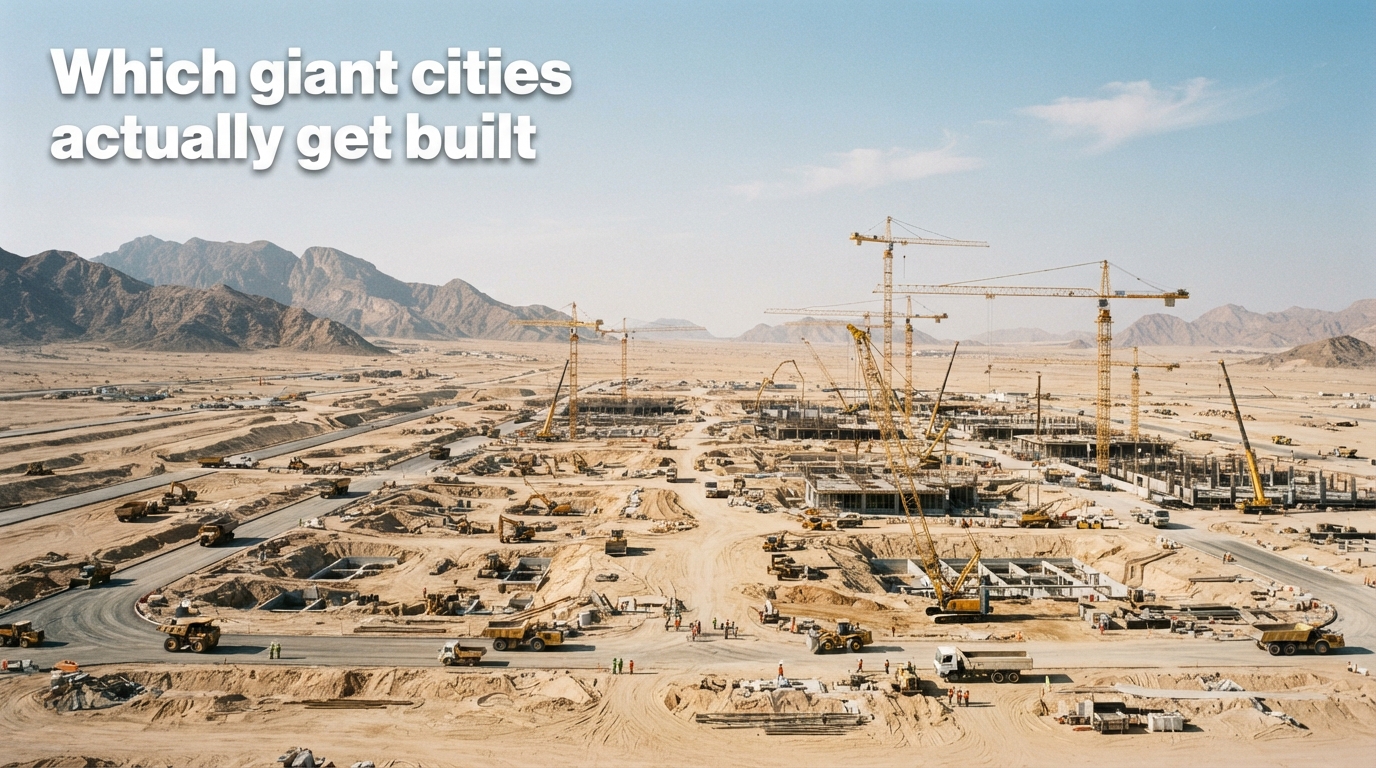
Pictures in this frame are AI-generated, not photographs.
What happenedThousands of $1bn-plus builds show systematic overruns and rare full delivery, sorting today's most famous giants from China's finished dam to Saudi Arabia's shortened desert-city pilot to Japan's pyramid and a 96,000km space ribbon still on paper.
Why it mattersA built-to-paper ladder that tests any proposal on materials at scale and who pays when forecasts fail gives readers a portable check beyond renders.
Still openWhether phased modular delivery and reference-class forecasting can beat the pattern for first-of-kind giants, or whether material limits and financing keep 2km pyramids and orbital ribbons as research programmes.
A database of more than 16,000 megaprojects — builds costing over $1 billion — finds about nine in ten go over budget and only about 0.5% hit budget, time and promised benefits together. About 8.5% manage the first two. That baseline is a portable test for any glossy render: ask what material must exist at scale and who pays when the forecast is wrong, not how good the animation looks.
How many of 16,000+ megaprojects actually hit budget, schedule and promised benefits. Share of more than 16,000 megaprojects in Bent Flyvbjerg's database that met budget, schedule, and promised benefits. 91.5% missed budget or schedule; 8.5% were on budget and on time, and only 0.5% — one in 200 — also delivered the promised benefits. Fat-tail figures at right are documented examples from the same literature, not a typical-project average; they show how large the misses can get (Sydney Opera House 1,400% cost overrun). — AI-assisted analytic, built only from real cited or sourced data. Source: The Independent Review, Towards Data Science. As of 2026-05-13.
Megaprojects, as Oxford professor Bent Flyvbjerg defines them, are not just big buildings but transport, energy, water, IT, defence, health, science and events that cost over $1bn, run for years and are hard to reverse once started. Complexity, long horizons and irreversibility mean errors compound rather than cancel.
Flyvbjerg calls the pattern the Iron Law: over budget, over time, under benefits, over and over. Overruns of up to 50% are common and over 50% not uncommon. The tails are fatter than the averages suggest: Denver International Airport about 200% over, Boston's Big Dig about 220%, Sydney Opera House about 1,400%. For dams, delays average 44%, with each extra year adding about 4.6% to costs; for rail, average cost overrun is 44.7% while demand falls 51.4% short. The Channel Tunnel is the textbook case — about 80% over on construction in real terms, 140% over on financing, revenues about half forecast, a negative 14.5% return. Technologically it works; financially it destroyed value, with losses socialised when Eurotunnel went insolvent.
Performance has not improved in 70 years, across public and private sectors and geographies. The $1bn line is a conventional analytical bucket, not a legal threshold, and the 91.5%/8.5%/0.5% figures are snapshots from one large database, not natural constants. But the shape — systematic overrun with extreme outliers — is stable.
Why it happens is disputed. One driver is honest optimism bias: planners genuinely underestimate costs and overestimate benefits. The other is strategic misrepresentation: costs are low-balled and benefits inflated to win approval. Flyvbjerg documents both, but critics including Lavagnon Ika and Peter Love argue the distinction matters for the remedy and that lumping them overstates inevitability.
Two dynamics follow. Break-fix: projects break when reality hits, then are fixed at great cost because they cannot be abandoned. Survival-of-the-unfittest: the projects that look best on paper — the most underestimated — are the ones approved, so the worst bets are selected. Debt makes it worse, as delay drives cost growth and interest capitalises into a trap where income cannot cover costs. The Channel Tunnel and Sydney's Lane Cove Tunnel are cited examples.
Against this stands Albert Hirschman's Principle of the Hiding Hand, from 1967: decision-makers underestimate difficulties but also underestimate their creativity to solve them, so hidden problem-solving offsets hidden difficulty and initial ignorance is benevolent — without it, nothing ambitious would start. Flyvbjerg directly revisits the idea and calls it "unfounded and corrupting," arguing the offset does not hold empirically and encourages bad selection.
The evidence does not settle into fatalism. Flyvbjerg himself qualifies the Iron Law as a tendency, not destiny, pointing to the Guggenheim Museum Bilbao and Madrid's 2003-07 metro extension — 80 stations, 90km — built in about half the time and cost of comparable projects by standardising stations and running as many tunnel-boring machines and teams as needed. His prescription is "think slow, act fast": thorough front-end planning and frozen scope before the green light, then fast delivery, plus "find your LEGO" — scale-free modularity via repeatable modules, from solar cells to wind-turbine parts. Reference-class forecasting — comparing to a class of similar past projects rather than inside-view engineering estimates — is the antidote to optimism bias. None guarantees success; it improves odds. A credible minority caveat adds that the database may overstate inevitability through selection bias, overrepresenting troubled public projects that publish data and defining success narrowly as hitting all three targets at once.
That baseline gives you a ladder — built, underway, stalled, paper — a framing device, not an official taxonomy, that tracks material readiness and financing realism.
Paper giants vs. built giants: scale and where each stands
| Project | Height / length | Capacity, people, or output | Cost estimate | Status |
|---|---|---|---|---|
| Shimizu TRY 2004 Mega-City Pyramid | 2,004 m tall | Up to about 1 million people at full conceptual occupancy | — | PAPER — proposed; ENR describes the needed materials as not currently feasible |
| Burj Khalifa | 828 m tall | 163 floors | — | BUILT — completed 2010; tallest-building reference |
| The Line — full vision | 170 km long; 500 m tall; 200 m wide | 9 million residents planned | US$500bn stated initial framing | PAPER — the full vision has no completed funding or timeline |
| The Line — pilot | 2.4 km long | Under 300,000 residents by 2030 was the reported target | — | UNDERWAY / PHASED — earthworks and an initial segment, not the full city |
| Obayashi Space Elevator | 96,000 km ribbon to counterweight | 100-ton climbers planned; 2050 target | — | PAPER — concept depends on a carbon-nanotube tether |
| Three Gorges Dam | — | 22,500 MW installed; 111.795 TWh generated in 2020 | CNY207.27bn | BUILT — first units 2003; staged completion 2003–2012 |
How the proposed giants compare to what has actually been built — and where each sits on the feasibility ladder. This table compares the proposed giants with the Burj Khalifa and Three Gorges Dam, showing that the built examples are the exceptions: the pilot Line is only a phased earthworks target, while the pyramid, full Line, and space elevator remain paper concepts. The dimensions and capacities are not one common unit, and the Line pilot figures are reported targets rather than completed capacity; sources checked include Engineering News-Record CTBUH Skyscraper Center Deutsche Welle Bloomberg Obayashi Corporation and China Daily — AI-assisted analytic, built only from real cited or sourced data. Source: Engineering News-Record, Obayashi Corporation, Vision2030.ai. As of 2026-05-13.
Built is China's Three Gorges Dam on the Yangtze, built 1994-2012. At 22,500 megawatts from 32 turbines it is the world's largest hydro plant, 185 metres tall and 2.3km long, creating a 667km reservoir. Cost is put at about CNY207bn, roughly $29bn. It first generated power in 2003 and reached full capacity in 2012, with reported output around 88 terawatt-hours a year and a record above 111 in 2020, plus flood control and inland navigation to Chongqing. The full cost includes the largest hydropower resettlement in history — about 1.3 million people displaced — plus submerged heritage and ongoing landslide, seismic and ecological risks. Benefits — power revenues and avoided flood losses — have been tangible but unevenly distributed: downstream industry and the grid gain, resettled communities and ecology bear the loss. It shows Flyvbjerg's nuance: technological success is not the same as financial success, but inelastic demand for power and flood control can make a megadam viable if displacement is counted.
Underway is Saudi Arabia's The Line, the centrepiece of the 26,500 sq km NEOM zone in Tabuk Province developed by NEOM Company and its owner, the kingdom's $925bn sovereign fund, the Public Investment Fund. Announced as twin 500-metre mirrored walls, 200 metres apart, running 170km across desert for 9 million people, with zero cars and a 20-minute end-to-end trip, it has no precedent at full scale: continuous 500-metre structures over 170km, foundations and wind loads, cooling a 34 sq km canyon above 45C, desalination dependence and a mirrored facade in desert conditions. A $500bn figure was never detailed; later press reports cited $1.5tn for NEOM overall and $1.6tn to $4.5tn for The Line alone — press estimates, not audited budgets, with no audited spend published.
As of 2024-25 the status is earthworks on a short segment, no residents, with Sindalah island resort the most advanced part. Trojena's earthworks for the 2029 Asian Winter Games later saw the Games reassigned, with reports of about 35% workforce cuts. In April 2024 Bloomberg reported the 2030 target had been scaled back from 1.5 million people over 170km to fewer than 300,000 over a 2.4km initial segment, with the PIF budget not approved. Saudi officials pushed back. Economy Minister Faisal Al Ibrahim told CNBC at the World Economic Forum in Riyadh: "All projects are moving full steam ahead... There is no change in scale. It is a long-term project that's modular in design." Finance Minister Mohammed Al-Jadaan offered a more nuanced official view at the same meeting — "We will downscale some of the projects, we will accelerate other projects... We will change course and adjust as needed" — and by February 2026 the government described adjustment as portfolio prioritisation, with some projects scaled back, others expanded and some put on hold. Both framings can be true at once: a 2-3km segment is a very large mixed-use development — feasible but extraordinarily expensive — while 170km remains paper. That is the Iron Law meeting financing constraints as oil prices soften.
Paper is where material readiness fails. Japan's Shimizu Corporation proposed TRY 2004, a 2,004-metre pyramid in Tokyo Bay for 250,000 people, and its Ocean Spiral, a 500-metre floating sphere linked by a 15km spiral for 5,000 people, presented in 2014 as buildable in five years for about 3tn yen (about £16bn) once technology allowed in about 15 years. Architect Dante Bini said the pyramid was far above current technology; Shimizu framed both as future visions requiring carbon-nanotube-class strength and seismic engineering for a 2km structure in an earthquake-prone bay. Neither has funding or a timeline, and the 15-year horizon has not materialised.
The same block stops Obayashi Corporation's space elevator, announced in 2012 for 2050: a 96,000km ribbon well beyond geostationary orbit — about 36,000km up, where a satellite stays over one spot — to a counterweight, with climbers reaching orbit in about five hours at roughly 1/100th of launch cost. It needs a tether far stronger and lighter than steel — roughly 180 times stronger by one assessment — and even high-strength fibres would snap after a few hundred kilometres. Candidates like carbon nanotubes and graphene have been tested on the International Space Station, but defects and inability to spin continuous pure lengths mean no known material works at that length, and the 2050 date assumes a mass-production breakthrough with no demonstrated trajectory. Political risks — airspace, debris, liability if the ribbon snaps — are second-order to the material block.
Other paper giants follow the same split. Atlantropa, a 1928 plan to dam the Strait of Gibraltar and drop the Mediterranean 200 metres, attracted designs into the 1960s despite ecological and geopolitical absurdity. The 85km Bering Strait tunnel via the Diomede Islands recurs from 1904 to a 2014 Chinese high-speed rail fantasy to an October 2025 claim by Russian envoy Kirill Dmitriev of a joint US-Russia feasibility study at about $8bn in under eight years, floated on social media and reported as resting solely on him with no US confirmation — implausible against the Channel Tunnel's roughly $21bn today for 50km in benign geology, plus thousands of kilometres of missing rail across tundra and permafrost. Floating cities split similarly: UN-backed Oceanix Busan and the Maldives Floating City have modular prototypes and reported groundbreakings for thousands of residents, but scale-up is slowed by cost and regulation; mile-long ship concepts like Freedom Ship remain paper after 30 years. Small floating neighbourhoods are feasible; self-contained floating cities are not yet, with financing, insurance and flag-state law unsolved.
Cost-benefit analyses are systematically misleading, and overruns are paid by taxpayers on public projects or by equity holders wiped out in restructuring on private ones, while benefits arrive late and short. Winners tend to be contractors, consultants, nearby landowners and politicians who cut ribbons, and sometimes users who get a subsidised service. Losers are displaced people, taxpayers and investors.
Bets pay off when three conditions hold: demand is inelastic and large, as with Three Gorges power and flood control; delivery is modular and repeatable, as with Madrid's metro; and front-end planning is thorough with scope frozen — think slow, act fast — plus reference-class forecasting. NEOM concentrates risk on a single oil-exposed sovereign fund, now marketed via investor roadshows and a pivot to tourism, logistics, energy and events like the 2034 World Cup.
Place any giant on the ladder, ask what material must exist at scale and who is contractually on the hook when the forecast is wrong, and compare to a reference class that actually exists. If there is no reference class — a 2km pyramid, a 96,000km ribbon — you are not looking at a construction schedule. You are looking at a research programme.
Source recordSources / claims / limits
How this piece is framed: The Iron Law as baseline, the feasibility ladder as test — sorting today's most famous giants by what the data says actually gets built
Charts & tables — AI-assisted; provenance on each line
- The Iron Law: almost none hit budget, time and benefits together — from claims clm_58a84b9ed9, clm_f08842c905, clm_db282b526b, clm_5715ba47ed, clm_154c7a80f0, clm_71134f0b10, clm_8c54b8445b · as of 2026-05-13
- Paper giants vs. built giants: scale and where each stands — sourced for this figure · as of 2026-05-13
Sources
- (primary) What You Should Know About Megaprojects and Why: An Overview — Project Management Journal 45(2) via ResearchGate — https://www.researchgate.net/publication/261411676_What_You_Should_Know_About_Megaprojects_and_Why_An_Overview · read in full · captured 2026-09-19
- (primary) Space Elevator | Six Stories | OBAYASHI CHRONICLE 130 — Obayashi Corporation — https://www.obayashi.co.jp/chronicle/130th/en/story/space-elevator · read in full · captured 2026-09-19
- (primary) The Iron Law of Megaprojects — Towards Data Science — https://towardsdatascience.com/the-iron-law-of-megaprojects-18b886590f0b · read in full · captured 2026-09-19
- (secondary) NEOM Feasibility | Saudi Arabia Vision 2030 Analysis — Vision2030.ai — https://vision2030.ai/analysis/neom-feasibility · read in full · captured 2026-09-19
- (secondary) Book Review: How Big Things Get Done — The Independent Review — https://www.independent.org/tir/2023-fall/how-big-things-get-done · read in full · captured 2026-09-19
- (secondary) Ocean Spiral: Japanese firm plans underwater city powered by seabed — The Guardian — https://www.theguardian.com/world/2014/nov/20/ocean-spiral-japan-underwater-city · read in full · captured 2026-09-19
- (secondary) Saudi Arabia says all NEOM megaprojects will go ahead as planned despite reports of scaling back — CNBC — https://www.cnbc.com/2024/04/29/saudi-arabia-says-all-neom-megaprojects-will-go-ahead-as-planned.html · read in full · captured 2026-09-19
- (secondary) A Mile-Long Ship for 80,000 People? Why Floating Cities Never Get Built — Newsweek — https://www.newsweek.com/freedom-ship-why-floating-cities-never-get-built-12022797 · read in full · captured 2026-09-19
- (secondary) Are space elevators possible? Physicist says they could transform humanity into a 'spacefaring civilization' — Phys.org — https://phys.org/news/2024-02-space-elevators-physicist-humanity-spacefaring.html · read in full · captured 2026-09-19
- (secondary) Three Gorges - the world's biggest hydropower plant — NS Energy Business — https://www.nsenergybusiness.com/projects/three-gorges-dam-hydropower-station · read in full · captured 2026-09-19
- (secondary) Why do large projects go over budget? — strategy+business (PwC) — https://www.strategy-business.com/article/Why-do-large-projects-go-over-budget · read in full · captured 2026-09-19
- (secondary) Book Review: How Big Things Get Done — Greater Auckland — https://www.greaterauckland.org.nz/2024/12/19/book-review-how-big-things-get-done · read in full · captured 2026-09-19
- (secondary) Oxford Professor's Latest Book Examines Roots of Project Failure — Engineering News-Record — https://www.enr.com/articles/55774-oxford-professors-latest-book-examines-roots-of-project-failure · read in full · captured 2026-09-19
- (secondary) Bomb the Arctic, dam the Mediterranean and build a second moon: five outlandish plans to remodel our climate — The Guardian — https://www.theguardian.com/environment/2026/jul/06/five-outlandish-plans-to-remodel-earth-climate · read in full · captured 2026-09-19
- (secondary) Saudi Arabia reshapes Vision 2030 around new priorities — Deutsche Welle — https://www.dw.com/en/saudi-arabia-reshapes-vision-2030-around-new-priorities/a-75900119 · read in full · captured 2026-09-19
- (secondary) Alaska-Russia 70-mile friendship tunnel: Kremlin envoy says feasibility study started six months ago — Times of India — https://timesofindia.indiatimes.com/world/us/alaska-russia-70-mile-friendship-tunnel-kremlin-envoy-says-feasibility-study-started-six-months-ago/articleshow/124672927.cms · read in full · captured 2026-09-19
- (secondary) Dream Projects: Mega-Pyramid Solves Urban Congestion — Engineering News-Record — https://www.enr.com/articles/392-dream-projects-mega-pyramid-solves-urban-congestion · read in full · captured 2026-09-19
- (secondary) Saudi Arabia desperately trying to counter reports Neom is struggling — Business Insider — https://www.businessinsider.com/saudi-arabia-neom-megaproject-not-struggling-vision-2030-minister-2024-4 · read in full · captured 2026-09-19
- (secondary) The Technologies That Could Finally Make Space Elevators a Reality — Interesting Engineering — https://interestingengineering.com/innovation/tech-that-can-make-space-elevators-a-reality · read in full · captured 2026-09-19
- (secondary) Interview | Programme management academic Bent Flyvbjerg identifies the ingredients of successful major projects — New Civil Engineer — https://www.newcivilengineer.com/latest/interview-programme-management-academic-bent-flyvbjerg-identifies-the-ingredients-of-successful-major-projects-26-06-2023 · read in full · captured 2026-09-19
- (secondary) ‘USA and Russia started researching Bering Strait tunnel six months ago’ — RailFreight.com — https://www.railfreight.com/beltandroad/2025/10/20/usa-and-russia-started-researching-bering-strait-tunnel-six-months-ago · read in full · captured 2026-09-19
- (secondary) Neom considering plan to move 1,000 staff from project headquarters: report — Global Construction Review — https://www.globalconstructionreview.com/neom-considering-plan-to-move-1000-staff-from-project-headquarters-report · full text not obtained — used its summary
- (secondary) A Closer Look at NEOM's The Line Project in Saudi Arabia — Construction Review Online — https://constructionreviewonline.com/neom-leadership-changes-the-line-partners-named-as-progress-continues · full text not obtained — used its summary
Claims, and how far we tracked each down
- [confirmed] Megaprojects are conventionally defined as projects exceeding US$1 billion in cost · read in full (as of 2026-09-19)
- [confirmed] Flyvbjerg's Iron Law states megaprojects are over budget, over time, under benefits, over and over again · read in full (as of 2026-09-19)
- [confirmed] Nine out of ten megaprojects have cost overruns; overruns up to 50% are common, over 50% not uncommon · read in full (as of 2026-09-19)
- [confirmed] Only 8.5% of projects in Flyvbjerg's database of 16,000+ are on budget and on time, and only 0.5% are on budget, on time and deliver promised benefits · read in full (as of 2026-09-19)
- [confirmed] Channel Tunnel cost overrun was 80% in real terms for construction (140% for financing) and revenues were about half forecast, yielding negative 14.5% internal rate of return · read in full (as of 2026-09-19)
- [confirmed] Shimizu TRY 2004 Mega-City Pyramid is a proposed 2,004m (6,561 ft) lattice-truss pyramid in Tokyo Bay, composed of 55 smaller pyramids (each ~Luxor size) using octahedral units · read in full (as of 2026-09-19)
- [confirmed] Shimizu pyramid is not buildable with current materials; it requires future advances in lightweight super-strong materials and is explicitly a future vision, based on Bini's Binistar space-frame scaled up · read in full (as of 2026-09-19)
- [confirmed] Obayashi Corporation announced in February 2012 a Space Elevator Construction Concept targeting operational capability by 2050 · read in full (as of 2026-09-19)
- [confirmed] Obayashi design envisions a 96,000-km cable extending beyond geostationary orbit (36,000 km), with floating Earth Port at equator, Geostationary Orbit Station, and counterweight serving as Solar System Exploration Gate · read in full (as of 2026-09-19)
- [confirmed] No known material is currently both strong and light enough for a space elevator at scale; carbon nanotubes have theoretical tensile strength ~130 GPa vs steel <5 GPa but cannot be manufactured long/pure enough and tend to fray · read in full (as of 2026-09-19)
- [confirmed] NEOM's The Line was announced as a 170-km long, 200m wide, 500m tall twin mirrored linear city for 9 million residents as part of 26,500 sq km NEOM zone in Tabuk Province · read in full (as of 2026-09-19)
- [confirmed] In April 2024 Bloomberg reported Saudi Arabia scaled back The Line's 2030 target from 1.5 million residents over 170km to fewer than 300,000 residents over 2.4km initial segment · read in full (as of 2026-09-19)
- [confirmed] Three Gorges Dam on Yangtze River has 22,500 MW installed capacity, the world's largest hydroelectric plant, producing record 111.88 TWh in 2020 · read in full (as of 2026-09-19)
- [confirmed] Three Gorges Dam displaced approximately 1.3 million people between 1993-2009, the largest hydropower resettlement in history, and cost about CNY207.27bn (~$29bn) · read in full (as of 2026-09-19)
- [confirmed] Albert O. Hirschman's Principle of the Hiding Hand (1967) argues decision-makers systematically underestimate difficulties and underestimate their own creativity to solve them; hidden difficulties are offset by hidden problem-solving, making initial ignorance benevolent and enabling projects that would otherwise never be started. · read in full (as of 2026-09-19)
- [confirmed] Flyvbjerg directly revisits and critiques Hirschman's Hiding Hand as 'unfounded and corrupting for megaproject thinking in both the academy and policy' — arguing the benevolent offset does not hold empirically and encourages survival-of-the-unfittest selection. · read in full (as of 2026-09-19)
- [confirmed] Flyvbjerg qualifies the Iron Law as statistical tendency, not absolute: 'This is not to say projects do not exist that were built on budget and time and delivered the promised benefits. The Guggenheim Museum Bilbao is an example of that rare breed... Similarly, recent metro extensions in Madrid were built on time and to budget' and studying successes is 'particularly important.' · read in full (as of 2026-09-19)
- [confirmed] Madrid Metro extension 2003-2007 (80 stations, 90km) cited by Flyvbjerg as modular success: completed in half the time and half the cost of comparable projects by standardizing all stations and optimizing tunnel-boring machines to 3-6km segments with as many TBMs/teams as needed — 'At the time that was revolutionary.' · read in full (as of 2026-09-19)
- [confirmed] Flyvbjerg's prescriptive counter to Iron Law is 'think slow, act fast' — thorough front-end planning before green-light, then fast delivery — plus 'Find your LEGO' / scale-free scalability via repeatable modules (solar cells to arrays; wind turbine foundation/tower/nacelle/blades; Heathrow T5 partnering contracts with risk on client and carrot incentives). · read in full (as of 2026-09-19)
- [likely] Within megaproject economics there is active debate whether cost underestimation reflects honest optimism bias (cognitive) vs strategic misrepresentation (deliberate to secure approval). Flyvbjerg documents both, but critics including Lavagnon Ika and Peter Love argue the distinction matters for remedy and that lumping them overstates inevitability. · read in full (as of 2026-09-19)
- [confirmed] Saudi official rebuttal to April 2024 Bloomberg 2.4km/300k scale-back report: Economy Minister Faisal Al Ibrahim told CNBC at WEF Riyadh: 'All projects are moving full steam ahead... For NEOM, the projects, the intended scale is continuing as planned. There is no change in scale. It is a long-term project that's modular in design.' Decisions prioritize 'optimal economic impact' and avoiding overheating. · read in full (as of 2026-09-19)
- [confirmed] Finance Minister Mohammed Al-Jadaan at same WEF meeting offered nuanced official view: 'We will downscale some of the projects, we will accelerate other projects... We will change course and adjust as needed' due to 'challenges,' framing NEOM as phased/prioritized portfolio not collapse. · read in full (as of 2026-09-19)
- [confirmed] By Feb 2026 Saudi government publicly acknowledged adjustment: Finance Minister Al-Jadaan working on new five-year plan 'doubling down on tourism, manufacturing, logistics and energy' where 'some projects will be scaled back, others expanded and some put on hold,' with Trojena Asian Winter Games 2029 moved to Almaty and Mukaab suspended — presented as 'periods of revision and adjustment' for initially unrealistic giga-projects. · read in full (as of 2026-09-19)
- [confirmed] Other documented overruns include Denver International Airport 200%, Boston Big Dig 220%, Sydney Opera House 1,400% · read in full (as of 2026-09-19)
- [confirmed] Delays on dams average 44%; a one-year delay correlates with 4.64% increase in cost overrun (e.g., $1.2bn per year on $26bn Crossrail) · read in full (as of 2026-09-19)
- [confirmed] Benefit shortfalls up to 50% are common; for rail, average cost overrun 44.7% combines with average demand shortfall 51.4% · read in full (as of 2026-09-19)
- [likely] Shimizu pyramid would house 250,000 residents per ENR (other popular accounts cite 750,000-1 million) with lower four layers residential/office and upper four layers hotels/recreation/research · read in full (as of 2026-09-19)
- [confirmed] Obayashi plans to use carbon nanotubes and is testing durability on ISS Japanese Experiment Module Kibo with Shizuoka University · read in full (as of 2026-09-19)
- [likely] The Line's original budget was framed as $500bn for NEOM overall, with later press reports citing $1.5 trillion for NEOM and internal estimates of $1.6tn-$4.5tn for The Line alone · read in full (as of 2026-09-19)
- [confirmed] As of 2024-2025 The Line has seen extensive earthworks/foundation work but no resident population; Sindalah island resort is most advanced component, NEOM Bay is operational base · read in full (as of 2026-09-19)
- [confirmed] The Line's engineering challenges include unprecedented continuous 500m-tall structures over 170km, climate control in >45C desert, 500 km/h transit for 20-minute end-to-end, desalination dependence, and mirrored facade maintenance · read in full (as of 2026-09-19)
- [likely] Three Gorges provides flood control, navigation for oceangoing freighters 2,250km inland to Chongqing, and power, but has been blamed for landslides, seismicity and ecological loss · read in full (as of 2026-09-19)
- [confirmed] Atlantropa was proposed in 1928-1930s by German architect/engineer Herman Sörgel to dam Strait of Gibraltar, lower Mediterranean 200m, create new land and hydroelectricity; it survived WWII and limped into 1960s · read in full (as of 2026-09-19)
- [unconfirmed] Bering Strait tunnel proposals envision ~70-mile (85km) rail link between Chukotka and Alaska via Diomede Islands, more than double Channel Tunnel's 31.5 miles; RDIF envoy Kirill Dmitriev claimed in Oct 2025 a joint US-Russia feasibility study started six months earlier at ~$8bn and <8 years · read in full (as of 2026-09-19)
- [likely] Oceanix Busan, backed by UN-Habitat and Busan city, aims for 12,000 residents expanding to 100,000 on floating modular platforms generating 100% operational energy on site; Phase 1 reportedly broke ground 2023 · read in full (as of 2026-09-19)
- [likely] Maldives Floating City by Dutch Docklands/Waterstudio has prototypes floating with full government support and title deeds but scale-up slowed by Middle East disruptions · read in full (as of 2026-09-19)
- [confirmed] Freedom Ship (1990s concept, 5,900 ft /1.1 miles, 80,000 people) remains paper-only, estimated $8-16bn, requiring new shipyard, with construction notionally 2033 if funded · read in full (as of 2026-09-19)
- [confirmed] Shimizu Ocean Spiral (2014) envisions 500m-wide floating sphere connected by 15km helix to seabed resource center housing 5,000 residents; Shimizu said technology could be ready within 15 years · read in full (as of 2026-09-19)
- [confirmed] Megaproject cost overruns and delays have stayed high and constant for 70 years across geographies and public/private sectors; benefit shortfalls show same persistence · read in full (as of 2026-09-19)
- [confirmed] A megaproject may be technological success but financial failure; debt-financed delays create debt trap where escalating costs and interest make income unable to cover costs (Channel Tunnel, Lane Cove) · read in full (as of 2026-09-19)
- [contested] Credible minority critique argues Iron Law may be overstated due to selection bias: database of 16,000+ overrepresents troubled public projects that publish data, undercounts private/industrial modular successes, and defines success narrowly as on-budget/on-time/on-benefits simultaneously (0.5% success) rather than outcome benefits. · read in full (as of 2026-09-19)
- [likely] PIF-centric risk view from Saudi official sources: NEOM is sovereign-wealth-funded, modular, marketed via investor roadshows (Beijing/Shanghai/Hong Kong) with 'increased investor interest' per Al Ibrahim; PIF ($925bn) shifting focus to six ecosystems (tourism, urban development, innovation, clean energy, industry) and internationally-facing returns (World Cup 2034, Expo 2030) rather than pure real-estate scale. · read in full (as of 2026-09-19)
- [confirmed] Seasteading Institute's French Polynesia floating island project collapsed in 2017-2018 after memorandum expired amid political opposition · read in full (as of 2026-09-19)
Where we hit a limit / what to double-check
- We did not obtain the full text of Neom considering plan to move 1,000 staff from project headquarters: report (https://www.globalconstructionreview.com/neom-considering-plan-to-move-1000-staff-from-project-headquarters-report); claims resting on it are from its summary — you may be able to reach it directly.
- We did not obtain the full text of A Closer Look at NEOM's The Line Project in Saudi Arabia (https://constructionreviewonline.com/neom-leadership-changes-the-line-partners-named-as-progress-continues); claims resting on it are from its summary — you may be able to reach it directly.
- Figures we could not match to our stored evidence — worth confirming against the source (which may state them exactly), and note live sources move: 4.6%, 91.5%, 35%.